The objective of this course is to provide an overview of the culture of ancient Rome beginning about 1000 BCE and ending with the so-called "Fall of Rome". We will look at some of the key people who played a role in Rome, from the time of the kings through the Roman Republic and the Roman Empire. We will also focus on the city of Rome itself, as well as Rome's expansion through Italy, the Mediterranean, and beyond.
Here you can find all of the introductory information, course syllabus, and helpful resources.
The Early Romans and Their Ancestors (ca. 1000 - 500 BCE)
Module 2•5 hours to complete
Module details
In the Early Iron Age (ca. 1000 BCE), civilization in Italy was rather simple. The most sophisticated cultures in the peninsula were not the Romans at all, but rather groups to the north of Rome who have come to be called The Villanovans, who exploited the metal resources of northern Italy even before the officially noted founding of Rome. Later the Etruscans would appear (ca. 800 BCE), Rome's first great rivals. The Etruscans were a loose confederation of city-states north of Rome who even expanded into Rome and further south, as far as Pompeii. The Etruscans are particularly noted for their magnificent art, in particular the glorious painted tombs of Tarquinia.
What's included
29 videos3 assignments1 peer review
Show info about module content
29 videos•Total 100 minutes
1. Italy before Rome•9 minutes
2. Rome before Rome•2 minutes
3. The Sepulcretum•1 minute
4. The People of Ancient Italy•5 minutes
5. Guest Lecture: Dr. Emma Blake on Bronze Age Italians•15 minutes
6. Early Iron Age Chronology•1 minute
1. The Orientalizing Period•2 minutes
2. The Etruscans•2 minutes
3. Etruscan Origins I•1 minute
4. Etruscan Origins II•1 minute
5. Etruscan Origins III•1 minute
6. Etruscan Society•6 minutes
7. Etruscan Artisans•4 minutes
8. Tumuli at Cerveteri•2 minutes
9. Tombs at Tarquinia•3 minutes
10. Life and Death•4 minutes
1. Greek Art in Etruria•1 minute
2. The Francois Vase•5 minutes
3. Greek Myth in Etruria I•1 minute
4. Greek Myth in Etruria II•5 minutes
5. Etruscan Belief•3 minutes
6. Tomb of the Infernal Chariot•5 minutes
7. The Necropolis at Orvieto I•1 minute
8. The Necropolis at Orvieto II•4 minutes
9. Guest Lecture: Dr. Alba Frascarelli on Velzna•9 minutes
10. Populonia I•1 minute
11. Populonia II•5 minutes
12. The Etruscans in Rome•1 minute
13. The Early Roman Forum•2 minutes
3 assignments•Total 90 minutes
Quiz One: The Early Romans and Their Ancestors•30 minutes
Quiz Two: The Etruscans, Part I•30 minutes
Quiz Three: The Etruscans, Part II•30 minutes
1 peer review•Total 120 minutes
Essay Question One•120 minutes
The Roman Republic's Rise and Fall (509 - 31 BCE)
Module 3•6 hours to complete
Module details
Having thrown off the Etruscans in 509 BCE., Rome emerged as independent Latin community that quickly became known for its disciplined army and militaristic intentions. As the Romans expanded throughout the Mediterranean, it came into contact with various cultures, all who had an influence on the young power, especially Greek culture, art, and architecture. By the end of this period Rome may have grown to a million people. The first century BCE. was a time of amazing development in many fields of artistic endeavor, but it was also a time of civil unrest as soldiers became more loyal to their commanders than to the state. Leaders such as Sulla, Marius, Julius Caesar, Mark Antony and others took advantage of this turmoil, which culminated with the powerful influence of the decadent Egyptian charmer Cleopatra and the emergence of Octavian.
What's included
23 videos3 assignments1 peer review
Show info about module content
23 videos•Total 124 minutes
1. The Roman Republic•8 minutes
2. Forum Romanum I•5 minutes
3. Forum Romanum II•4 minutes
4. Forum Romanum III•2 minutes
5. Ancient Architectural Orders•5 minutes
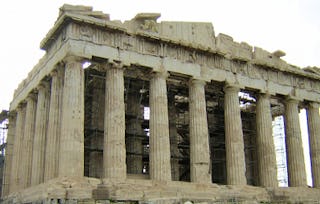
6. The Doric Order•4 minutes
7. The Ionic and Tuscan Orders•6 minutes
8. The Capitoline Hill•3 minutes
9. The Beginning of Rome's Expansion•1 minute
1. Early Roman Expansion•11 minutes
2. Underwater Archaeology•5 minutes
3. Republican Art•12 minutes
4. Carthage•1 minute
5. "Carthage: A Mosaic of Ancient Tunisia"•28 minutes
1. Rome's Revolutionary Century•9 minutes
2. The Temple of Fortuna at Praeneste•5 minutes
3. The Roman Domus and Theatre•6 minutes
4. The Theater of Pompey Today•1 minute
5. Roman Portraiture•2 minutes
6. Greek Art in Rome•2 minutes
7. Roman Lamps I•1 minute
8. Roman Lamps II•1 minute
9. Roman Glass•3 minutes
3 assignments•Total 90 minutes
Quiz Four: The Early Republic•30 minutes
Quiz Five: The Middle Republic•30 minutes
Quiz Six: The Civil Wars•30 minutes
1 peer review•Total 120 minutes
Essay Question Two•120 minutes
Augustus and the Early Roman Empire (31 BCE - 1st century CE)
Module 4•6 hours to complete
Module details
Augustus - formerly known as Octavian - set the tone for the next major phase of Rome: the Roman empire. His family-related successors, the Julio-Claudians, would continue his rule. Yet none of his successors had the charisma or vision of Augustus himself, and some such as Caligula and Nero have become synonymous with profligacy and decadence of an extreme nature. By the year 69 CE. Rome was in chaos. But the emperor Vespasian restored order and dignity - not to mention humility - to the office, and instituted his own dynasty, the Flavians. Unfortunately, Vespasian's second son, Domitian, brought his Flavian dynasty to an end through dreadful administration. Domitian was murdered in 96 CE.
What's included
19 videos2 readings3 assignments1 peer review
Show info about module content
19 videos•Total 152 minutes
1. Augustan Art•19 minutes
2. "Forgotten Lives: The Ancient City of Troy"•18 minutes
3. Guest Lecture: Dr. David Gilman Romano's Digital Map of Augustan Rome•11 minutes
4. Guest Lecture: Dr. Marylin Skinner on Roman Gender and Sexuality•13 minutes
5. The Legacy of Augustus•0 minutes
1. Art After Augustus: Tiberius and the Julio-Claudians•10 minutes
2. Roman Pottery•5 minutes
3. The Julio-Claudians after Tiberius: Caligula, Claudius, and Nero•7 minutes
4. Guest Lecture: Dr. Phillip Waddell on Roman Historiography and Nero•16 minutes
5. Nero's Domus Aurea•12 minutes
1. The Flavian Emperors: Vespasian, Titus, and Domitian•11 minutes
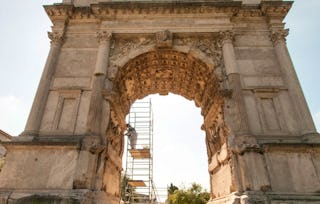
2. The Arch of Titus•7 minutes
3. The Eruption of Vesuvius (79 CE)•3 minutes
4. Pompeii•4 minutes
5. The Pompeian House•3 minutes
6. Pompeii in 3D•4 minutes
7. The Alexander Mosaic I•2 minutes
8. The Alexander Mosaic II•6 minutes
9. The End of the Flavians•1 minute
2 readings•Total 20 minutes
Peter Ustinov sings as Nero•10 minutes
Dr. Soren's Work at Kourion (Coming Soon!)•10 minutes
3 assignments•Total 90 minutes
Quiz Seven: The Age of Augustus•30 minutes
Quiz Eight: The Julio-Claudian Emperors•30 minutes
Quiz Nine: The Flavian Emperors•30 minutes
1 peer review•Total 120 minutes
Essay Question Three•120 minutes
Rome at its Zenith (2nd century CE)
Module 5•3 hours to complete
Module details
Rome is said to have reached its zenith in security and expansion during the period of the "Five Good Emperors" (96 to 180 CE.). The time of Trajan (98 to 117 CE.) was a particular epoch of conquest and building, highlighted by the construction of Trajan's Markets and enormous Forum, the ruins of which still dominate the center of Rome. Trajan's successor, Hadrian, was a horse of a different color. He was himself an architect obsessed with circles, squares, spheres, and cubes. And his fondness for Greek art bordered on manic.
What's included
12 videos2 readings2 assignments1 peer review
Show info about module content
12 videos•Total 58 minutes
1. Trajan•4 minutes
2. The Imperial Roman Forum•2 minutes
3. Trajan's Forum•6 minutes
4. Hadrian•6 minutes
5. The Pantheon•2 minutes
6. Hadrian's Villa at Tivoli•4 minutes
1. Antoninus Pius•4 minutes
2. The Roman Sarcaphogus•5 minutes
3. The Roman Domus in the 2nd Century CE•9 minutes
4. Marcus Aurelius and the Beginnings of Crisis I•4 minutes
5. Marcus Aurelius and the Beginnings of Crisis II•5 minutes
6. The Severans•8 minutes
2 readings•Total 20 minutes
Hollywood's "Gladiator"•10 minutes
Richard Harris plays Marcus Aurelius•10 minutes
2 assignments•Total 60 minutes
Quiz Ten: Nerva, Trajan, and Hadrian•30 minutes
Quiz Eleven: The Antonine and Severan Emperors•30 minutes
1 peer review•Total 60 minutes
Essay Question Four•60 minutes
Crisis and Conclusion (3rd to 7th centuries CE)
Module 6•5 hours to complete
Module details
What does it mean to talk about the fall of Rome? The far-flung empire collapsed in varying degrees in different places at different times. In the fourth century enormous earthquakes caused such devastation that in the Roman east the whole fabric of ancient religious belief was called into question. In central Italy along the Tiber River an epidemic of malaria, a virulent new-mutated strain from North Africa, left many dead. The legacy of Rome, however, continued into the Carolingian and Byzantine empires. And yet the city of Rome underwent a major revival in the later Middle Ages, continuing through the Renaissance, Baroque, Rococo and Romantic Periods, playing a major role in the foundation of our own country.
What's included
23 videos2 assignments1 peer review
Show info about module content
23 videos•Total 140 minutes
1. The Years of Crisis•3 minutes
2. The Baths of Caracalla•10 minutes
3. The "Soldier Emperors"•5 minutes
4. Ostia, The Port of Rome•3 minutes
5. Diocletian•7 minutes
6. Roman Sculpture in the 3rd century CE•5 minutes
1. Constantine and the Rise of Christianity I•8 minutes
2. Constantine and the Rise of Christianity II•2 minutes
3. The Arch of Constantine•5 minutes
4. Kourion and Seismic Archaeology I•2 minutes
5. Kourion and Seismic Archaeology II•2 minutes
6. Lugnano and the Fall of Rome I•2 minutes
7. Lugnano and the Fall of Rome II•3 minutes
8. The Silver Amphora of Baratti I•4 minutes
9. The Silver Amphora of Baratti II•2 minutes
10. 5th and 6th Century Disruptions•1 minute
11. Climate Change and the Fall of Rome•3 minutes
12. Guest Lecture: Dr. Charlotte Pearson on Dendrochronology•13 minutes
13. Guest Lecture: Cynthia Hart on Digitally Reconstructing Antiquity•6 minutes
14. A Patchwork of Settlements•1 minute
15. The Column of Phocas: The Last Roman Monument•3 minutes
1. From Dr. Soren and Lana, "Farewell!"•1 minute
2. "Malaria and the Fall of Rome"•49 minutes
2 assignments•Total 60 minutes
Quiz Twelve: The Beginning of the End•30 minutes
Quiz Thirteen: Rome in Late Antiqutity•30 minutes
1 peer review•Total 120 minutes
Essay Question Five•120 minutes
Instructor
Instructor ratings
Instructor ratings
We asked all learners to give feedback on our instructors based on the quality of their teaching style.
The University of Arizona is the state’s land-grant university and a member of the Association of American Universities—made up of just 62 universities in the country. As one of the world’s premier public research universities, the university conducts more than $625 million of research annually. Home to two allopathic medical schools in Tucson and Phoenix, the UA Tech Park, and a member of the Arizona Space Grant Consortium, the university creates an $8.3 billion economic impact for Arizona. U.S. News and World Report placed 14 University of Arizona graduate programs among the top 20 in the nation and it is one of the nation’s top producers of Fulbright Scholars. With its strategic academic and business plan, “Never Settle,” as its guide, the university is producing graduates who are global citizens, engaged leaders, and fulfilled individuals.
"To be able to take courses at my own pace and rhythm has been an amazing experience. I can learn whenever it fits my schedule and mood."
Jennifer J.
Learner since 2020
"I directly applied the concepts and skills I learned from my courses to an exciting new project at work."
Larry W.
Learner since 2021
"When I need courses on topics that my university doesn't offer, Coursera is one of the best places to go."
Chaitanya A.
"Learning isn't just about being better at your job: it's so much more than that. Coursera allows me to learn without limits."
Learner reviews
4.8
684 reviews
5 stars
80.99%
4 stars
15.20%
3 stars
2.33%
2 stars
0.73%
1 star
0.73%
Showing 3 of 684
C
CB
5·
Reviewed on Apr 29, 2023
I loved this class, the Professor is so knowledgeable and he shares his life experiences. I would love a chance to take more classes by this Professor.
O
OO
5·
Reviewed on Jan 11, 2017
Fantastic course, both interesting and informative. Writing weekly essays was interesting, and peer grading was challenging. Overall, I greatly enjoyed this course!
E
EW
4·
Reviewed on Aug 15, 2017
Really enjoyed this course. Especially enjoyed the numerous guest interviews that covered many different areas of the Classics field. The addition of the professor's dog was a little odd.
When will I have access to the lectures and assignments?
To access the course materials, assignments and to earn a Certificate, you will need to purchase the Certificate experience when you enroll in a course. You can try a Free Trial instead, or apply for Financial Aid. The course may offer 'Full Course, No Certificate' instead. This option lets you see all course materials, submit required assessments, and get a final grade. This also means that you will not be able to purchase a Certificate experience.
What will I get if I purchase the Certificate?
When you purchase a Certificate you get access to all course materials, including graded assignments. Upon completing the course, your electronic Certificate will be added to your Accomplishments page - from there, you can print your Certificate or add it to your LinkedIn profile.
Is financial aid available?
Yes. In select learning programs, you can apply for financial aid or a scholarship if you can’t afford the enrollment fee. If fin aid or scholarship is available for your learning program selection, you’ll find a link to apply on the description page.