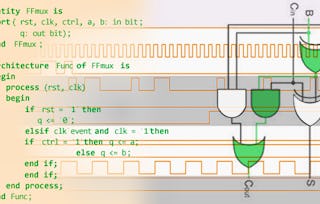
A modern VLSI chip has a zillion parts -- logic, control, memory, interconnect, etc. How do we design these complex chips? Answer: CAD software tools. Learn how to build thesA modern VLSI chip is a remarkably complex beast: billions of transistors, millions of logic gates deployed for computation and control, big blocks of memory, embedded blocks of pre-designed functions designed by third parties (called “intellectual property” or IP blocks). How do people manage to design these complicated chips? Answer: a sequence of computer aided design (CAD) tools takes an abstract description of the chip, and refines it step-wise to a final design. This class focuses on the major design tools used in the creation of an Application Specific Integrated Circuit (ASIC) or System on Chip (SoC) design. Our focus in this first part of the course is on key Boolean logic representations that make it possible to synthesize, and to verify, the gate-level logic in these designs. This is the first step of the design chain, as we move from logic to layout. Our goal is for students to understand how the tools themselves work, at the level of their fundamental algorithms and data structures. Topics covered will include: Computational Boolean algebra, logic verification, and logic synthesis (2-level and multi-level).

VLSI CAD Part I: Logic
4 days left! Save on skills that make you shine with 40% off 3 months of Coursera Plus. Save now

Gain insight into a topic and learn the fundamentals.
557 reviews
Intermediate level
Some related experience required
Flexible schedule
2 weeks at 10 hours a week
Learn at your own pace
94%
Most learners liked this course
Skills you'll gain
Tools you'll learn
Details to know

Shareable certificate
Add to your LinkedIn profile
Assessments
8 assignments
Taught in English
91% of learners achieved a positive career outcome
See how employees at top companies are mastering in-demand skills

There are 6 modules in this course
Instructor
Instructor ratings
(125 ratings)
2 Courses68,570 learners
Offered by


Explore more from Algorithms

University of Illinois Urbana-Champaign
Universitat Autònoma de Barcelona


Why people choose Coursera for their career

Felipe M.
Learner since 2018
"To be able to take courses at my own pace and rhythm has been an amazing experience. I can learn whenever it fits my schedule and mood."

Jennifer J.
Learner since 2020
"I directly applied the concepts and skills I learned from my courses to an exciting new project at work."

Larry W.
Learner since 2021
"When I need courses on topics that my university doesn't offer, Coursera is one of the best places to go."

Chaitanya A.
"Learning isn't just about being better at your job: it's so much more than that. Coursera allows me to learn without limits."
Learner reviews
- 5 stars
73.96%
- 4 stars
20.82%
- 3 stars
2.87%
- 2 stars
0.89%
- 1 star
1.43%
Showing 3 of 557
VT
Reviewed on Jul 15, 2020
Excellent course in VLSI tools design, that covers most of the basic algorithms and basic idea of tools.
AS
Reviewed on Aug 4, 2020
Was cool enough to keep me till the end. That's not usual for me though!-aditosh007/YouTube
SR
Reviewed on Aug 26, 2023
Excellent course with lots of lots of new things to learn. Mandatory for people doing research in VLSI and digital circuits.