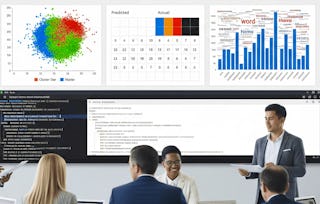
"Introduction to Predictive Analytics and Advanced Predictive Analytics Using Python" is specially designed to enhance your skills in building, refining, and implementing predictive models using Python. This course serves as a comprehensive introduction to predictive analytics, beginning with the fundamentals of linear and logistic regression. These models are the cornerstone of predictive analytics, enabling you to forecast future events by learning from historical data. We cover a bit of the theory behind these models, but in particular, their application in real-world scenarios and the process of evaluating their performance to ensure accuracy and reliability. As the course progresses, we delve deeper into the realm of machine learning with a focus on decision trees and random forests. These techniques represent a more advanced aspect of supervised learning, offering powerful tools for both classification and regression tasks. Through practical examples and hands-on exercises, you'll learn how to build these models, understand their intricacies, and apply them to complex datasets to identify patterns and make predictions. Additionally, we introduce the concepts of unsupervised learning and clustering, broadening your analytics toolkit, and providing you with the skills to tackle data without predefined labels or categories. By the end of this course, you'll not only have a thorough understanding of various predictive analytics techniques, but also be capable of applying these techniques to solve real-world problems, setting the stage for continued growth and exploration in the field of data analytics.

Intro to Predictive Analytics Using Python

Intro to Predictive Analytics Using Python
This course is part of How to Use Data Specialization

Instructor: Brandon Krakowsky
Access provided by Modern Academy
Gain insight into a topic and learn the fundamentals.
Beginner level
Recommended experience
1 week to complete
at 10 hours a week
Flexible schedule
Learn at your own pace
What you'll learn
Implement data preprocessing and model training procedures for regression.
Interpret feature importance in decision trees and random forests.
Explain the difference between supervised and unsupervised learning.
Skills you'll gain
- Logistic Regression
- Predictive Modeling
- Regression Analysis
- Feature Engineering
- Advanced Analytics
- Decision Tree Learning
- Predictive Analytics
- Classification And Regression Tree (CART)
- Supervised Learning
- Unsupervised Learning
- Machine Learning Methods
- Random Forest Algorithm
- Forecasting
- Model Training
- Machine Learning
- Model Evaluation
Tools you'll learn
Details to know

Shareable certificate
Add to your LinkedIn profile
Assessments
7 assignments
Taught in English
See how employees at top companies are mastering in-demand skills

Build your subject-matter expertise
This course is part of the How to Use Data Specialization
When you enroll in this course, you'll also be enrolled in this Specialization.
- Learn new concepts from industry experts
- Gain a foundational understanding of a subject or tool
- Develop job-relevant skills with hands-on projects
- Earn a shareable career certificate

There are 3 modules in this course
Earn a career certificate
Add this credential to your LinkedIn profile, resume, or CV. Share it on social media and in your performance review.
Instructor
Offered by

Why people choose Coursera for their career

Felipe M.
Learner since 2018
"To be able to take courses at my own pace and rhythm has been an amazing experience. I can learn whenever it fits my schedule and mood."

Jennifer J.
Learner since 2020
"I directly applied the concepts and skills I learned from my courses to an exciting new project at work."

Larry W.
Learner since 2021
"When I need courses on topics that my university doesn't offer, Coursera is one of the best places to go."

Chaitanya A.
"Learning isn't just about being better at your job: it's so much more than that. Coursera allows me to learn without limits."