This course examines how the idea of "the modern" develops at the end of the 18th century in European philosophy and literature, and how being modern (or progressive, or hip) became one of the crucial criteria for understanding and evaluating cultural change. Are we still in modernity, or have we moved beyond the modern to the postmodern?
“The Modern and the Postmodern Part I” covers the first half of a full semester course on European history, literature and philosophy. We begin with Immanuel Kant and Jean Jacques Rousseau and conclude with Friedrich Nietzsche and Charles Baudelaire and a very quick look at painting at the time they wrote. Although in the final week themes of postmodernism begin to emerge, a discussion of how modernism becomes postmodernism is at the heart of Part II of this course.
What's included
2 readings
Show info about module content
2 readings•Total 20 minutes
Syllabus•10 minutes
Course Logistics•10 minutes
Philosophy, Modernity, and Intellectual History
Module 2•1 hour to complete
Module details
Why is philosophy relevant to modernity?
Through reading Jean-Jacques Rousseau and Immanuel Kant, we examine philosophy as a reflection on modernity and progress.
What's included
2 videos1 reading
Show info about module content
2 videos•Total 24 minutes
Philosophy, Modernity, and Intellectual History I•14 minutes
Philosophy, Modernity, and Intellectual History II•10 minutes
1 reading•Total 10 minutes
Philosophy and Modernity -- Kant•10 minutes
What is Enlightenment?
Module 3•1 hour to complete
Module details
Using Rousseau’s Discourse on the Origins of Inequality, we study how the pursuit of knowledge is related to the politics of inequality.
What's included
4 videos1 reading
Show info about module content
4 videos•Total 61 minutes
What is Enlightenment? I•15 minutes
What is Enlightenment? II•15 minutes
What is Enlightenment? III•15 minutes
What is Enlightenment? IV•16 minutes
1 reading•Total 10 minutes
What is Enlightenment?--Rousseau•10 minutes
From Enlightenment to Revolution
Module 4•3 hours to complete
Module details
Karl Marx is our focus here as we move from a consideration of ideas to a confrontation with alienation, class struggle and revolution.
What's included
5 videos1 reading1 peer review
Show info about module content
5 videos•Total 60 minutes
From Enlightenment to Revolution I•12 minutes
From Enlightenment to Revolution II•13 minutes
From Enlightenment to Revolution III•9 minutes
From Enlightenment to Revolution IV•13 minutes
From Enlightenment to Revolution V•13 minutes
1 reading•Total 10 minutes
From Enlightenment to Revolution--Marx•10 minutes
1 peer review•Total 120 minutes
First Writing Assignment •120 minutes
Modernism and Art for Art's Sake
Module 5•2 hours to complete
Module details
We read Flaubert’s Madame Bovary as a reflection on convention, stupidity and art in the wake of the failures of mid-19th century revolution.
What's included
4 videos1 reading1 peer review
Show info about module content
4 videos•Total 59 minutes
Modernism and Art for Art's Sake I•13 minutes
Modernism and Art for Art's Sake II•14 minutes
Modernism and Art for Art's Sake III•15 minutes
Modernism and Art for Art's Sake IV•18 minutes
1 reading•Total 10 minutes
Modernism and Art for Art's Sake--Flaubert•10 minutes
1 peer review•Total 60 minutes
Second Writing Assignment•60 minutes
Re-imagining the World
Module 6•1 hour to complete
Module details
We situate Charles Darwin’s great achievement in the context of the English Enlightenment traditions and reimaging the world without a goal for change.
What's included
4 videos1 reading
Show info about module content
4 videos•Total 65 minutes
Re-imagining the World I•14 minutes
Re-imagining the World II•15 minutes
Re-imagining the World III•19 minutes
Re-imagining the World IV•17 minutes
1 reading•Total 10 minutes
Re-imagining the World--Darwin•10 minutes
From Struggle to Intensity
Module 7•3 hours to complete
Module details
Through an examination of Charles Baudelaire and Friedrich Nietzsche, we focus on an aesthetic embrace of intensity instead of search for the “really real.”
What's included
6 videos1 reading1 peer review
Show info about module content
6 videos•Total 87 minutes
From Struggle to Intensity I•14 minutes
From Struggle to Intensity II•14 minutes
From Struggle to Intensity III•16 minutes
From Struggle to Intensity IV•12 minutes
From Struggle to Intensity V•13 minutes
From Struggle to Intensity VI•18 minutes
1 reading•Total 10 minutes
From Struggle to Intensity--Baudelaire and Nietzsche•10 minutes
1 peer review•Total 60 minutes
Third Writing Assignment•60 minutes
Paintings
Module 8•1 hour to complete
Module details
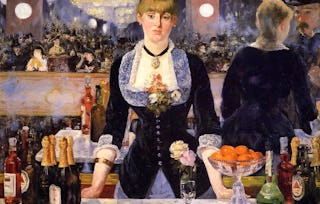
A Quick Survey of how advanced painting moved toward a consideration of the surface of the canvas and away from a quest for the most realistic representation of the world.
What's included
2 videos
Show info about module content
2 videos•Total 36 minutes
Paintings I•15 minutes
Paintings II•21 minutes
Instructor
Instructor ratings
Instructor ratings
We asked all learners to give feedback on our instructors based on the quality of their teaching style.
Wesleyan University, founded in 1831, is a diverse, energetic liberal arts community where critical thinking and practical idealism go hand in hand. With our distinctive scholar-teacher culture, creative programming, and commitment to interdisciplinary learning, Wesleyan challenges students to explore new ideas and change the world. Our graduates go on to lead and innovate in a wide variety of industries, including government, business, entertainment, and science.
"To be able to take courses at my own pace and rhythm has been an amazing experience. I can learn whenever it fits my schedule and mood."
Jennifer J.
Learner since 2020
"I directly applied the concepts and skills I learned from my courses to an exciting new project at work."
Larry W.
Learner since 2021
"When I need courses on topics that my university doesn't offer, Coursera is one of the best places to go."
Chaitanya A.
"Learning isn't just about being better at your job: it's so much more than that. Coursera allows me to learn without limits."
Learner reviews
4.8
1,046 reviews
5 stars
84.06%
4 stars
12.40%
3 stars
1.90%
2 stars
0.57%
1 star
1.04%
Showing 3 of 1046
C
CH
5·
Reviewed on Dec 28, 2020
Excellent course. The lectures were engaging and very informative and broad with the inclusion of a variety of thinkers. I also appreciated learning about the paintings of the post-modern period.
V
VD
5·
Reviewed on Sep 5, 2015
I've not finished this course yet, but I found it to be excellent, the content is important to understand, the teacher is clear and I enjoy listening to him. I really recommend it.
D
DS
5·
Reviewed on Jan 30, 2018
Best course and professor I have taken at Coursera, since Demystifying Mindfulness (which is #1).Really liked Prof Roth, and appreciate his continued emails after the course via Mentor connections.
When will I have access to the lectures and assignments?
To access the course materials, assignments and to earn a Certificate, you will need to purchase the Certificate experience when you enroll in a course. You can try a Free Trial instead, or apply for Financial Aid. The course may offer 'Full Course, No Certificate' instead. This option lets you see all course materials, submit required assessments, and get a final grade. This also means that you will not be able to purchase a Certificate experience.
What will I get if I purchase the Certificate?
When you purchase a Certificate you get access to all course materials, including graded assignments. Upon completing the course, your electronic Certificate will be added to your Accomplishments page - from there, you can print your Certificate or add it to your LinkedIn profile.
Is financial aid available?
Yes. In select learning programs, you can apply for financial aid or a scholarship if you can’t afford the enrollment fee. If fin aid or scholarship is available for your learning program selection, you’ll find a link to apply on the description page.