Big Data Courses
Big Data courses can help you learn data analysis, data visualization, statistical modeling, and data mining techniques. You can build skills in interpreting large datasets, designing data-driven strategies, and utilizing machine learning algorithms. Many courses introduce tools like Hadoop, Spark, and Tableau, that support processing vast amounts of information and presenting insights effectively. Additionally, you may explore topics such as data warehousing, predictive analytics, and the ethical implications of data usage.
Popular Big Data Courses and Certifications
 Status: Free Trial
University of Colorado Boulder
Skills you'll gain: Service Level, Databases, Database Development, Database Management, Acceptance Testing, Data Architecture, Software Engineering, Web Applications, Performance Testing, Scalability, Software Systems, Microservices, Software Architecture, System Testing, Distributed Computing, Data Infrastructure, System Monitoring, Functional Requirement, Application Deployment, Big Data
 Status: Free Trial
University of Illinois Urbana-Champaign
Skills you'll gain: Health Informatics, Machine Learning Methods, Deep Learning, Machine Learning, Machine Learning Algorithms, Health Care, Artificial Neural Networks, Applied Machine Learning, Supervised Learning, Model Evaluation, Artificial Intelligence and Machine Learning (AI/ML), Healthcare Project Management, Medical Science and Research, Unsupervised Learning, Program Development
 Status: NewStatus: Free Trial
Skills you'll gain: Amazon Redshift, AWS Identity and Access Management (IAM), AWS SageMaker, Amazon Web Services, AWS Kinesis, Amazon DynamoDB, Identity and Access Management, Amazon S3, Encryption, Data Infrastructure, Data Pipelines, Apache Spark, Dataflow, Big Data, Apache Hive, Data Storage Technologies, Data Visualization Software, Kibana, Data Storage, Data Visualization
 Status: Free Trial
Skills you'll gain: Data Security, Data Migration, Data Governance, Extract, Transform, Load, Cloud Storage, Data Architecture, Data Management, Data Integration, Data Storage, Enterprise Architecture, Data Quality, Data Modeling, Incident Response, Security Controls, Information Privacy, Data Infrastructure, Computer Security Incident Management, Data Storage Technologies, Security Strategy, Database Architecture and Administration
 Status: NewStatus: Free Trial
Skills you'll gain: Stakeholder Management, Data Storytelling, People Analytics, Risk Mitigation, Workforce Planning, HR Tech, Consulting, Organizational Strategy, Persuasive Communication, Management Reporting, Communication, Data Visualization, Data Analysis, Talent Management, Strategic Thinking, Employee Engagement, Information Technology, Project Management, Empathy, Statistical Methods
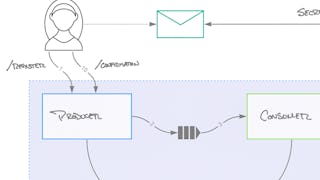 Status: Free Trial
University of Colorado Boulder
Skills you'll gain: Performance Testing, Scalability, Data Architecture, Software Architecture, Distributed Computing, Data Infrastructure, Performance Stress Testing, Predictive Modeling, Performance Tuning, Microservices, Big Data, Database Theory, Software Engineering, Database Systems, Data Store
What brings you to Coursera today?
 Status: Free Trial
Corporate Finance Institute
Skills you'll gain: Classification Algorithms, Data Preprocessing, Feature Engineering, Data Visualization, Model Evaluation, Data Import/Export, Matplotlib, Exploratory Data Analysis, Data Presentation, Data Science, Plot (Graphics), Regression Analysis, Financial Data, Data Analysis, Business Analytics, Data Cleansing, Machine Learning Algorithms, Correlation Analysis, Advanced Analytics, Predictive Analytics
 Status: Free Trial
University of Colorado Boulder
Skills you'll gain: Databases, Database Development, Database Management, Acceptance Testing, Data Architecture, Web Applications, Microservices, Software Architecture, Software Engineering, System Testing, Data Infrastructure, Software Systems, System Monitoring, Functional Requirement, Application Deployment, Site Reliability Engineering, Middleware, Distributed Computing, Prototyping, Big Data
 Status: Free Trial
University of Colorado Boulder
Skills you'll gain: Service Level, Software Engineering, Software Systems, Software Architecture, Distributed Computing, Data Architecture, Microservices, Software Development, Transaction Processing, Program Development, Test Driven Development (TDD), Blockchain, Big Data, Data Structures, System Monitoring, Database Theory, Databases
 Status: Preview
The State University of New York
Skills you'll gain: Bioinformatics, Big Data, Health Informatics, R (Software), Biomedical Technology, Medical Science and Research, Predictive Analytics, R Programming, Predictive Modeling, Statistical Analysis, Data Cleansing, Feature Engineering, Data Preprocessing, Model Evaluation, Unsupervised Learning, Classification Algorithms
 Status: Free Trial
Skills you'll gain: Apache Kafka, Apache Spark, Scala Programming, Real Time Data, Apache Hadoop, Apache Cassandra, Applied Machine Learning, Big Data, Data Processing, Application Deployment, Distributed Computing, Programming Principles, Cloud Deployment, Data Structures, Development Environment
 Status: Free Trial
Skills you'll gain: Apache Spark, Model Evaluation, Data Preprocessing, Keras (Neural Network Library), Transfer Learning, Deep Learning, Model Training, Tensorflow, A/B Testing, Responsible AI, Data Processing, Convolutional Neural Networks, Machine Learning Software, Artificial Neural Networks, Machine Learning Algorithms, Data Cleansing, Model Deployment, Machine Learning, Recurrent Neural Networks (RNNs), Dimensionality Reduction
In summary, here are 10 of our most popular big data courses
- Software Architecture for Big Data: University of Colorado Boulder
- Health Data Science Foundation: University of Illinois Urbana-Champaign
- AWS Certified Big Data - Specialty: Packt
- Enterprise Data Integration, Governance and Architecture: SkillUp
- People Analytics with AI: Data-Driven HR Strategies: Coursera
- Software Architecture Patterns for Big Data: University of Colorado Boulder
- Practical Data Science for Data Analysts: Corporate Finance Institute
- Applications of Software Architecture for Big Data: University of Colorado Boulder
- Fundamentals of Software Architecture for Big Data: University of Colorado Boulder
- Big Data, Genes, and Medicine: The State University of New York










