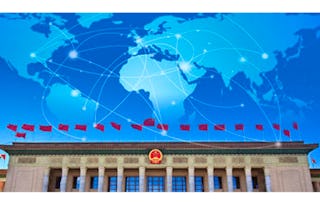
In 1978, after nearly 30 years of socialist planning under Mao Zedong, China was one of the world’s poorest countries, saddled with an inefficient, inward-looking economy. Today, China is an upper-middle income country and the world’s largest trading nation, contributing more to global economic growth than any other nation. How could such a remarkable transformation take place?
This course will examine in detail the reforms that have contributed to China’s economic development and the current challenges facing the Chinese economy. After completing this course, you will be able to:
- describe the origin and consequences of China’s key economic reforms since 1978;
- explain how features of China’s fiscal and financial systems have impacted development outcomes;
- assess the extent to which China has integrated itself into the global economy and the consequences of such integration for China and other countries;
- explain the importance of different sources of economic growth during different periods since 1978; and
- critically assess the economic and policy challenges facing China going forward.
This course does not offer certificate at the moment.
Course Overview video: https://youtu.be/YBkhpvWUoIw
In this module, we will introduce you to China's gradualist reforms. But before you start with the lectures, please watch the Course Overview, review the Assignment and Grading page, and introduce yourself to other learners who will be studying this course with you.
In this module, we will focus on China's fiscal and financial system reform.
What's included
7 videos2 readings1 assignment1 discussion prompt
Show info about module content
7 videos•Total 59 minutes
2.1 Fiscal and Financial System Reform – An Introduction•4 minutes
2.2 Fiscal Decentralization: Pros and Cons•10 minutes
2.3 Reforming the Fiscal System•8 minutes
2.4 The Soft Budget Constraint•11 minutes
2.5 Reforming the Financial System•13 minutes
2.6 Shadow Banking: Threat or Opportunity?•10 minutes
2.7 Fiscal and Financial System Reform – Module Summary•2 minutes
2 readings•Total 20 minutes
Module 2 Course Reading•10 minutes
Module 2 Lecture References•10 minutes
1 assignment•Total 30 minutes
Quiz 2•30 minutes
1 discussion prompt•Total 10 minutes
Module 2 Discussion•10 minutes
Module 3: Globalization: Trade and Foreign Direct Investment
Module 3•3 hours to complete
Module details
In this module, we will focus on China's trade and foreign direct investment. Apart from regular lectures, we will visit firms in China to understand the impact of foreign direct investment on them. We will also have interviews and discussions with leading scholars to provide greater insight into what is happening in the areas of China's outbound foreign direct investment and the internationalization of the Renminbi.
3.1 Globalization: Trade and Foreign Direct Investment – An Introduction•5 minutes
3.2 International Trade: Performance and Policies•14 minutes
3.3 Trade and Development•16 minutes
3.4 Foreign Direct Investment•16 minutes
3.5 Foreign Direct Investment – Firm Visits in China•18 minutes
3.6 China’s Outbound Foreign Direct Investment•6 minutes
3.7 China’s Outbound FDI – An Expert Discussion•13 minutes
3.8 Internationalization of the Renminbi•7 minutes
3.9 Internationalization of the Renminbi – An Expert Discussion•9 minutes
3.10 Globalization: Trade and FDI – Module Summary•4 minutes
2 readings•Total 20 minutes
Module 3 Course Reading•10 minutes
Module 3 Lecture References•10 minutes
1 assignment•Total 30 minutes
Quiz 3•30 minutes
1 discussion prompt•Total 10 minutes
Module 3 Discussion•10 minutes
Module 4: Economic Growth and Structural Change
Module 4•2 hours to complete
Module details
In this module, we will focus on China's economic growth and structural change.
What's included
6 videos2 readings1 assignment1 discussion prompt
Show info about module content
6 videos•Total 49 minutes
4.1 Economic Growth and Structural Change – An Introduction•3 minutes
4.2 Sources of Growth•10 minutes
4.3 Structural Change•8 minutes
4.4 Resource Misallocation•14 minutes
4.5 Productivity Growth•11 minutes
4.6 Economic Growth and Structural Change – Module Summary•3 minutes
2 readings•Total 20 minutes
Module 4 Course Reading•10 minutes
Module 4 Lecture References•10 minutes
1 assignment•Total 30 minutes
Quiz 4•30 minutes
1 discussion prompt•Total 10 minutes
Module 4 Discussion•10 minutes
Module 5: Governance and Current Challenges
Module 5•2 hours to complete
Module details
In this module, we will focus on China's governance and current challenges. Apart from regular lectures, we will visit firms in China to understand the impact of rising wages on them.
What's included
9 videos2 readings1 assignment1 discussion prompt
Show info about module content
9 videos•Total 83 minutes
5.1 Governance and Current Challenges – An Introduction•3 minutes
5.2 China’s Governance Puzzle•11 minutes
5.3 Incentivizing Local Leaders•14 minutes
5.4 Economic Challenges•11 minutes
5.5 Rebalancing Growth•12 minutes
5.6 Challenge of Rising Wages•9 minutes
5.7 Challenge of Rising Wages – Firm Visits in China•13 minutes
5.8 Governance and Current Challenges – Module Summary•3 minutes
5.9 Economic Reform and Growth in China – Conclusion•6 minutes
2 readings•Total 20 minutes
Module 5 Course Reading•10 minutes
Module 5 Lecture References•10 minutes
1 assignment•Total 30 minutes
Quiz 5•30 minutes
1 discussion prompt•Total 10 minutes
Module 5 Discussion•10 minutes
Final Exam and Course Evaluation
Module 6•1 hour to complete
Module details
Now is time to test your understanding on the entire course. Take the final exam and complete the post-course survey. Your valuable feedback will certainly help us improve future iterations of the course.
What's included
1 reading2 assignments
Show info about module content
1 reading•Total 10 minutes
Rate this course•10 minutes
2 assignments•Total 72 minutes
Post-course Survey•42 minutes
Final exam•30 minutes
Instructor
Instructor ratings
Instructor ratings
We asked all learners to give feedback on our instructors based on the quality of their teaching style.
HKUST is a world-class research-intensive university that focuses on science, technology, and business as well as humanities and social science. HKUST offers an international campus, and a holistic and interdisciplinary pedagogy to nurture well-rounded graduates with a global vision, a strong entrepreneurial spirit, and innovative thinking.
OK
Explore more from Economics
RecommendedSpecializations
T
The Hong Kong University of Science and Technology
"To be able to take courses at my own pace and rhythm has been an amazing experience. I can learn whenever it fits my schedule and mood."
Jennifer J.
Learner since 2020
"I directly applied the concepts and skills I learned from my courses to an exciting new project at work."
Larry W.
Learner since 2021
"When I need courses on topics that my university doesn't offer, Coursera is one of the best places to go."
Chaitanya A.
"Learning isn't just about being better at your job: it's so much more than that. Coursera allows me to learn without limits."
Learner reviews
4.8
204 reviews
5 stars
84.80%
4 stars
13.23%
3 stars
1.47%
2 stars
0%
1 star
0.49%
Showing 3 of 204
A
A
5·
Reviewed on Aug 19, 2018
A great course for anyone interested in learning about China. You can expect your perceptions of China, along with the driving forces behind China's rapid transformation, to be challenged.
C
CK
5·
Reviewed on May 5, 2020
Full of information and different angles, theories, and explanation to understand the success of China's reforms. The professor interviewed experts and factory managers to understand the issues better
M
MC
4·
Reviewed on Aug 5, 2020
great course to have a brief understanding of China's economic reform :)
When will I have access to the lectures and assignments?
To access the course materials, assignments and to earn a Certificate, you will need to purchase the Certificate experience when you enroll in a course. You can try a Free Trial instead, or apply for Financial Aid. The course may offer 'Full Course, No Certificate' instead. This option lets you see all course materials, submit required assessments, and get a final grade. This also means that you will not be able to purchase a Certificate experience.
What will I get if I purchase the Certificate?
When you purchase a Certificate you get access to all course materials, including graded assignments. Upon completing the course, your electronic Certificate will be added to your Accomplishments page - from there, you can print your Certificate or add it to your LinkedIn profile.
Is financial aid available?
Yes. In select learning programs, you can apply for financial aid or a scholarship if you can’t afford the enrollment fee. If fin aid or scholarship is available for your learning program selection, you’ll find a link to apply on the description page.