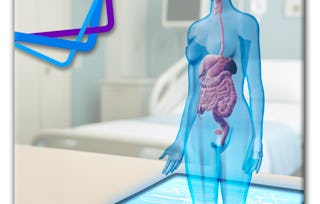
Imagine if there were an organ in your body that weighed as much as your brain, that affected your health, your weight, and even your behavior. Wouldn’t you want to know more about it? There is such an organ — the collection of microbes in and on your body, your human microbiome.
Welcome Citizen Scientists! We're very pleased to have you join us on an exploration of the human microbiome. This is a fascinating area of study, and we hope you will find this six-module course worthwhile. Each module's content will be presented in similar fashion; our team will introduce topics by way of pre-recorded video lectures interspersed with guest interviews by subject matter experts. Module 1 will provide a broad overview about microbes and their diversity on earth and in the human body.
What's included
10 videos4 readings1 assignment1 peer review
Show info about module content
10 videos•Total 60 minutes
Introduction•3 minutes
Welcome to the Course•3 minutes
What are Microbes?•9 minutes
Interview: Jack Gilbert•8 minutes
Interview: Valerie McKenzie•5 minutes
The Human Microbiome•15 minutes
Where Do You Get Your Microbes?•6 minutes
Web interview: Maria Gloria Dominguez-Bello•5 minutes
Web interview: Elizabeth Costello•5 minutes
Rob's Module 1 wrap-up•1 minute
4 readings•Total 31 minutes
Course Updates and Accessibility Support•1 minute
About This Course•10 minutes
Assignments•10 minutes
Part 1: You and Your Gut•10 minutes
1 assignment•Total 12 minutes
Introduction to Microbes and the Human Microbiome•12 minutes
1 peer review•Total 60 minutes
Personal Microbiome Project Part I: Brainstorming•60 minutes
Studying the Microbiome
Module 2•2 hours to complete
Module details
In this module, we will dive into the fundamentals of how we study the human microbiome. We highlight recent advances in microbiome research methods and take you on a tour of the Knight lab. Please keep in mind, that Modules 2 and 3 are meant to provide a glimpse into our world of data generation and analysis. Modules 4, 5, and 6 will be less technical and provide a broad overview of fascinating research on the human microbiome. Stick with us!
What's included
9 videos2 readings1 assignment
Show info about module content
9 videos•Total 50 minutes
How we study the microbiome: Introduction•1 minute
The history of studying microbes with Norm Pace•6 minutes
Basics of high-throughput DNA sequencing•12 minutes
Demo: Tour of the Knight Lab•8 minutes
'Omics' and other useful technologies•7 minutes
Interview: Luke Thompson•3 minutes
Web interview: Janet Jansson•4 minutes
Web interview: Pieter Dorrestein•7 minutes
Rob's Module 2 wrap-up•1 minute
2 readings•Total 20 minutes
Assignments•10 minutes
Part 1: You and Your Gut (continued)•10 minutes
1 assignment•Total 30 minutes
Studying the Microbiome•30 minutes
Making Sense Out of Microbial Data
Module 3•2 hours to complete
Module details
This module highlights the basics of generating and analyzing microbiome data. We will also discuss how computational scientists are revolutionizing the development of tools for analyzing large, complex biological data sets and show you some of the cool ways that we visualize data! This module will help you understand data plots in later modules, but do not get discouraged if the material here is too technical, a full understanding is not required to complete the course!
What's included
7 videos2 readings1 assignment
Show info about module content
7 videos•Total 52 minutes
How do we identify a microbe?•6 minutes
Web interview: Philip Hugenholtz•11 minutes
Basics of alpha-diversity with fuzzy microbe demo•9 minutes
Beta-diversity, and visualizing differences•13 minutes
Demo: EMPeror, a QIIME visualization tool•2 minutes
Web interview: Gregory Caporaso•10 minutes
Rob's Week 3 wrap-up•1 minute
2 readings•Total 20 minutes
Assignments•10 minutes
Part 1: You and Your Gut (continued)•10 minutes
1 assignment•Total 30 minutes
Making Sense Out of Microbial Data•30 minutes
The Human Gut Microbiome and Your Health
Module 4•3 hours to complete
Module details
Now that we've given you some background about the methods we use to analyze microbial data, it's time for us to talk more about recent discoveries in microbiome research. This module will focus on the main factors impacting the gut microbiota as well as the influence of the gut microbiota on nutrition and gut health. This is the fun part, so get excited!
What's included
8 videos1 reading1 assignment1 peer review
Show info about module content
8 videos•Total 51 minutes
Impact of diet and age on the gut microbiota•14 minutes
Obesity and the gut microbiota•8 minutes
Human microbiome and gut disease•7 minutes
Interview: On location in Tanzania with Martin Blaser•6 minutes
Interview: On location in Tanzania with Jeff Leach•7 minutes
Interview: On location in Tanzania with Maria Gloria Dominguez-Bello•3 minutes
Manipulating the microbiome through fecal transplants•6 minutes
Rob's Module 4 wrap-up•1 minute
1 reading•Total 10 minutes
Assignments•10 minutes
1 assignment•Total 30 minutes
The Human Gut Microbiome and Your Health•30 minutes
1 peer review•Total 60 minutes
Personal Microbiome Project Part I: Reflection Questions•60 minutes
Gut Microbe-Host Interactions: Beyond Nutrition
Module 5•2 hours to complete
Module details
You're more than halfway through the course! We hope you've been learning lots of new, exciting things about the human gut microbiota! In this module, we'll shift the focus from nutrition and gut health to the rest of your body. How do your gut microbes and your immune system interact? What about your nervous system? Does the gut microbiota play a role in allergies and stress?
What's included
11 videos1 reading1 assignment
Show info about module content
11 videos•Total 82 minutes
Gut microbiota interactions with the immune system•10 minutes
Gut microbiota, autoimmune diseases, and allergies•9 minutes
Web interview: Sarkis Mazmanian•11 minutes
Interview: Cathy Lozupone•11 minutes
The gut-brain axis•10 minutes
Post-mortem human microbiome•7 minutes
Zech on machine learning•6 minutes
Web interview: Sibyl Bucheli•9 minutes
Web interview: David Carter•5 minutes
Web interview: Charlotte Carter•4 minutes
Rob's Module 5 wrap-up•1 minute
1 reading•Total 10 minutes
Assignments•10 minutes
1 assignment•Total 30 minutes
Gut Microbe-Host Interactions: Beyond Nutrition•30 minutes
What's in the American Gut
Module 6•4 hours to complete
Module details
We will wrap up the course in this module by discussing what's in the American Gut. Rob will walk us through results from the American Gut Project and compare results from Jeff Leach and Michael Pollan. We will also hear from Michael Pollan on the importance of microbiome research and how it has changed the way he thinks about his health and what he eats.
What's included
8 videos4 readings1 assignment1 peer review
Show info about module content
8 videos•Total 60 minutes
The American Gut Project and crowd-funding•6 minutes
Interview: Tom Cech•7 minutes
Collecting samples•12 minutes
Interview: Daniel McDonald•10 minutes
Michael Pollan vs. Jeff Leach: American Gut results explained•9 minutes
Web interview: Michael Pollan•10 minutes
Comparing the American Gut to other populations•4 minutes
Rob's Module 6 wrap-up and thank you's•2 minutes
4 readings•Total 40 minutes
Assignments•10 minutes
Closing Remarks•10 minutes
Acknowledgements•10 minutes
Post-Course Survey•10 minutes
1 assignment•Total 30 minutes
What's in the American Gut•30 minutes
1 peer review•Total 120 minutes
Personal Microbiome Project Part II•120 minutes
Instructors
Instructor ratings
Instructor ratings
We asked all learners to give feedback on our instructors based on the quality of their teaching style.
CU Boulder is a dynamic community of scholars and learners on one of the most spectacular college campuses in the country. As one of 34 U.S. public institutions in the prestigious Association of American Universities (AAU), we have a proud tradition of academic excellence, with five Nobel laureates and more than 50 members of prestigious academic academies.
UC San Diego is an academic powerhouse and economic engine, recognized as one of the top 10 public universities by U.S. News and World Report. Innovation is central to who we are and what we do. Here, students learn that knowledge isn't just acquired in the classroom—life is their laboratory.
"To be able to take courses at my own pace and rhythm has been an amazing experience. I can learn whenever it fits my schedule and mood."
Jennifer J.
Learner since 2020
"I directly applied the concepts and skills I learned from my courses to an exciting new project at work."
Larry W.
Learner since 2021
"When I need courses on topics that my university doesn't offer, Coursera is one of the best places to go."
Chaitanya A.
"Learning isn't just about being better at your job: it's so much more than that. Coursera allows me to learn without limits."
Learner reviews
4.7
1,226 reviews
5 stars
78.48%
4 stars
17.27%
3 stars
2.60%
2 stars
0.81%
1 star
0.81%
Showing 3 of 1226
G
GR
5·
Reviewed on Jun 30, 2018
It was a good experience, and while I'm not too big on microbiology in general, I was intrigued in the role our microbiome plays in our lives. The summer I did this changed my life in a way. :)
N
NP
5·
Reviewed on Sep 2, 2021
Great course, very helpful in my work, very knowledgeable instructors and latest research on the impact of human gut microbiome on our overall health. Thank you to the creators of the course!
P
PB
5·
Reviewed on Feb 25, 2016
This is a very good course. The instructors are knowledgeable and very clear in their exposition. The materials are very good and there are many things worth learning within.
When will I have access to the lectures and assignments?
To access the course materials, assignments and to earn a Certificate, you will need to purchase the Certificate experience when you enroll in a course. You can try a Free Trial instead, or apply for Financial Aid. The course may offer 'Full Course, No Certificate' instead. This option lets you see all course materials, submit required assessments, and get a final grade. This also means that you will not be able to purchase a Certificate experience.
What will I get if I purchase the Certificate?
When you purchase a Certificate you get access to all course materials, including graded assignments. Upon completing the course, your electronic Certificate will be added to your Accomplishments page - from there, you can print your Certificate or add it to your LinkedIn profile.
Is financial aid available?
Yes. In select learning programs, you can apply for financial aid or a scholarship if you can’t afford the enrollment fee. If fin aid or scholarship is available for your learning program selection, you’ll find a link to apply on the description page.