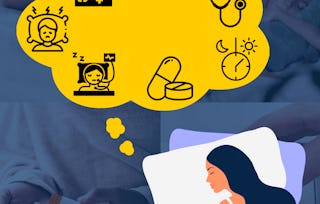
The objective of this course is to give students the most up-to-date information on the biological, personal, and societal relevance of sleep. Personal relevance is emphasized by the fact that the single best predictor of daytime performance is the quality of the previous night's sleep. The brain actively generates sleep, and the first section of the course is an overview of the neurobiological basis of sleep control. The course provides cellular-level understanding of how sleep deprivation, jet lag, and substances such as alcohol, ,caffeine, and nicotine alter sleep and wakefulness. The second section of the course covers sleep-dependent changes in physiology and sleep disorders medicine. Particular emphasis will be placed on disorders of excessive sleepiness, insomnia, and sleep-dependent changes in autonomic control. Chronic sleep deprivation impairs immune function and may promote obesity. Deaths due to all causes are most frequent between 4:00 and 6:00 a.m., and this second section of the class highlights the relevance of sleep for preventive medicine. The societal relevance of sleep will be considered in the final section of the class. In an increasingly complex and technologically oriented society, operator-error by one individual can have a disastrous negative impact on public health and safety. Fatigue-related performance decrements are known to have contributed as causal factors to nuclear power plant failures, transportation disasters, and medical errors.
This unit begins with a Course Overview video from Ralph Lydic, Ph.D., followed by the first portion of the Neurobiology of Sleep and Wakefulness lecture, delivered by Helen Baghdoyan, Ph.D. PLEASE NOTE: Only the Course Overview video, and the Getting Started and Syllabus readings are required for students who have chosen to engage in the Standard Track portion of the course content. Standard track students may also bypass all content in units 2, 3, and 4, and instead move directly to unit 5 after viewing the Course Overview video.
What's included
6 videos4 readings1 assignment
Show info about module content
6 videos•Total 93 minutes
01.01 - Course Overview - Ralph Lydic, Ph.D. •18 minutes
Unit 02 - Neurobiology Section: Neurobiology of Sleep and Wakefulness (Part Two) - (Honors Track)
Module 2•2 hours to complete
Module details
Unit 2 continues the lecture from Helen Baghdoyan, Ph.D. on the Neurobiology of Sleep and Wakefulness. PLEASE NOTE: This content is only required for students who have chosen to pursue the Honors Track certification.
What's included
5 videos2 assignments
Show info about module content
5 videos•Total 73 minutes
02.06 - Wake & REM: GABA•17 minutes
02.07: Wake & REM: Orexin•17 minutes
02.08: NREM: GABA•15 minutes
02.09: NREM: Adenosine •12 minutes
02:10: Summary•12 minutes
2 assignments•Total 32 minutes
Did you complete Lesson 03?•2 minutes
Unit 02 Honors Track Quiz - Neurobiology of Sleep and Wakefulness•30 minutes
Unit 03 - Neurobiology: Mathematical Modeling of Sleep-Wake Regulation - (Honors Track)
Module 3•2 hours to complete
Module details
Unit 3 continues the Neurobiology section of the content with a lecture from Victoria Booth, Ph.D. on the Mathematical Modeling of Sleep-Wake Regulation. PLEASE NOTE: This content is only required for students who have chosen to pursue the Honors Track certification.
What's included
10 videos1 reading2 assignments
Show info about module content
10 videos•Total 67 minutes
03.01 - Introduction to Mathematical Modeling of Sleep-Wake Regulation •3 minutes
03.02 - Two Process Model •6 minutes
03.03 - Sleep-Wake Flip-Flop Model•6 minutes
03.04 - Reciprocal Interaction Model •12 minutes
03.05 - REM Sleep Flip-Flop Model•5 minutes
03.06 - Features for an Ideal Model of Sleep-Wake Regulation•7 minutes
03.07 - Introduction to Mechanistic Models of Sleep-Wake Regulation •4 minutes
03.08 - Diniz Benh & Booth Model - Part I•10 minutes
03.09 - Diniz Benh & Booth Model - Part II •14 minutes
03.10 - Conclusion •2 minutes
1 reading•Total 10 minutes
Unit 03 Orientation•10 minutes
2 assignments•Total 60 minutes
Did you Complete Lesson 5?•30 minutes
Unit 03 Quiz - Mathematical Modeling of Sleep-Wake Regulation•30 minutes
Unit 04 - Neurobiology: Molecular Biology and Genetics of Sleep - (Honors Track)
Module 4•1 hour to complete
Module details
Unit 4 closes out the Neurobiology section with a lecture from Chiara Cirelli, Ph.D. on Molecular Biology and the Genetics of Sleep. PLEASE NOTE: This content is only required for students who have chosen to pursue the Honors Track certification.
What's included
6 videos2 assignments
Show info about module content
6 videos•Total 52 minutes
04.01 - Expression of mRNA Varies During Sleep and Wakefulness•8 minutes
04.02 - Wake Genes that are Associated with Energy Metabolism •7 minutes
04.03 - Synaptic Plasticity is Genetically Modulated •8 minutes
04.04 - Brain Glial Cells Influence States of Sleep and Wakefulness •9 minutes
04.05 - Genetic Modulation of Human Sleep Phenotypes •8 minutes
04.06 - Conclusion •11 minutes
2 assignments•Total 32 minutes
Did you complete Lesson 7?•2 minutes
Unit 04 Quiz - Molecular Biology and Genetics of Sleep•30 minutes
Unit 05 - Medicine: Overview of Sleep Medicine - Ronald Chervin, M.D. - (Standard Track)
Module 5•2 hours to complete
Module details
Unit 5 marks the beginning of the Medicine section of the course. This unit features an overview of Sleep Medicine from Ronald Chervin, M.D.
What's included
7 videos1 reading1 assignment
Show info about module content
7 videos•Total 94 minutes
05.01 - Introduction - Overview of Sleep Medicine •5 minutes
05.02 - Clinical Approach to Sleep Disorders•10 minutes
05.03 - Polysomnography •17 minutes
05.04 - Classification of Sleep Disorders•20 minutes
05.05 - Obstructive Sleep Apnea •16 minutes
05.06 - Testing for Obstructive Sleep Apnea•7 minutes
05.07 - Treatment for Obstructive Sleep Apnea, and Concluding Thoughts•18 minutes
1 reading•Total 10 minutes
Unit 05 Orientation•10 minutes
1 assignment•Total 30 minutes
Unit 05 Quiz- Overview of Sleep Medicine•30 minutes
Unit 06 - Medicine: Disordered Sleep and Breathing Alters Cardiovascular Health - (Standard Track)
Module 6•1 hour to complete
Module details
Unit 6 continues the Medicine section of the course, featuring a lecture from Helena Schotland, M.D. exploring how Disordered Sleep and Breathing may alter Cardiovascular Health.
What's included
3 videos1 reading1 assignment
Show info about module content
3 videos•Total 40 minutes
06.01- Impact of Disordered Sleep and Breathing on Cardiovascular Health (Part 1) •21 minutes
06.02 - Impact of Disordered Sleep and Breathing on Cardiovascular Health (Part 2)•14 minutes
06.03 - Outcomes of CPAP Therapy and Conclusions•5 minutes
1 reading•Total 10 minutes
Unit 06 Orientation•10 minutes
1 assignment•Total 30 minutes
Unit 06 Quiz - Disordered Sleep and Breathing Alters Cardiovascular Health•30 minutes
Unit 07 - Medicine: Sleep and Psychiatric Disorders - (Standard Track)
Module 7•2 hours to complete
Module details
Unit 7 further continues the Medicine section of the course with a lecture on the relationship of Sleep and Psychiatric Disorders from Eric Nofzinger, M.D
What's included
8 videos1 reading1 assignment
Show info about module content
8 videos•Total 68 minutes
07.01 - Introduction - Sleep and Psychiatric Disorders•9 minutes
07.02 - What Goes to Sleep?•14 minutes
07.03 - Sleep Alterations Associated with Specific Psychiatric Disorders•21 minutes
07.04 - Bipolar Disorder and Schizophrenia•4 minutes
07.05 - Anxiety Disorders•5 minutes
07.06 - Substance Use Disorders •4 minutes
07.07 - Insomnia•5 minutes
07.08 - Interventions for Insomnia•7 minutes
1 reading•Total 10 minutes
Unit 07 Orientation•10 minutes
1 assignment•Total 30 minutes
Unit 07 Quiz - Sleep and Psychiatric Disorders•30 minutes
Unit 08 - Medicine: Insomnia: Causes and Consequences - (Standard Track)
Module 8•1 hour to complete
Module details
Unit 8 further continues the Medicine section of the course with a lecture from Christopher Drake, Ph.D. on the causes and consequences of Insomnia.
What's included
4 videos1 reading1 assignment
Show info about module content
4 videos•Total 49 minutes
08.01 - Insomnia: Causes and Consequences •8 minutes
08.02 - Consequences of Insomnia •12 minutes
08.03 - Causes of Insomnia •17 minutes
08.04 - Insomnia and its Relation to Hyperarousal•13 minutes
1 reading•Total 10 minutes
Unit 08 Orientation•10 minutes
1 assignment•Total 30 minutes
Unit 08 Quiz - Insomnia: Causes and Consequences•30 minutes
Unit 09 - Medicine: Treatments for Insomnia - (Standard Track)
Module 9•1 hour to complete
Module details
Unit 9 further continues the Medicine section of the course with a lecture from J. Todd Arendt, Ph.D. on the range of available treatments for Insomnia.
What's included
9 videos1 assignment
Show info about module content
9 videos•Total 48 minutes
09.01 - Behavioral and Pharmacological Treatments for Insomnia•7 minutes
09.02 - Treatment Options for Insomnia•5 minutes
09.03 - BzRA Hypnotics•6 minutes
09.04 - Abuse Liability of Hypnotic Agents•5 minutes
09.05 - Pharmacological Treatments for Insomnia•4 minutes
09.06 - Nonpharmacological Treatments for Insomnia•6 minutes
09.07 - How CBT-I Works•6 minutes
09.08 - Pharmacological Treatments for Insomnia Part III•6 minutes
09.09 - Summary •3 minutes
1 assignment•Total 30 minutes
Unit 09 Quiz - Treatments for Insomnia•30 minutes
Unit 10 - Medicine: Sleep and Anesthesia - (Standard Track)
Module 10•1 hour to complete
Module details
Unit 10 brings the Medicine section of the course to a close with a lecture on Sleep and Anesthesia delivered by George Mashour, M.D.
What's included
4 videos1 assignment
Show info about module content
4 videos•Total 33 minutes
Unit 10 Overview•0 minutes
10.01 - Sleep and Anesthesia: Shared Phenotype and Shared Mechanism? •14 minutes
10.02 - Sleep and Anesthesia: Shared Function? •17 minutes
10.03 - Summary•2 minutes
1 assignment•Total 30 minutes
Unit 10 Quiz - Sleep and Anesthesia•30 minutes
Unit 11 - Society: Circadian Rhythms, Sleep, and Health - (Standard Track)
Module 11•2 hours to complete
Module details
Unit 11 kicks off the Society section of the course with a lecture on Circadian Rhythms, Sleep, and Health from Theresa Lee, Ph.D.
What's included
5 videos1 reading1 assignment
Show info about module content
5 videos•Total 88 minutes
11.01 - Why Sleep is Important •21 minutes
11.02 - Sleep Occurs as a Circadian Rhythm •18 minutes
11.03 - Changes in Sleep Rhythms Across the Lifespan (Part 1) •22 minutes
11.04 - Changes in Sleep Rhythms Across the Lifespan (Part 2) •16 minutes
11.05 - Circadian Rhythms and Sleep Hygiene•11 minutes
1 reading•Total 10 minutes
Unit 11 Orientation•10 minutes
1 assignment•Total 30 minutes
Unit 11 Quiz - Circadian Rhythms, Sleep, and Health•30 minutes
Unit 12 - Society: Daytime Sleepiness and Sleep Need - Thomas Roth, Ph.D. (Standard Track)
Module 12•2 hours to complete
Module details
Unit 12 wraps up the final section of the course and the Society section of the content with a lecture on Daytime Sleepiness and Sleep Need by Thomas Roth, Ph.D.
What's included
4 videos4 readings1 assignment
Show info about module content
4 videos•Total 46 minutes
12.01 - Brain Basis of Daytime Sleepiness•3 minutes
12.02 - How is Sleepiness Measured? •10 minutes
12.03 - How Many People in our Society are Sleepy? •19 minutes
12.04 - What are the Causes of Daytime Sleepiness? •14 minutes
4 readings•Total 40 minutes
Unit 12 Orientation•10 minutes
Farewell for Now•10 minutes
Post-Course Survey•10 minutes
Keep Learning with Michigan Online!•10 minutes
1 assignment•Total 30 minutes
Unit 12 Quiz - Daytime Sleepiness and Sleep Need•30 minutes
Instructors
Instructor ratings
Instructor ratings
We asked all learners to give feedback on our instructors based on the quality of their teaching style.
The mission of the University of Michigan is to serve the people of Michigan and the world through preeminence in creating, communicating, preserving and applying knowledge, art, and academic values, and in developing leaders and citizens who will challenge the present and enrich the future.
When will I have access to the lectures and assignments?
To access the course materials, assignments and to earn a Certificate, you will need to purchase the Certificate experience when you enroll in a course. You can try a Free Trial instead, or apply for Financial Aid. The course may offer 'Full Course, No Certificate' instead. This option lets you see all course materials, submit required assessments, and get a final grade. This also means that you will not be able to purchase a Certificate experience.
What will I get if I purchase the Certificate?
When you purchase a Certificate you get access to all course materials, including graded assignments. Upon completing the course, your electronic Certificate will be added to your Accomplishments page - from there, you can print your Certificate or add it to your LinkedIn profile.
Is financial aid available?
Yes. In select learning programs, you can apply for financial aid or a scholarship if you can’t afford the enrollment fee. If fin aid or scholarship is available for your learning program selection, you’ll find a link to apply on the description page.