When you enroll in this course, you'll also be enrolled in this Specialization.
Learn new concepts from industry experts
Gain a foundational understanding of a subject or tool
Develop job-relevant skills with hands-on projects
Earn a shareable career certificate
There are 4 modules in this course
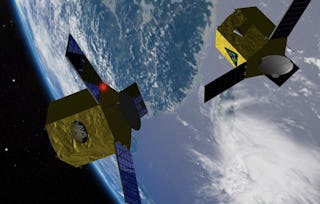
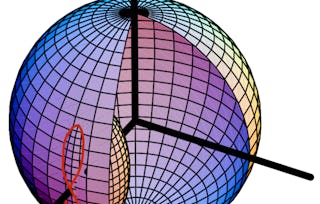
The movement of bodies in space (like spacecraft, satellites, and space stations) must be predicted and controlled with precision in order to ensure safety and efficacy. Kinematics is a field that develops descriptions and predictions of the motion of these bodies in 3D space. This course in Kinematics covers four major topic areas: an introduction to particle kinematics, a deep dive into rigid body kinematics in two parts (starting with classic descriptions of motion using the directional cosine matrix and Euler angles, and concluding with a review of modern descriptors like quaternions and Classical and Modified Rodrigues parameters). The course ends with a look at static attitude determination, using modern algorithms to predict and execute relative orientations of bodies in space.
After this course, you will be able to...
* Differentiate a vector as seen by another rotating frame and derive frame dependent velocity and acceleration vectors
* Apply the Transport Theorem to solve kinematic particle problems and translate between various sets of attitude descriptions
* Add and subtract relative attitude descriptions and integrate those descriptions numerically to predict orientations over time
* Derive the fundamental attitude coordinate properties of rigid bodies and determine attitude from a series of heading measurements
The material covered is taking from the book "Analytical Mechanics of Space Systems" available at https://arc.aiaa.org/doi/book/10.2514/4.105210.
This module covers particle kinematics. A special emphasis is placed on a frame-independent vectorial notation. The position velocity and acceleration of particles are derived using rotating frames utilizing the transport theorem.
Optional Review: Time Derivatives of Vectors, Matrix Representations of Vector•2 minutes
1 reading•Total 1 minute
Course Updates and Accessibility Support•1 minute
3 assignments•Total 125 minutes
Concept Check 1 - Particle Kinematics and Vector Frames•30 minutes
Concept Check 2 - Angular Velocities•30 minutes
Concept Check 3 - Vector Differentiation and the Transport Theorem•65 minutes
Rigid Body Kinematics I
Module 2•9 hours to complete
Module details
This module provides an overview of orientation descriptions of rigid bodies. The 3D heading is here described using either the direction cosine matrix (DCM) or the Euler angle sets. For each set the fundamental attitude addition and subtracts are discussed, as well as the differential kinematic equation which relates coordinate rates to the body angular velocity vector.
What's included
18 videos1 reading10 assignments
Show info about module content
18 videos•Total 210 minutes
Module Two: Rigid Body Kinematics Part 1 Introduction•1 minute
1: Introduction to Rigid Body Kinematics•19 minutes
This module covers modern attitude coordinate sets including Euler Parameters (quaternions), principal rotation parameters, Classical Rodrigues parameters, modified Rodrigues parameters, as well as stereographic orientation parameters. For each set the concepts of attitude addition and subtraction is developed, as well as mappings to other coordinate sets.
What's included
29 videos18 assignments
Show info about module content
29 videos•Total 251 minutes
Module Three: Rigid Body Kinematics Part 2 Introduction•1 minute
1: Principal Rotation Parameter Definition•10 minutes
2: PRV Relation to DCM•18 minutes
3: PRV Properties•6 minutes
Optional Review: Principal Rotation Parameters•7 minutes
This module covers how to take an instantaneous set of observations (sun heading, magnetic field direction, star direction, etc.) and compute a corresponding 3D attitude measure. The attitude determination methods covered include the TRIAD method, Devenport's q-method, QUEST as well as OLAE. The benefits and computation challenges are reviewed for each algorithm.
CU Boulder is a dynamic community of scholars and learners on one of the most spectacular college campuses in the country. As one of 34 U.S. public institutions in the prestigious Association of American Universities (AAU), we have a proud tradition of academic excellence, with five Nobel laureates and more than 50 members of prestigious academic academies.
"To be able to take courses at my own pace and rhythm has been an amazing experience. I can learn whenever it fits my schedule and mood."
Jennifer J.
Learner since 2020
"I directly applied the concepts and skills I learned from my courses to an exciting new project at work."
Larry W.
Learner since 2021
"When I need courses on topics that my university doesn't offer, Coursera is one of the best places to go."
Chaitanya A.
"Learning isn't just about being better at your job: it's so much more than that. Coursera allows me to learn without limits."
Learner reviews
4.9
341 reviews
5 stars
90.90%
4 stars
6.74%
3 stars
0.87%
2 stars
0.87%
1 star
0.58%
Showing 3 of 341
S
SM
5·
Reviewed on Oct 18, 2017
Brilliant classes! Absolutely brilliant, enjoyed every bit of it. All you need is that you should love Physics and Maths to attend these classes. If you do, it is an enriching experience for you.
D
DM
5·
Reviewed on Nov 9, 2021
Great professor, and the content is interesting. The assignments where you had to write your own code to determine the spacecraft attitudes were very useful for applying what you had learnt.
D
DA
5·
Reviewed on Jun 14, 2020
one of the best course i have learn from online which enhance my knowledge and skill in particular field.
When will I have access to the lectures and assignments?
To access the course materials, assignments and to earn a Certificate, you will need to purchase the Certificate experience when you enroll in a course. You can try a Free Trial instead, or apply for Financial Aid. The course may offer 'Full Course, No Certificate' instead. This option lets you see all course materials, submit required assessments, and get a final grade. This also means that you will not be able to purchase a Certificate experience.
What will I get if I subscribe to this Specialization?
When you enroll in the course, you get access to all of the courses in the Specialization, and you earn a certificate when you complete the work. Your electronic Certificate will be added to your Accomplishments page - from there, you can print your Certificate or add it to your LinkedIn profile.
Is financial aid available?
Yes. In select learning programs, you can apply for financial aid or a scholarship if you can’t afford the enrollment fee. If fin aid or scholarship is available for your learning program selection, you’ll find a link to apply on the description page.