Ends in 4 days! Get Coursera Plus for $239/year this Black Friday and explore skills that last.
Software Engineer Resume: Examples, Tips, and More for 2027
Software engineers are highly sought after in the job market. Learn how to create your software engineer resume and stand out from the crowd.

Key takeaways
Your software engineer resume will help you demonstrate your experience and achievements to employers.
Following software engineer resume examples can help you understand how to build your resume for different experience levels.
A senior software engineer resume should showcase your leadership capabilities in addition to technical skills.
In an entry-level software engineer resume, focus on demonstrating the skills you possess that overlap with the job you’re applying to. Examine three different examples of resumes for software engineer positions of varying levels and explore tips to improve your resume in this article. If you’re ready to start building in-demand skills in software engineering, try the IBM DevOps and Software Engineering Professional Certificate to learn about Agile methodologies, creating apps with Python, and overseeing the continuous development of applications.
Computer software engineer resume examples
Your resume is an opportunity for you to showcase your experience, achievements, and expertise to potential employers. What you choose to show employers will differ based on the precise software engineer job you’re applying for.
Consider the following three resumes for software engineers, including one for interns, one for entry-level job seekers, and one for senior-level positions. Plus, to help you craft the best possible resume, you'll also find software engineer resume templates and examples for each job.
Software engineer intern resume
As an intern, you don’t need to fill your resume with years of experience, but it should instead clearly demonstrate your interest in developing into a future software engineer and what you’ve done so far to develop toward your goal.
Internships can be a great way for students and recent graduates to explore what it’s like to be a software engineer in the real world. Typically lasting only a few months, internships can be found at large, established tech companies like Google or Microsoft, or at smaller startups that may have only a handful of employees.
Usually, companies want internship applicants to highlight their interest in the position or company, their knowledge of the field through relevant coursework, and any achievements or skills that are relevant to the position.
Software engineer intern resume example
Why it works
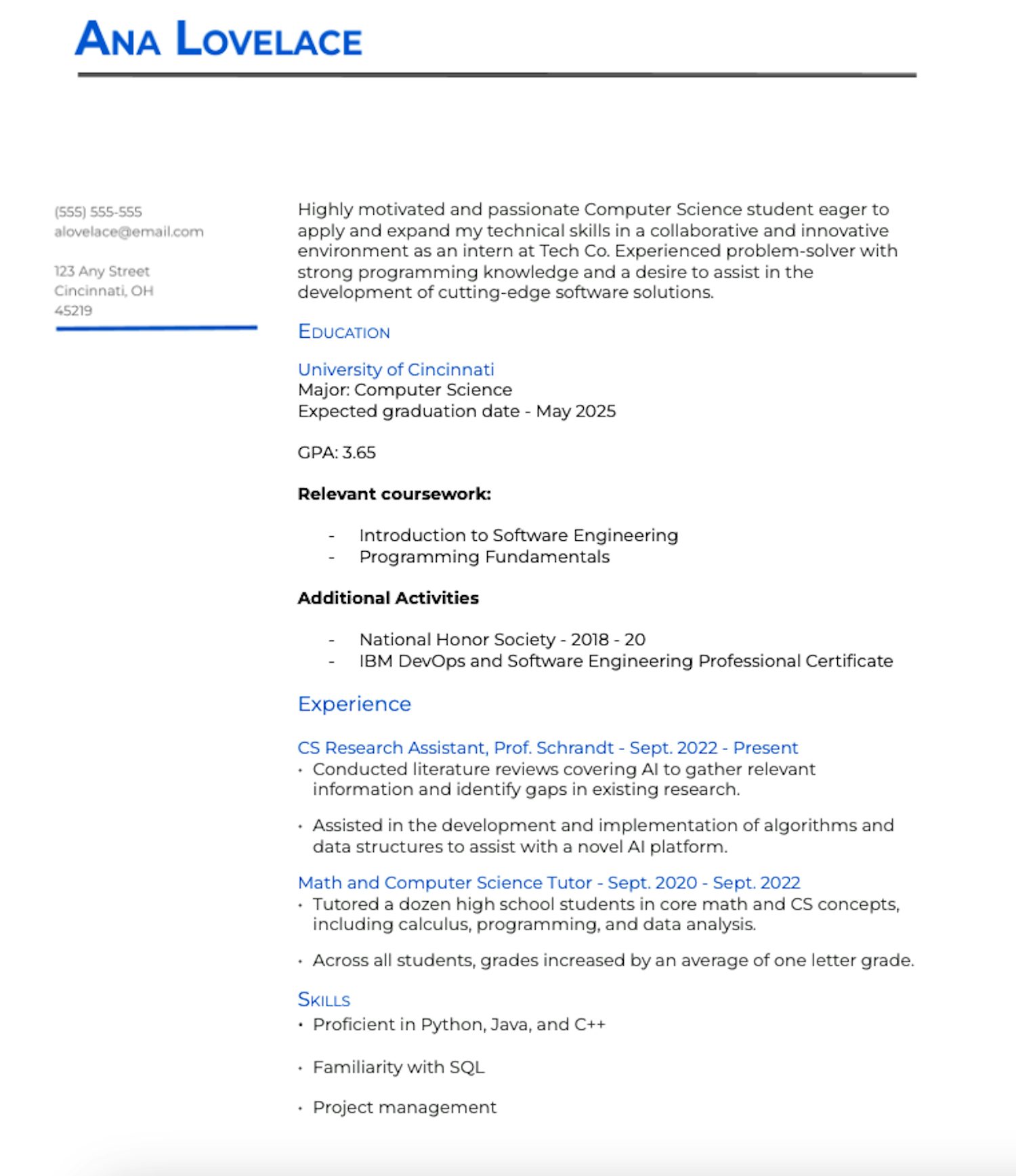
This resume is simple, professional, and clearly demonstrates the applicant's preparedness for an internship as a software engineer.
The statement of purpose at the top outlines their personal objectives, while their related coursework indicates they’ve taken classes that can prepare them for the role. Ana also had some related experience as a research assistant in college and a tutor in high school. Best of all, they demonstrated their impact as a tutor by noting that their student raised their grades by one letter.
They’re also smart about what to include. Ana highlighted their education at the top, emphasized their technical and people skills at the bottom, and even described activities relevant to the position. Ultimately, while they don’t have extensive professional experience, it’s clear that Ana has demonstrated interest in the field and has done a lot to become a professional in it.

Entry-level software engineer resume
If you’re creating a resume for an entry-level software engineer position, read the job posting to identify the experience and skills you possess that overlap with the position. Highlight these on your resume. In some cases, you may not have direct experience in the field, but you may have related experience that allows you to highlight your transferable skills.
Entry-level software engineer positions provide a great opportunity for early-career professionals or job switchers to gain experience in the field. Typically, employers don’t expect applicants for entry-level software engineer jobs to have extensive prior work experience, but they do expect applicants to have knowledge of certain programming languages, experience working with teams, and a degree in computer science or a related field.
However, don’t be afraid to apply to entry-level jobs with extensive “job requirements,” as these usually just describe the ideal applicant rather than the most realistic one. In fact, many employers are still happy to hire those without the “perfect” background.
Entry-level software engineer resume example
Why it works
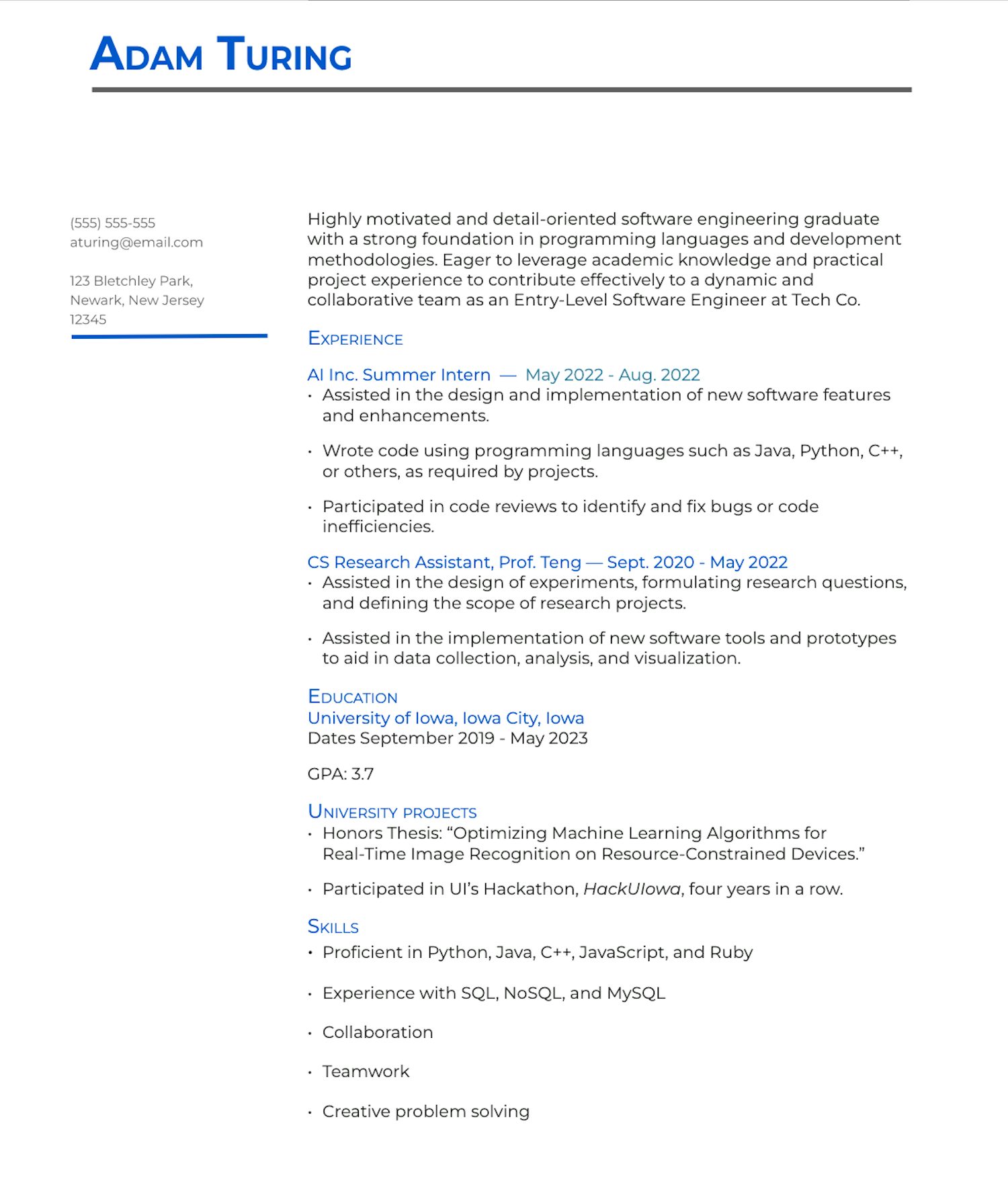
This junior software engineer resume clearly guides the employer through the applicant’s purpose for applying, relevant work experience, and qualifications for the role. Unlike the internship resume, this one places the education section lower because Adam has work experience directly related to the position they want to highlight for their potential employer.
Although the applicant doesn’t have extensive work experience, they have worked on personal projects and even participated in activities that relate to the role. Finally, they emphasize relevant skills at the bottom so that hiring managers can quickly identify what they bring to the table. All of these factors ensure that the resume plainly explains Adam’s overall preparedness for an entry-level software engineer job.
Senior software engineer resume
For a senior software engineer resume, employers typically prefer to see applications that demonstrate relevant work experience, showcase a comprehensive understanding of programming languages and software best practices, and demonstrate comfort taking on leadership roles.
Once you’ve gained some real-world experience as a software engineer, you’ll be ready to apply to senior software engineering positions. When reviewing your resume, they’ll be looking to see that you have the people skills, technical skills, and experience required to take on a position that requires additional responsibility, such as leading key projects and mentoring more junior engineers.
Senior software engineer resume example
Why it works
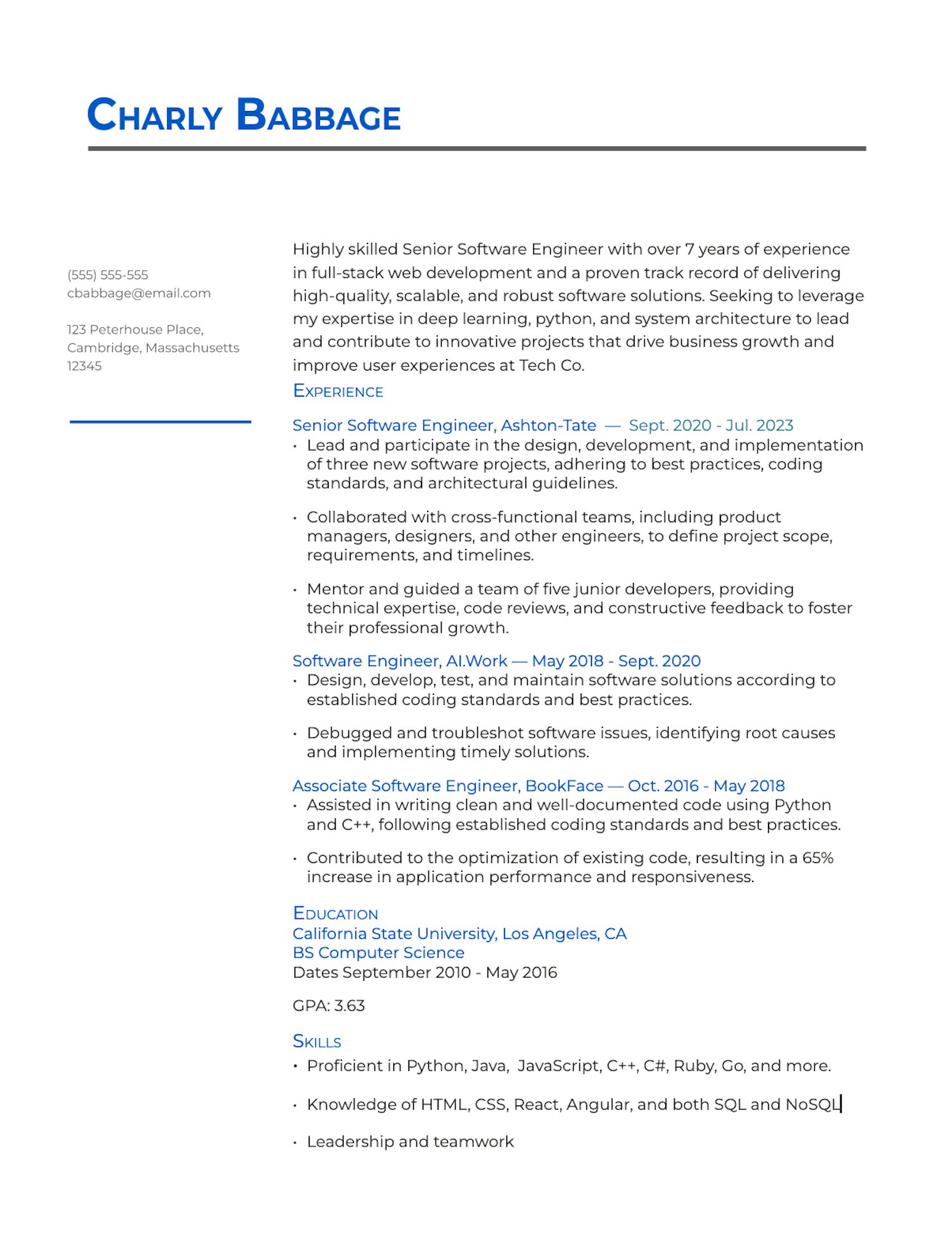
This resume for a senior software engineer position works well because it clearly explains the applicant’s work experience, qualifications, and the skills they bring to the role. Unlike the past two resumes, this one has an expanded work experience section, which Charly uses to explain the most relevant duties and responsibilities they performed at their previous positions.
Furthermore, the applicant demonstrates their impact at their previous positions by specifically stating the number of software systems they developed in their former role (three), how many junior developers they’ve mentored (five), and the positive impact they had on the organization by optimizing existing code (a 65 percent increase). All of this information further reinforces Charly’s preparedness for the position and gives the employer a sense of how the applicant could help them in the future, too.
Tips for how to write a software engineer resume
Hiring managers often only look at resumes for a few seconds. In that span of time, you must effectively highlight that you have the experience, qualifications, and software engineering skills needed to meet the job requirements. That’s a lot to do in a short amount of time, but with some careful planning and intention-setting, it’s possible.
Consider these tips to help you craft a software engineering resume that stands out from the crowd.
1. Format it properly.
Your resume should only span one to two pages and include a header with your contact information, such as your name, job title, phone number, and email address. You should also include sections to describe your work experience, educational background, and skills relevant to the position.
In some cases, you may also include a resume section to highlight any notable accomplishments or credentials, such as IBM’s Full Stack Software Developer Professional Certificate or Meta’s Back-End Developer Professional Certificate.
In your work section, list your jobs in reverse chronological order and note your job title, employer, and the length of time that you worked at each position. Describe key responsibilities using three to five bullet points below each title.
Finally, use an easy-to-read font, such as Helvetica or Times New Roman, throughout your resume and cover letter. Use size 11 to 12 font in the body of your resume and a slightly larger 14 to 16 size font for each resume section heading.
2. Tailor it to the job.
Although many of the positions you will be applying for will undoubtedly have many similarities, they’ll also have important differences that truly matter to employers. Rather than sending out one generic resume, it’s best to tailor your resume to each job.
You can read through the job posting and identify the duties that overlap with your previous work experience. Next, emphasize your experience on your resume so that hiring managers get a sense of your preparedness for the role. Finally, use the skills section of your resume to highlight any human and technical skills that you possess that are also described in the job listing, such as your leadership abilities or programming skills.
You should also consider incorporating specific keywords found in the job description throughout your cover letter, resume summary, work experience section, and skills section. This can be a good way to get your resume noticed by the applicant tracking systems (ATS) used by many recruiters.
What skills should you put in your software engineer resume skills section?
The software engineering skills that you put in the skills section of your resume will depend on the position to which you're applying. However, some workplace skills (or "soft skills") that you might consider highlighting include emotional intelligence, communication, critical thinking, collaboration, and time management. Some technical skills you might highlight include data management, familiarity with Agile methodologies, and knowledge of programming languages such as Python and C++.
3. Use action words.
Action words are verbs that describe your previous work experience in impactful terms. Rather than using run-of-the-mill verbs like led or oversaw, consider more descriptive verbs such as designed, managed, or initiated. These kinds of verbs can help hiring managers get a better sense of your impact elsewhere, so they can start to imagine the value you’ll add to your new position.
4. Highlight your transferable skills.
Whether you realize it or not, you use many different skills every day. When you’re applying for a job in a new field, you might consider highlighting the skills you honed elsewhere that could transfer over to the new role. These are called your transferable skills and can include everything from collaboration and teamwork to project management and statistical analysis.
5. Emphasize your credentials.
It’s always a good idea to highlight any relevant educational training you may have undergone that has prepared you for a job as a software engineer. This can include any degrees you hold, continuing education courses you may have completed, or relevant certifications.
Recent graduates who lack relevant work experience may also choose to highlight their education by moving their education section to the top of their resume, below their resume summary.
Read more: 10 Software Engineer Interview Questions + Example Answers
Explore our free resources for software engineers
Want to stay connected to industry insights, skill-building resources, and networking opportunities? Then subscribe to our Career Chat newsletter on LinkedIn. Afterward, explore our free resources for software engineers:
Study terms: Python Glossary: Essential Terms and Definitions
Watch on YouTube: How to Pivot Industries as a Software Engineer
Hear from a learner: Meet the Software Engineer Looking to Be a More Competitive Job Candidate
With Coursera Plus, you can learn and earn credentials at your own pace from over 350 leading companies and universities. With a monthly or annual subscription, you’ll gain access to over 10,000 programs; just check the course page to confirm your selection is included.


Keep reading
- May 30, 2026
- June 16, 2026
- May 26, 2026
- December 5, 2025
- May 30, 2026
- November 18, 2026
Coursera Staff
Editorial Team
Coursera’s editorial team is comprised of highly experienced professional editors, writers, and fact...
This content has been made available for informational purposes only. Learners are advised to conduct additional research to ensure that courses and other credentials pursued meet their personal, professional, and financial goals.