Financial Analytics Courses
Financial analytics courses can help you learn data interpretation, risk assessment, investment analysis, and financial forecasting. You can build skills in statistical modeling, data visualization, and performance measurement to make informed financial decisions. Many courses introduce tools like Excel for financial modeling, Tableau for data visualization, and Python for data analysis, showing how these skills can be applied in real-world financial contexts.
Popular Financial Analytics Courses and Certifications

Skills you'll gain: Operations Research, Probability & Statistics, Statistics, Excel Formulas, Data-Driven Decision-Making, Technical Analysis, Probability, Quantitative Research, Microsoft Excel, Sampling (Statistics), Probability Distribution, Operational Efficiency, Transportation Operations, Financial Analysis, Business Operations, Spreadsheet Software, Resource Utilization, Operations, Process Optimization, Finance
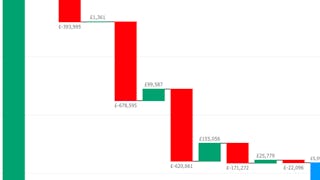
Skills you'll gain: Operational Analysis, Operational Performance Management, Performance Measurement, Performance Analysis, Performance Metric, Performance Improvement, Operating Cost, Data Import/Export, Variance Analysis, Exploratory Data Analysis, Data Analysis, Financial Analysis, Profit and Loss (P&L) Management, Corrective and Preventive Action (CAPA), Operations Management, Plot (Graphics), Waterfall Methodology
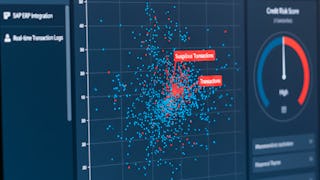
Skills you'll gain: Data-Driven Decision-Making, Financial Data, Case Studies, Analytics, Financial Services, Business Analytics, SAP Analytics Cloud, Business Intelligence, Advanced Analytics, Banking, Data Ethics, Banking Services, Financial Analysis, Big Data, Data Analysis, Risking, Trend Analysis, Fraud detection, Law, Regulation, and Compliance, Data Visualization Software

Skills you'll gain: Financial Data, Big Data, Analytics, Accounting Systems, Enterprise Resource Planning, Data Mining, Governance Risk Management and Compliance, Advanced Analytics, Governance, Data Visualization, Predictive Analytics, Statistical Visualization, Control Objectives for Information and Related Technology (COBIT), Financial Systems, Data-Driven Decision-Making, Financial Analysis, Business Systems, Information Systems, Accounting, Systems Analysis
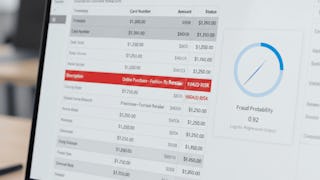
Skills you'll gain: Financial Data, Data-Driven Decision-Making, Profit and Loss (P&L) Management, Banking Services, Risk Modeling, Decision Intelligence, Lending and Underwriting, Financial Statement Analysis, Applied Machine Learning, Financial Systems, Consumer Lending, Operational Analysis, Loans, Anomaly Detection, Statistical Machine Learning, Financial Regulation, Regulatory Compliance, Benchmarking

Skills you'll gain: Risk Management Framework, Governance Risk Management and Compliance, Risk Modeling, Risk Analysis, Financial Analysis, Financial Market, Financial Trading, Cyber Governance, Risk Management, Bank Regulations, Financial Regulations, Financial Systems, Operational Risk, Analysis, Financial Data, Supplier Risk Management, Hedge Accounting, Performance Stress Testing, Governance, Capital Budgeting
What brings you to Coursera today?

Skills you'll gain: Generative AI, Financial Forecasting, Predictive Modeling, Financial Modeling, Financial Data, Market Data, Predictive Analytics, Financial Analysis, Portfolio Management, Financial Acumen, Risk Management, Investment Management, Risk Analysis, Spreadsheet Software, AI Integrations, Portfolio Risk, Financial Reporting, Analysis, Power BI, Automation

University of Illinois Urbana-Champaign
Skills you'll gain: Portfolio Management, Financial Data, Time Series Analysis and Forecasting, Performance Measurement, Financial Forecasting, Market Data, Forecasting, Analytics, Financial Trading, Financial Analysis, R Programming, Financial Market, Portfolio Risk, Trend Analysis, Investment Management, Investments, Model Evaluation, Statistical Methods, Correlation Analysis, Risk Analysis

Skills you'll gain: Analytical Skills, Analytics, Data Visualization, Scientific Visualization, Trend Analysis, Data-Driven Decision-Making, Business Analytics, Statistical Analysis, Financial Modeling, Data Storytelling, Statistical Modeling, Predictive Modeling, Python Programming, Data Wrangling

Skills you'll gain: Excel Formulas, Quantitative Research, Microsoft Excel, Financial Analysis, Spreadsheet Software, Statistical Analysis, Business Mathematics, Statistical Methods, Market Data, Financial Data, Descriptive Statistics, Data Analysis Software, Market Trend

Coursera
Skills you'll gain: Financial Modeling, Variance Analysis, Financial Statements, Revenue Forecasting, Budget Management, Financial Statement Analysis, Business Intelligence Software, Financial Forecasting, Power BI, Financial Analysis, Cash Flows, Cost Management, Spreadsheet Software, Balance Sheet, Financial Reporting, Microsoft Excel, Dashboard, Data Visualization, Key Performance Indicators (KPIs), Business Intelligence

Board Infinity
Skills you'll gain: Dashboard, Dashboard Creation, Real Time Data, Power BI, Extract, Transform, Load, Tableau Software, Financial Data, Financial Forecasting, Data Pipelines, Interactive Data Visualization, LLM Application, Microsoft Power Platform, Business Intelligence, Cloud Deployment, Business Intelligence Software, Key Performance Indicators (KPIs), Large Language Modeling, Governance, Automation, Data Integration
In summary, here are 10 of our most popular financial analytics courses
- Financial Analytics & Decision Science: EDUCBA
- Financial Analytics in RStudio: Identify Profit Drivers: Coursera
- Analyze Big Data Analytics for Financial Transformation: EDUCBA
- Master Financial Systems & Data Analytics: EDUCBA
- Analyze Financial Fraud Using Machine Learning Analytics: EDUCBA
- Apply Financial Risk, Capital & Governance Analytics: EDUCBA
- GenAI for Financial Analysts: Essential Predictive Analytics: Coursera
- Applying Data Analytics in Finance: University of Illinois Urbana-Champaign
- Analyze Financial Data with Python for Decision Making: EDUCBA
- Statistical Tools for Financial Analysis: EDUCBA










