Public economics courses can help you learn about government policies, taxation, public spending, and their impacts on economic efficiency and equity. You can build skills in cost-benefit analysis, fiscal policy evaluation, and understanding the role of public goods in the economy. Many courses introduce tools like econometric software for analyzing data and modeling economic scenarios, as well as methods for assessing the effectiveness of various public programs.

O.P. Jindal Global University
Skills you'll gain: Public Policies, Policy Development, Policy Analysis, Political Sciences, Advocacy, Environmental Policy, Behavioral Economics, Public Administration, Program Evaluation, Ethical Standards And Conduct, Governance, Systems Thinking, Economics
Build toward a degree
Beginner · Course · 1 - 3 Months

Erasmus University Rotterdam
Skills you'll gain: Consumer Behaviour, Market Dynamics, Financial Market, Economics, Market Analysis, Tax, Economics, Policy, and Social Studies, Public Policies, Environmental Issue, Socioeconomics, Sustainable Development, Supply And Demand, Behavioral Economics, Decision Making
Beginner · Course · 1 - 3 Months
Corporate Finance Institute
Skills you'll gain: Consumer Behaviour, Economics, Economic Development, Market Data, Business Economics, Financial Policy, Behavioral Economics, Market Dynamics, Financial Market, Market Trend, Decision Making
Beginner · Course · 1 - 3 Months

Indian Institute for Human Settlements
Skills you'll gain: Economics, Policy, and Social Studies, Policy Development, Public Policies, Policy Analysis, Financial Policy, Behavioral Economics, Political Sciences, Economics, Environmental Policy, Market Dynamics, Public Affairs, Governance, Program Implementation, Decision Making
Beginner · Course · 1 - 3 Months

University of Illinois Urbana-Champaign
Skills you'll gain: Supply And Demand, Economics, Market Dynamics, Business Economics, Behavioral Economics, Policy Analysis, Business Operations, Price Negotiation, Socioeconomics, Consumer Behaviour, Political Sciences, Economics, Policy, and Social Studies, Business Strategy, Public Policies, Competitive Analysis, Resource Allocation, Decision Making, Market Analysis, Cost Benefit Analysis, Environmental Issue
Beginner · Specialization · 1 - 3 Months

IE Business School
Skills you'll gain: Financial Policy, International Finance, Economics, Economic Development, Economics, Policy, and Social Studies, Business Economics, Market Opportunities, International Relations, Tax, Global Marketing, Financial Trading, Policy Analysis, Socioeconomics, Demography, Business Risk Management, Crisis Management, Fiscal Management, World History, Supply And Demand, Analysis
Intermediate · Specialization · 3 - 6 Months
O.P. Jindal Global University
Skills you'll gain: Econometrics, Surveys, Data Ethics, Environmental Laws, Sampling (Statistics), Social Sciences, Research Reports, Social Determinants Of Health, Matplotlib, Public Policies, Research Methodologies, Political Sciences, Economic Development, Policy Analysis, Diplomacy, International Relations, Economics, Climate Change Adaptation, Tax, Complex Problem Solving
Earn a degree
Degree · 1 - 4 Years
University of Illinois Urbana-Champaign
Skills you'll gain: Supply And Demand, Economics, Market Dynamics, Behavioral Economics, Resource Allocation, Socioeconomics, Consumer Behaviour, Cost Benefit Analysis, Decision Making, Critical Thinking
Beginner · Course · 1 - 4 Weeks

University of Pennsylvania
Skills you'll gain: Supply And Demand, Economics, Market Dynamics, Market Analysis, Resource Allocation, Policy Analysis, Tax, Consumer Behaviour, Cost Benefit Analysis, Decision Making
Mixed · Course · 1 - 3 Months

Rice University
Skills you'll gain: Economics, Supply And Demand, Business Economics, Market Dynamics, Economic Development, Game Theory, Financial Policy, Tax, Market Analysis, International Relations, Operating Cost, Cost Benefit Analysis, Business Metrics, Public Policies, Performance Metric, International Finance, Fiscal Management, Consumer Behaviour, Investments, Labor Relations
Beginner · Specialization · 3 - 6 Months

University of Pennsylvania
Skills you'll gain: Market Dynamics, Economics, Socioeconomics, Supply And Demand, Market Analysis, Market Share, Competitive Analysis, Public Policies, Policty Analysis, Research, and Development, Consumer Behaviour
Mixed · Course · 1 - 3 Months

University of Michigan
Skills you'll gain: Data Visualization, Exploratory Data Analysis, Plot (Graphics), Statistical Analysis, Data Presentation, Ggplot2, Program Evaluation, Policy Analysis, Surveys, Data Ethics, R (Software), Data Analysis, Tidyverse (R Package), Statistical Visualization, R Programming, Statistical Methods, Data Visualization Software, Statistical Hypothesis Testing, Case Studies, Political Sciences
Intermediate · Specialization · 3 - 6 Months
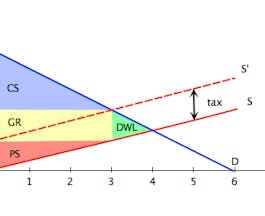
Public economics is a branch of economics that focuses on the role of the government in the economy. It examines how government policies affect economic efficiency, equity, and overall welfare. Understanding public economics is crucial because it helps policymakers design effective interventions to address market failures, redistribute income, and provide public goods. By studying public economics, individuals can gain insights into how fiscal policies, taxation, and government spending influence economic outcomes and societal well-being.
A background in public economics can lead to various career opportunities. Potential job roles include public policy analyst, economic consultant, budget analyst, and research economist. These positions often exist within government agencies, think tanks, non-profit organizations, and private sector firms. Professionals in this field analyze data, evaluate policies, and provide recommendations to improve economic outcomes. Additionally, roles in academia or teaching positions in economics can also be pursued.
To excel in public economics, several key skills are essential. Strong analytical abilities are crucial for interpreting data and evaluating economic policies. Proficiency in statistical software and econometrics is also important for conducting research and analysis. Furthermore, effective communication skills are necessary to present findings and recommendations clearly to stakeholders. Understanding economic theory and public policy frameworks will enhance your ability to navigate complex economic issues.
There are several online courses available that can help you learn about public economics. Some recommended options include the Agribusiness and Sustainable Food Production Economics Specialization and the Managerial Economics and Business Analysis Specialization. These courses cover various aspects of economics and can provide a solid foundation for understanding public economics.
Yes. You can start learning public economics on Coursera for free in two ways:
If you want to keep learning, earn a certificate in public economics, or unlock full course access after the preview or trial, you can upgrade or apply for financial aid.
To learn public economics effectively, start by exploring foundational courses that cover basic economic principles. Engage with online resources, such as lectures and articles, to deepen your understanding. Participating in discussions or study groups can also enhance your learning experience. Additionally, applying theoretical knowledge to real-world scenarios through case studies or projects can solidify your grasp of public economics.
Public economics courses typically cover a range of topics, including government intervention in markets, taxation, public goods, externalities, and income distribution. Students may also explore the impact of fiscal policies on economic performance and social welfare. Understanding these concepts is essential for analyzing how government actions influence economic behavior and outcomes.
For training and upskilling employees in public economics, courses like the Data Analytics in the Public Sector with R Specialization can be particularly beneficial. These courses provide practical skills that can be applied in various public sector roles, enhancing employees' ability to analyze data and inform policy decisions effectively.