When you enroll in this course, you'll also be enrolled in this Specialization.
Learn new concepts from industry experts
Gain a foundational understanding of a subject or tool
Develop job-relevant skills with hands-on projects
Earn a shareable career certificate
There are 3 modules in this course
Anti-Racism I is an introduction to the topic of race and racism in the United States. The primary audience for this course is anyone who is interested in learning about race/racism in the US who has never taken a course in critical race or ethnic studies or affiliated fields (indeed, who may not know what the fields of critical race studies or ethnic studies are), who has never read a book about race/racism, or attended any race equity or diversity trainings on the topic of race/racism.
In this course you will learn how to:
- Use and comprehend contemporary intersectional terminology through a provided glossary
- Critically discuss “whiteness”
- Recognize the concept of White privilege that all White people have whether they want that privilege or not and to differentiate between White supremacy as a systemic concept vs. White supremacists (who are professional racists like the KKK).
- Distinguish between being not racist and being anti-racist
- Define systemic and institutional racism
- Accept the unequal history of race and racism in the United States that has created racial hierarchies that has disenfranchised Black Americans
- Share with others the true foundations of United States’s histories beginning with the acknowledgement of settler colonialism and the rewards that White people have received due to White supremacy and Black oppression.
- Talk about race and racism
- Explain why phrases like “All Lives Matter” and “Blue Lives Matter” are racist
- Recognize that anyone can be anti-racist--it only takes the dedication and decision to be anti-racist, to educate yourself about the history of racism in the US and then to talk in an anti-racist way and to act as an anti-racist
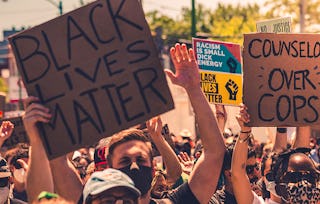
Course logo image credit: Liam Edwards, 06/04/2021. Available on Unsplash at https://unsplash.com/photos/x15GAQNepcQ
This week you will learn various ways of defining race through definitions of whiteness. While race and racism have, in popular discourse, been understood to refer to non-white people, we start with whiteness since whiteness has been the primary ideology that dominated the formation of the United States, its laws, power structure, society, and culture. The anti-racism glossary also provides a variety of definitions related to race, racism, and anti-racism.
What's included
3 videos8 readings1 assignment1 discussion prompt
Show info about module content
3 videos•Total 27 minutes
Anti-Racism I Version 2 Introduction (May 2021)•6 minutes
Course Introduction: Talking about Race•18 minutes
Week 1 Introduction•3 minutes
8 readings•Total 116 minutes
Course Updates and Accessibility Support•1 minute
Anti-Racism Glossary•20 minutes
White Fragility (DiAngelo)•10 minutes
There is No Neutral (Shapiro)•8 minutes
Who Taught You to Be White? (Unter)•32 minutes
White Privilege (McIntosh)•15 minutes
White Privilege (Coates)•15 minutes
The Language of White Supremacy (Newkirk)•15 minutes
1 assignment•Total 30 minutes
Anti-Racism Glossary Terms•30 minutes
1 discussion prompt•Total 10 minutes
What is Your Race?•10 minutes
Week 2: Identifying
Module 2•5 hours to complete
Module details
Now that you've learned to define whiteness and other terms related to race, racism, and anti-racism, this week focuses on identifying the impact of race, racism, and anti-racism. The first article contextualizes our current moment of racial crisis, along with identifying differences between being not-racist and anti-racist. The remaining readings and viewings provide historical context for systemic racism, especially anti-Black racism in the US.
What's included
1 video8 readings1 discussion prompt
Show info about module content
1 video•Total 2 minutes
Week 2 Introduction•2 minutes
8 readings•Total 300 minutes
Why Now, White People?•28 minutes
The Difference between being "Not Racist" and "Antiracist" (Kendi)•51 minutes
Straight Talk about the N-word (Lester)•15 minutes
The Disturbing History of the Suburbs•6 minutes
The Untold Story of Emmett Luis Till•78 minutes
The Montgomery Bus Boycott•7 minutes
13th / Just Mercy (Duvernay; Cretton)•105 minutes
Harvard Racial Bias Test•10 minutes
1 discussion prompt•Total 10 minutes
Racial Bias Test•10 minutes
Week 3: Applying
Module 3•7 hours to complete
Module details
For this final week of the anti-racism course you will see how the application of these terms and concepts are tied to other overlapping oppressions and how they can be used for specific anti-racism work, such as defunding the police (and why this is not as radical as people may think it is, though in many ways to imagine an anti-racist world is a radical act) and specific actions that each of us can do to be anti-racism allies and educators.
CU Boulder is a dynamic community of scholars and learners on one of the most spectacular college campuses in the country. As one of 34 U.S. public institutions in the prestigious Association of American Universities (AAU), we have a proud tradition of academic excellence, with five Nobel laureates and more than 50 members of prestigious academic academies.
"To be able to take courses at my own pace and rhythm has been an amazing experience. I can learn whenever it fits my schedule and mood."
Jennifer J.
Learner since 2020
"I directly applied the concepts and skills I learned from my courses to an exciting new project at work."
Larry W.
Learner since 2021
"When I need courses on topics that my university doesn't offer, Coursera is one of the best places to go."
Chaitanya A.
"Learning isn't just about being better at your job: it's so much more than that. Coursera allows me to learn without limits."

Learner reviews
4.6
296 reviews
5 stars
81.08%
4 stars
11.14%
3 stars
2.36%
2 stars
1.01%
1 star
4.39%
Showing 3 of 296
A
AG
5·
Reviewed on Dec 4, 2022
I found the material in this course to be well curated, engaging, highly influential, and pertinent in informing the future of my work and personal life.
I
IW
5·
Reviewed on Oct 14, 2021
Excellent course! Insightful and lots of heavy topics to absorb and build a new understanding
R
RR
5·
Reviewed on Nov 9, 2025
Very informative, engaging and reflective. Great start, looking forward to the next two.
When will I have access to the lectures and assignments?
To access the course materials, assignments and to earn a Certificate, you will need to purchase the Certificate experience when you enroll in a course. You can try a Free Trial instead, or apply for Financial Aid. The course may offer 'Full Course, No Certificate' instead. This option lets you see all course materials, submit required assessments, and get a final grade. This also means that you will not be able to purchase a Certificate experience.
What will I get if I subscribe to this Specialization?
When you enroll in the course, you get access to all of the courses in the Specialization, and you earn a certificate when you complete the work. Your electronic Certificate will be added to your Accomplishments page - from there, you can print your Certificate or add it to your LinkedIn profile.
Is financial aid available?
Yes. In select learning programs, you can apply for financial aid or a scholarship if you can’t afford the enrollment fee. If fin aid or scholarship is available for your learning program selection, you’ll find a link to apply on the description page.