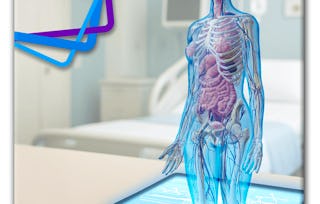
Visualization is a rapidly progressive specialty in academia, research and industry, and becoming the future of science. With the advancement of digital technologies and their applications, biomedical visualization is an evolving and popular field. With new techniques and technologies to image, process and analyze data related to the human body, and its biological processes, it is at the forefront of the digital revolution. Why not view our course trailer video.
By the end of this course, you will be able to:
1. Create accurate, ethical biomedical visuals using modern digital tools and evidence based design.
2. Use advanced 3D modeling and imaging skills to build clear, anatomically accurate visuals for education and practice.
3. Evaluate and apply accessibility, inclusivity, and communication principles to design biomedical media for diverse users.
4. Develop a professional portfolio showing technical skill, reflective practice, and adherence to biomedical visualization standards.
This course is the first of its kind on Coursera. It explores the structure and function of the human body including terminology used. It showcases visualization techniques available using technology to image and display data related to the body and biological processes. It also provides training in the creation of animations, and examines the applicability of different types of reality.
You will learn from experts in these fields and with the knowledge you will gain from this course, be able to evaluate and apply how best to use visualization in your own discipline.
No prior experience is necessary but should be able to learn at an intermediate level.
Module 1 will cover introductory material of visualization and its applications, as well as exploring the basis of human anatomy. You will learn about a historical journey of "visualization" to the present day advances and uses with biomedical science. Exploring the human body, you will learn its structure and function; the body systems and their roles; as well as learning frequently used terminology within anatomy. Examples of visualization techniques will be covered, and as a learner you will be able to name examples as and evaluate their advantages and disadvantages.
What's included
5 videos10 readings3 assignments
Show info about module content
5 videos•Total 19 minutes
Introduction to Biomedical Visualization and Human Anatomy•0 minutes
Organisational Levels of the Human Body•5 minutes
Anatomical Planes, Positions and Directional Terms•6 minutes
Types of Muscle Movements in Human Anatomy•5 minutes
Musculoskeletal Visualisation Applications in Sport Science with Prof. Niall MacFarlane•3 minutes
10 readings•Total 180 minutes
Meet the Course Educators•20 minutes
Reflect and Discuss: Visualization in Practice•15 minutes
What Do We Mean by Visualization?•20 minutes
Terminology Tables•20 minutes
Body Systems•20 minutes
The Musculoskeletal System•20 minutes
Reflect and Discuss: Musculoskeletal Case Studies•15 minutes
Introduction to Applications in Biomedical Visualization•15 minutes
Gross Visualization•15 minutes
Microscopic Visualization•20 minutes
3 assignments•Total 60 minutes
Structure and Terminology Formative Assessment •15 minutes
The Body Systems Formative Assessment •15 minutes
End of Week 1 Graded Assessment•30 minutes
3D Models and Animation
Module 2•4 hours to complete
Module details
Module 2 will give you an introductory lesson into 3D modeling software "Blender" and modeling terminology. By completion you will be able to create your own organic 3D models and animations using Blender. You will be briefly introduced to modeling and its vast variety of uses within Biomedical Science. The theory and process of segmentation from patient imaging data will be explored as another option to obtain realistic 3D models.
Discussion of Modeling Workflows in Blender•15 minutes
Virtual Reality and Augmented Reality
Module 3•4 hours to complete
Module details
Module 3 will introduce virtual (VR) and augmented reality (AR). The history and background of virtual reality will be explored, and how augmented reality rose in popularity within this field as well. This week will allow you as a learner to hear interviews with VR and AR experts. They will discuss their research, theory and some of the applications of this technology in biomedical science. The wide variety of applications will be taught, and why it has become such a popular tool in research, teaching and in other areas.
What's included
5 videos9 readings3 assignments1 plugin
Show info about module content
5 videos•Total 19 minutes
Introduction to Virtual Reality and Augmented Reality in Biomedical Science•1 minute
Virtual Reality in Immersive Education: Project Mobius with Dr Neil McDonnell•4 minutes
Transforming Confocal Microscopy Data into Virtual Reality with Dr Craig Daly•8 minutes
The Future of Augmented Reality in Healthcare with Dr Neil McDonnell•3 minutes
Immersive Learning Technologies: Virtual and Augmented Reality in Education with Dr Matthieu Poyade•4 minutes
9 readings•Total 106 minutes
Definitions: The Realities and Background•15 minutes
Applications of Virtual Reality•10 minutes
Next: Key Note Lecture by Professor Paul Chapman - Introduction•1 minute
Not all Medical: Other Unconventional Applications•10 minutes
Applications of VR and AR•15 minutes
Reflect and Discuss: The Future of Digital Realities•20 minutes
The Downside of VR•10 minutes
The Rise of Augmented Reality•15 minutes
The Power of Immersion•10 minutes
3 assignments•Total 60 minutes
Formative Assessment: VR Terms and Background •15 minutes
Formative Assessment: Applications of Virtual Reality •15 minutes
Summative Assessment •30 minutes
1 plugin•Total 60 minutes
Keynote Lecture by Professor Paul Chapman•60 minutes
Extended Reality: The Realities and The Future
Module 4•5 hours to complete
Module details
Module 4 is the concluding module for Biomedical Visualization. New theory that will be introduced are Mixed and 'Extended reality' as a whole, and what could potentially come of the realities in the future. This week is for the learner to reflect on what they have learned throughout this course. When to best use visualization techniques; their advantages and disadvantages; and how you could use what you have learned throughout the course for future projects in your area of interest.
The University of Glasgow has been changing the world since 1451. It is a world top 100 university (THE, QS) with one of the largest research bases in the UK.
We are a member of the prestigious Russell Group of leading UK Universities with annual research income of more than £179m.
The University’s #TeamUofG community is truly international with over 8000 staff and 28,0000 students from more than 140 countries.
A 2019 Time Out survey placed Glasgow in the top ten cities in the world. Ranked between Berlin and Paris, Glasgow was voted number one for both friendliness and affordability.
Right now our dedicated community of staff, students and alumni is working to address the challenges of Covid-19 and understand how we can make life safer for everyone.
"To be able to take courses at my own pace and rhythm has been an amazing experience. I can learn whenever it fits my schedule and mood."
Jennifer J.
Learner since 2020
"I directly applied the concepts and skills I learned from my courses to an exciting new project at work."
Larry W.
Learner since 2021
"When I need courses on topics that my university doesn't offer, Coursera is one of the best places to go."
Chaitanya A.
"Learning isn't just about being better at your job: it's so much more than that. Coursera allows me to learn without limits."
Learner reviews
4.6
533 reviews
5 stars
69.23%
4 stars
24.20%
3 stars
4.31%
2 stars
1.50%
1 star
0.75%
Showing 3 of 533
A
AD
5·
Reviewed on Aug 29, 2024
Great work by the entire team. Solid content with easy-to-understand lectures and engaging practical work.
D
DY
5·
Reviewed on Jul 3, 2020
seriously,i liked this course very much..i was very interested in digital world ..so i easily understood this course towards my interest on this subject.Thanku
S
SM
4·
Reviewed on May 28, 2020
It is very useful for me . It helps me to understand the Future technology thank you University of Glasgow . Thank u so much.i am happy for your work of teaching
When will I have access to the lectures and assignments?
To access the course materials, assignments and to earn a Certificate, you will need to purchase the Certificate experience when you enroll in a course. You can try a Free Trial instead, or apply for Financial Aid. The course may offer 'Full Course, No Certificate' instead. This option lets you see all course materials, submit required assessments, and get a final grade. This also means that you will not be able to purchase a Certificate experience.
What will I get if I purchase the Certificate?
When you purchase a Certificate you get access to all course materials, including graded assignments. Upon completing the course, your electronic Certificate will be added to your Accomplishments page - from there, you can print your Certificate or add it to your LinkedIn profile.
Is financial aid available?
Yes. In select learning programs, you can apply for financial aid or a scholarship if you can’t afford the enrollment fee. If fin aid or scholarship is available for your learning program selection, you’ll find a link to apply on the description page.