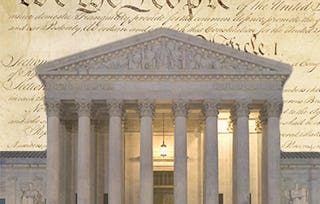
This course offers an introduction to the U.S. Constitution and landmark Supreme Court cases interpreting it. It explores the Constitution’s origins, its amendment over the years, and methods of constitutional interpretation. Topics include the nature and structure of the federal government, the powers of the federal government, and individual rights.
Classes 1, 2, and 3 discuss why we need a Constitution and the history that preceded its drafting. You will learn about the two conflicting lessons the founders learned from the Revolution and the failure of the Articles of Confederation: the national government can become a tyrant if it is too strong, but the nation will fall apart if it is too weak. These lectures explore how the drafters sought to balance these concerns in the original Constitution and the many compromises it contains. You will also learn about two approaches to interpreting the Constitution: Originalism and Living Constitutionalism. Classes 4, 5, and 6 explore the powers of the legislative, executive, and judicial branches of government and the separation of powers between those branches. The Framers gave the federal government limited powers, and divided those powers among the three branches in order to protect individual liberty and state authority.
What's included
6 videos1 assignment
Show info about module content
6 videos•Total 67 minutes
Class 1: Why We Needed a Constitution•13 minutes
Class 2: Creating the Constitution•11 minutes
Class 3: Interpreting the Constitution•11 minutes
Class 4: Article I: Legislative Branch•12 minutes
Class 5: Article II: Executive Branch•11 minutes
Class 6: Article III: Judicial Branch•9 minutes
1 assignment•Total 30 minutes
Quiz on the Constitution and three branches of government•30 minutes
Amendments and the First Amendment
Module 2•1 hour to complete
Module details
This segment first explores constitutional amendments, including the Bill of Rights, and the Reconstruction and Progressive-era Amendments. Then, we will take a detailed look at one of the most important amendments: the First. We will learn about the constitutional protections for speech and religion, how they have changed over time, and how they apply to various circumstances. Finally, we will learn about the Establishment Clause and what it means in today's society.
What's included
6 videos1 assignment
Show info about module content
6 videos•Total 58 minutes
Class 7: The Bill of Rights•9 minutes
Class 8: The Reconstruction Amendments•10 minutes
Class 9: The Progressive Amendments•9 minutes
Class 10: Freedom of Speech•11 minutes
Class 11: Free Exercise of Religion Clause•9 minutes
Class 12: Establishment Clause•10 minutes
1 assignment•Total 30 minutes
Quiz on the amendments and First Amendment•30 minutes
Criminal Procedure and Federalism and Nationalism
Module 3•1 hour to complete
Module details
We begin here by looking at another group of very important constitutional provisions: the Fourth, Fifth, and Sixth Amendments, which guarantee rights to individuals accused of committing crimes. These amendments protect us against unreasonable searches, ensure our right to remain silent in the face of police questioning, and allow us to demand the assistance of counsel and trial by jury. These rights are fundamental to our system of criminal justice.
Then we will shift our focus to examining the Second Amendment, the right to bear arms, and incorporation. We will also discuss the Ninth and Tenth Amendments, unenumerated rights, and states' rights, and finish by considering the implications of the Civil War and Reconstruction for the balance of power between the federal government and the states.
What's included
6 videos1 assignment
Show info about module content
6 videos•Total 60 minutes
Class 13: The Fourth Amendment•8 minutes
Class 14: The Fifth Amendment - The Right to Remain Silent•9 minutes
Class 15: The Sixth Amendment - The Right to Counsel/Trial by Jury•10 minutes
Class 16: The Second Amendment•11 minutes
Class 17: The Ninth and Tenth Amendments•10 minutes
Class 18: The Civil War and Reconstruction•11 minutes
1 assignment•Total 30 minutes
Quiz on criminal procedure and federalism and nationalism•30 minutes
The Fourteenth Amendment and Modern Controversies
Module 4•2 hours to complete
Module details
The first three lessons consider the equal protection and due process clauses of the 14th Amendment. We will begin by discussing race discrimination and the anti-classification and anti-subordination perspectives on equal protection. Next, we will discuss sex discrimination and the right to an abortion derived from the due process clause. Finally, we will examine discrimination based on sexual orientation, and the social progression of major civil rights movements in the United States. The final three lessons in this module consider some modern constitutional controversies. First, we will learn about presidential war powers. Next, we will analyze free speech in the context of campaign finance reform. Finally, we will discuss federal legislative power with a focus on health care reform.
What's included
6 videos1 assignment
Show info about module content
6 videos•Total 71 minutes
Class 19: Equal Protection/What is Discrimination?•11 minutes
Class 20: Women’s Equality and Abortion•11 minutes
Class 21: Sexual Orientation•11 minutes
Class 22: War Powers•16 minutes
Class 23: Campaign Finance•10 minutes
Class 24: Health Care Reform•13 minutes
1 assignment•Total 30 minutes
Quiz on the Fourteenth Amendment and modern controversies•30 minutes
Instructor
Instructor ratings
Instructor ratings
We asked all learners to give feedback on our instructors based on the quality of their teaching style.
The University of Pennsylvania (commonly referred to as Penn) is a private university, located in Philadelphia, Pennsylvania, United States. A member of the Ivy League, Penn is the fourth-oldest institution of higher education in the United States, and considers itself to be the first university in the United States with both undergraduate and graduate studies.
"To be able to take courses at my own pace and rhythm has been an amazing experience. I can learn whenever it fits my schedule and mood."
Jennifer J.
Learner since 2020
"I directly applied the concepts and skills I learned from my courses to an exciting new project at work."
Larry W.
Learner since 2021
"When I need courses on topics that my university doesn't offer, Coursera is one of the best places to go."
Chaitanya A.
"Learning isn't just about being better at your job: it's so much more than that. Coursera allows me to learn without limits."
Learner reviews
4.8
1,329 reviews
5 stars
87.35%
4 stars
10.98%
3 stars
1.05%
2 stars
0.22%
1 star
0.37%
Showing 3 of 1329
S
SJ
5·
Reviewed on Jul 21, 2017
Professor does a great job and in explaining the complexities. He does not take any partisan stand and does a great job and giving prominence to all sides of the argument. Enjoyed the course throughly
I
IP
5·
Reviewed on Jan 17, 2021
An interesting survey of US constitutional law (I'm Canadian), providing a useful analytical approach and showing great insight. I thoroughly enjoyed it. Very well done by Prof. Roosevelt
M
MR
4·
Reviewed on Jul 10, 2018
The videos can seem kind of awkward, so I followed along with the transcript at the bottom. Overall, very helpful! I used this course to prepare for a Constitutional Law class that I begin this fall!
When will I have access to the lectures and assignments?
To access the course materials, assignments and to earn a Certificate, you will need to purchase the Certificate experience when you enroll in a course. You can try a Free Trial instead, or apply for Financial Aid. The course may offer 'Full Course, No Certificate' instead. This option lets you see all course materials, submit required assessments, and get a final grade. This also means that you will not be able to purchase a Certificate experience.
What will I get if I purchase the Certificate?
When you purchase a Certificate you get access to all course materials, including graded assignments. Upon completing the course, your electronic Certificate will be added to your Accomplishments page - from there, you can print your Certificate or add it to your LinkedIn profile.
Is financial aid available?
Yes. In select learning programs, you can apply for financial aid or a scholarship if you can’t afford the enrollment fee. If fin aid or scholarship is available for your learning program selection, you’ll find a link to apply on the description page.