When you enroll in this course, you'll also be enrolled in this Specialization.
Learn new concepts from industry experts
Gain a foundational understanding of a subject or tool
Develop job-relevant skills with hands-on projects
Earn a shareable career certificate
There are 4 modules in this course
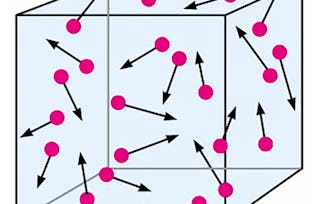
Course 4 of Statistical Thermodynamics addresses dense gases, liquids, and solids. As the density of a gas is increased, intermolecular forces begin to affect behavior. For small departures from ideal gas behavior, known as the dense gas limit, one can estimate the change in properties using the concept of a configuration integral, a modification to the partition function. This leads to the development of equations of state that are expansions in density from the ideal gas limit. Inter molecular potential energy functions are introduced and it is explored how they impact P-V-T behavior. As the density is increased, there is a transition to the liquid state. We explore whether this transition is smooth or abrupt by examining the stability of a thermodynamic system to small perturbations. We then present a brief discussion regarding the determination of the thermodynamic properties of liquids using concept of the radial distribution function (RDF), and how the function relates to thermodynamic properties. Finally, we explore two simple models of crystalline solids.
As the density of a gas is increased, intermolecular forces begin to affect behavior. For small departures from ideal gas behavior, known as the dense gas limit, one can estimate the change in properties using the concept of a configuration integral, a modification to the partition function. This leads to the development of equations of state that are expansions in density from the ideal gas limit. Inter molecular potential energy functions are introduced and it is explored how they impact P-V-T behavior.
What's included
4 videos5 readings2 discussion prompts
Show info about module content
4 videos•Total 24 minutes
Dense Gases: The Configuration Integral and The Fundamental Relation•9 minutes
Property Relations including the Virial Equation of State•4 minutes
Potential Energy Functions•6 minutes
Empirical Equations of States•5 minutes
5 readings•Total 41 minutes
Course Updates and Accessibility Support•1 minute
Dense Gases The Configuration Integral and The Fundamental Relation•10 minutes
Property Relations including the Virial Equation of State•10 minutes
Potential Energy Functions•10 minutes
Empirical Equations of State•10 minutes
2 discussion prompts•Total 30 minutes
Problem 8.2•15 minutes
Problem 8.3•15 minutes
Thermodynamic Stability
Module 2•2 hours to complete
Module details
As the density is increased, there is a transition to the liquid state. We explore whether this transition is smooth or abrupt by examining the stability of a thermodynamic system to small perturbations. We also explore Gibb's phase rule.
What's included
3 videos3 readings1 assignment1 discussion prompt
Show info about module content
3 videos•Total 16 minutes
The Basics of Thermodynamic Stability•6 minutes
First Order Phase Transitions and Finding the Vapor Dome•6 minutes
Gibb's Phase Rule•4 minutes
3 readings•Total 30 minutes
The Basics of Thermodynamic Stability•10 minutes
First Order Phase Transitions and Finding the Vapor Dome•10 minutes
Gibb's Phase Rule•10 minutes
1 assignment•Total 20 minutes
Problem 11.1•20 minutes
1 discussion prompt•Total 25 minutes
Problem 11.2•25 minutes
The radial distribution function, thermodynamic properties, and MD simulations of liquid properties
Module 3•1 hour to complete
Module details
In this Module we present a brief discussion regarding the determination of the thermodynamic properties of liquids using the concept of the radial distribution function (RDF), and how the function relates to thermodynamic properties. This includes introducing the use of molecular dynamics to obtain the radial distribution function.
What's included
3 videos3 readings1 discussion prompt
Show info about module content
3 videos•Total 20 minutes
Liquids: Cells, The Radial Distribution Function and Thermodynamic Properties•7 minutes
Molecular Dynamics•7 minutes
Determining g(r) from Molecular Dynamics•5 minutes
3 readings•Total 30 minutes
Liquids: Cells, The Radial Distribution Function and Thermodynamic Properties•10 minutes
Molecular Dynamics•10 minutes
Determining g(r) from Molecular Dynamics•10 minutes
1 discussion prompt•Total 10 minutes
Problem 9.1•10 minutes
Crystalline Solids
Module 4•1 hour to complete
Module details
It turns out that we can use the results of simple statistical thermodynamics to describe the behavior of crystalline solids.
What's included
2 videos2 readings3 assignments
Show info about module content
2 videos•Total 14 minutes
Solids: The Einstein Crystal•7 minutes
The Debye Crystal•7 minutes
2 readings•Total 20 minutes
Solids and the Einstein Crystal•10 minutes
The Debye Crystal•10 minutes
3 assignments•Total 40 minutes
Problem 10.2•10 minutes
Problem 10.1•15 minutes
Problem 10.4•15 minutes
Earn a career certificate
Add this credential to your LinkedIn profile, resume, or CV. Share it on social media and in your performance review.
CU Boulder is a dynamic community of scholars and learners on one of the most spectacular college campuses in the country. As one of 34 U.S. public institutions in the prestigious Association of American Universities (AAU), we have a proud tradition of academic excellence, with five Nobel laureates and more than 50 members of prestigious academic academies.
When will I have access to the lectures and assignments?
To access the course materials, assignments and to earn a Certificate, you will need to purchase the Certificate experience when you enroll in a course. You can try a Free Trial instead, or apply for Financial Aid. The course may offer 'Full Course, No Certificate' instead. This option lets you see all course materials, submit required assessments, and get a final grade. This also means that you will not be able to purchase a Certificate experience.
What will I get if I subscribe to this Specialization?
When you enroll in the course, you get access to all of the courses in the Specialization, and you earn a certificate when you complete the work. Your electronic Certificate will be added to your Accomplishments page - from there, you can print your Certificate or add it to your LinkedIn profile.
Is financial aid available?
Yes. In select learning programs, you can apply for financial aid or a scholarship if you can’t afford the enrollment fee. If fin aid or scholarship is available for your learning program selection, you’ll find a link to apply on the description page.