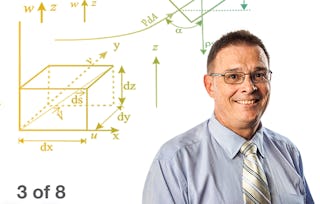
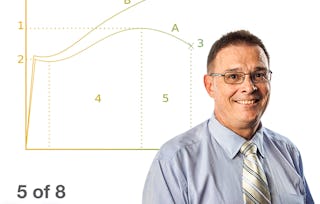
This course is an introduction to learning and applying the principles required to solve engineering mechanics problems. Concepts will be applied in this course from previous courses you have taken in basic math and physics. The course addresses the modeling and analysis of static equilibrium problems with an emphasis on real world engineering applications and problem solving.
The copyright of all content and materials in this course are owned by either the Georgia Tech Research Corporation or Dr. Wayne Whiteman. By participating in the course or using the content or materials, whether in whole or in part, you agree that you may download and use any content and/or material in this course for your own personal, non-commercial use only in a manner consistent with a student of any academic course. Any other use of the content and materials, including use by other academic universities or entities, is prohibited without express written permission of the Georgia Tech Research Corporation. Interested parties may contact Dr. Wayne Whiteman directly for information regarding the procedure to obtain a non-exclusive license.
In this section, students will learn the definition of a force and how to represent a force as a vector in two (2D) and three (3D) dimensions. Students will learn the concept of particle equilibrium and equilibrium of systems of particles. Concepts will be reinforced with example problems.
What's included
7 videos14 readings1 assignment
Show info about module content
7 videos•Total 52 minutes
Module 1: Course Introduction•7 minutes
Module 2: Definition of a Force•4 minutes
Module 3: Force Representation in 2D and Resultants•9 minutes
Module 4: Force Representation in 3D•9 minutes
Module 5: Particle Equilibrium•5 minutes
Module 6: Systems of Particles Equilibrium•11 minutes
Module 7: Solve a Particle Equilibrium Problem•7 minutes
14 readings•Total 140 minutes
Syllabus•10 minutes
PDF version of Solve a Particle Equilibrium Problem Powerpoint•10 minutes
PDF version of Course Introduction Powerpoint•10 minutes
PDF version of Definition of a Force Powerpoint•10 minutes
Consent Form•10 minutes
PDF version of Force Representation in 2D and Resultants Powepoints•10 minutes
Module Materials: Force Representations in 2D and Resultants•10 minutes
PDF version of Force Representation in 3D Powerpoint•10 minutes
Module Materials: Force Representation in 3D•10 minutes
Practice Problems•10 minutes
Get More from Georgia Tech•10 minutes
PDF version of Particle Equilibrium Powerpoint•10 minutes
PDF version of Systems of Particles Equilibrium Powerpoint•10 minutes
Solution to Quiz•10 minutes
1 assignment•Total 6 minutes
Forces and Particle Equilibrium•6 minutes
Define and Calculate Moments
Module 2•3 hours to complete
Module details
In this section, students will learn the definition of a moment. Students will calculate the moment of a force about a point, line or axis, and moment due to a couple.
What's included
5 videos10 readings1 assignment
Show info about module content
5 videos•Total 41 minutes
Module 8: Definition of a Moment•9 minutes
Module 9: Solve a 2D Moment Problem•10 minutes
Module 10: Solve a 3D Moment Problem•5 minutes
Module 11: Moment About a Line/Axis•9 minutes
Module 12: Moment Due to a Couple•9 minutes
10 readings•Total 100 minutes
PDF version of Definition of a Moment Powerpoint•10 minutes
PDF version of Solve a 2D Moment Problem Powerpoint•10 minutes
PDF version of Solve a 3D Moment Problem Powerpoint•10 minutes
Module Materials: Solve a 3D Moment Problem•10 minutes
PDF version of Moment About a Line/Axis Powerpoint•10 minutes
PDF version of Moment Due to a Couple Powerpoint•10 minutes
Module Materials: Moment Due to a Couple•10 minutes
Practice Problems•10 minutes
Earn a Georgia Tech Badge/Certificate/CEUs•10 minutes
Solution to Quiz 2•10 minutes
1 assignment•Total 30 minutes
Define and Calculate Moments•30 minutes
Equilibrium and Equivalence of Force Systems
Module 3•3 hours to complete
Module details
In this section, students will learn the equilibrium equations in two (2D) and three (3D) dimensions. Students will solve equivalent system problems. System force results will be defined and calculated.
What's included
6 videos8 readings1 assignment
Show info about module content
6 videos•Total 46 minutes
Module 13: 2D and 3D Equilibrium Equations•5 minutes
Module 14: Conditions for Equivalent Equations•9 minutes
Module 15: Solve an Equivalent Systems Problem•11 minutes
Module 16: Single Force Resultants-Coplanar System•5 minutes
Module 17: Single Force Resultants-Parallel Force Systems•7 minutes
Module 18: Distributed Force Systems•9 minutes
8 readings•Total 80 minutes
PDF version of 2D and 3D Equilibrium Equations Powerpoint•10 minutes
PDF version of Conditions for Equivalent Equations Powerpoint•10 minutes
PDF version of Solve an Equivalent Systems Problem Powerpoint•10 minutes
PDF version of Single Force Resultants-Coplanar System Powerpoint•10 minutes
PDF version of Single Force Resultants-Parallel Force Systems Powerpoint•10 minutes
PDF version of Distributed Force Systems Powerpoint•10 minutes
Practice Problems•10 minutes
Solution to Quiz 3•10 minutes
1 assignment•Total 30 minutes
Equilibrium and Equivalence of Force Systems•30 minutes
Free Body Diagrams and Equilibrium Analysis Techniques
Module 4•3 hours to complete
Module details
In this section, students will learn to analyze general equilibrium problems. Free Body Diagrams (FBD) will be defined. Concepts will be reinforced with example problems.
What's included
6 videos9 readings1 assignment
Show info about module content
6 videos•Total 47 minutes
Module 19: Centroids•5 minutes
Module 20: Method of Composite Parts I•11 minutes
Module 21: Method of Composite Parts II•9 minutes
Module 22: Resultant Force on Surfaces•5 minutes
Module 23: Free Body Diagrams I•8 minutes
Module 24: Free Body Diagrams II•9 minutes
9 readings•Total 90 minutes
PDF version of Centroids Powerpoint•10 minutes
PDF version of Method of Composite Parts I Powerpoint•10 minutes
PDF version of Method of Composite Parts II Powerpoint•10 minutes
PDF version of Resultant Force on Surfaces Powerpoint•10 minutes
PDF version of Free Body Diagrams I Powerpoint•10 minutes
PDF version of Free Body Diagrams II Powerpoint•10 minutes
Module Materials: Free Body Diagrams II•10 minutes
Practice Problems•10 minutes
Solution to Quiz 4•10 minutes
1 assignment•Total 30 minutes
Free Body Diagrams and Equilibrium Analysis Techniques•30 minutes
Application of Static Equilibrium Equations
Module 5•3 hours to complete
Module details
In this section, students will apply the equilibrium equations to solve two (2D) and three (3D) real world engineering problems. There will be an extensive use of example problems to reinforce concepts from the course.
The Georgia Institute of Technology is one of the nation's top research universities, distinguished by its commitment to improving the human condition through advanced science and technology.
Georgia Tech's campus occupies 400 acres in the heart of the city of Atlanta, where more than 20,000 undergraduate and graduate students receive a focused, technologically based education.
"To be able to take courses at my own pace and rhythm has been an amazing experience. I can learn whenever it fits my schedule and mood."
Jennifer J.
Learner since 2020
"I directly applied the concepts and skills I learned from my courses to an exciting new project at work."
Larry W.
Learner since 2021
"When I need courses on topics that my university doesn't offer, Coursera is one of the best places to go."
Chaitanya A.
"Learning isn't just about being better at your job: it's so much more than that. Coursera allows me to learn without limits."
Learner reviews
4.8
5,148 reviews
5 stars
82.21%
4 stars
14.88%
3 stars
1.90%
2 stars
0.38%
1 star
0.60%
Showing 3 of 5148
S
SW
5·
Reviewed on Apr 16, 2019
everyone should do this course because experimental solutions are also explained and we get a practical approach for each questionvery well prepared course with simple and lucid language.
R
RF
5·
Reviewed on Jul 19, 2020
I actually already understand this much from my days in college and come here with an expectation to gain new insights. My expectation is fulfilled. Great lecture Dr. Wayne Whiteman, PE.
S
SY
5·
Reviewed on Feb 2, 2017
Really Excellent Course. Learned a lot. The way Professor Teaches and explains is excellent. I would suggest all who are interested in mechanics should go through this course. Best Wishes.
When will I have access to the lectures and assignments?
To access the course materials, assignments and to earn a Certificate, you will need to purchase the Certificate experience when you enroll in a course. You can try a Free Trial instead, or apply for Financial Aid. The course may offer 'Full Course, No Certificate' instead. This option lets you see all course materials, submit required assessments, and get a final grade. This also means that you will not be able to purchase a Certificate experience.
What will I get if I purchase the Certificate?
When you purchase a Certificate you get access to all course materials, including graded assignments. Upon completing the course, your electronic Certificate will be added to your Accomplishments page - from there, you can print your Certificate or add it to your LinkedIn profile.
Is financial aid available?
Yes. In select learning programs, you can apply for financial aid or a scholarship if you can’t afford the enrollment fee. If fin aid or scholarship is available for your learning program selection, you’ll find a link to apply on the description page.