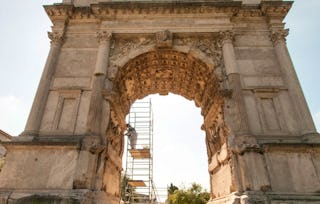
The destruction of the First Temple in Jerusalem and the Babylonian Exile were a great catastrophe in the history of the Jewish Nation.
What really happened during that dark, fateful age, and how did new opportunities arise from the ashes?
This course will temporarily close for enrollment from March 1st, 2022 to August 31st, 2022. During this time, the course will be closed for new enrolments. All of the course materials will continue to be able available to previously enrolled learners; however, the course staff will not provide support in the Discussion Forums during this period.
Best,
The Tel Aviv University Team
Welcome to the first module of "The Fall and Rise of Jerusalem"! In this module you will be introduced to the geopolitical reality of the time of the Assyrian empire, followed by the Neo-Babylonian. We hope you'll find the videos informative and interesting. We encourage you to use the discussion forums in order to raise any questions or thoughts you might have after watching the videos.
What's included
16 videos1 reading1 assignment1 plugin
Show info about module content
16 videos•Total 128 minutes
Course trailer•3 minutes
Welcome•2 minutes
The Babylonian Period•9 minutes
The Early Persian Period•3 minutes
Modern Scholarship•2 minutes
Course Overview•3 minutes
Geopolitical Background•7 minutes
The outcome of the Assyrian conquest and the Geopolitical situation in the Levant•11 minutes
Fall of Assyria (A)•14 minutes
Fall of Assyria (B)•11 minutes
Rise of Neo-Babylonian Empire•9 minutes
Babylonian chronicles•12 minutes
Babylonian-Egyptian struggle•12 minutes
Summary of part 1•2 minutes
Rise of The Egyptian 26th Dynasty (Optional)•19 minutes
The Rise of Judah (Optional)•10 minutes
1 reading•Total 10 minutes
Recommended reading for Week 1•10 minutes
1 assignment•Total 30 minutes
Week 1 quiz•30 minutes
1 plugin•Total 5 minutes
Opening survey•5 minutes
Judah Under Babylonian Rule
Module 2•2 hours to complete
Module details
The second module deals with Judah under Babylonian rule. We will learn about the Babylonian Conquest of Hattu-land and Judah, the events that lead to Jehoiakim's revolt and its outcome, and the changes in the Babylonian policy towards Judah following this revolt. You are welcome to raise questions for discussion regarding these topics.
What's included
7 videos1 reading1 assignment
Show info about module content
7 videos•Total 69 minutes
Introduction to Week 2•4 minutes
Babylonian conquest of Hattu-land (A)•12 minutes
Babylonian conquest of Hattu-land (B)•8 minutes
Babylonian conquest of Judah•9 minutes
Jehoiakim’s revolt (A)•11 minutes
Jehoiakim’s revolt (B)•12 minutes
Babylonian arrangements•13 minutes
1 reading•Total 10 minutes
Recommended Reading Week 2•10 minutes
1 assignment•Total 30 minutes
Week 2 quiz•30 minutes
The Days of the Destruction of Jerusalem
Module 3•2 hours to complete
Module details
This module deals with Zedekiah's rebellion and the destruction of Judah.You are invited to watch the following units and learn about the Egyptian intervention, the reasons for Zedekiah's revolt, and the history of the destruction of Judah.
What's included
7 videos1 reading1 assignment
Show info about module content
7 videos•Total 74 minutes
Introduction to Week 3•9 minutes
The Egyptian intervention (A)•9 minutes
The Egyptian intervention (B)•8 minutes
The causes of Zedekiah’s rebellion•13 minutes
History of destruction (A)•11 minutes
History of destruction (B)•14 minutes
History of destruction (C)•10 minutes
1 reading•Total 10 minutes
Recommended Reading for Week 3•10 minutes
1 assignment•Total 30 minutes
Week 3 quiz•30 minutes
Gedaliah son of Ahikam
Module 4•2 hours to complete
Module details
In this module we will learn about the transition of the capital city from Jerusalem to Mizpah and the governorship of Gedaliah son of Ahikam in Mizpah following the destruction. We encourage you to use the discussions to ask about anything that isn't clear or raise your own ideas regarding the material you learned.
What's included
8 videos1 reading1 assignment
Show info about module content
8 videos•Total 83 minutes
Introduction – between Jerusalem and Mizpah•7 minutes
Gedaliah and his status•15 minutes
Gedaliah as the governor of Judah: the text (A)•11 minutes
Gedaliah as the governor of Judah: the text (B)•6 minutes
Gedaliah as the governor of Judah: the history (A)•12 minutes
Gedaliah as the governor of Judah: the history (B)•15 minutes
Theology of the destruction (Konrad Schmid)•14 minutes
Summary of Week 4•3 minutes
1 reading•Total 10 minutes
Recommended Reading for Week 4•10 minutes
1 assignment•Total 30 minutes
Week 4 quiz•30 minutes
Archaeology of the sixth century BCE
Module 5•3 hours to complete
Module details
After learning of the days of the destruction and the historical role of Gedaliah son of Ahikam, you are invited to watch the lessons of the fifth module, which deals with the archaeology of the Babylonian Period. We will explore the magnificent finds from Ramat Rahel, the stamp impressions and what they can teach us about continuity or discontinuity in this period and the fate of Jerusalem and Judah following the destruction. I also recommend watching the optional videos which deal with additional interesting research topics.
What's included
12 videos1 reading1 assignment
Show info about module content
12 videos•Total 116 minutes
Introduction to Week 5•4 minutes
Ramat Rahel as a starting point•14 minutes
Stamped jar handles from the seventh and sixth century BCE (Ido Koch)•9 minutes
Lion Stamp Impressions•5 minutes
The continuity in the sixth century BCE•7 minutes
Destruction and changes in the material culture (A)•10 minutes
Destruction and changes in the material culture (B)•7 minutes
Destruction and changes in the material culture (C)•13 minutes
What between the results and the historical reconstruction•9 minutes
Summary of Week 5•3 minutes
Problems in research (Optional)•17 minutes
The rural hinterland of Jerusalem (Dr. Yuval Gadot) (Optional)•19 minutes
1 reading•Total 10 minutes
Recommended Reading for Week 5•10 minutes
1 assignment•Total 30 minutes
Week 5 quiz•30 minutes
The restoration of Jerusalem in the early Persian Period
Module 6•3 hours to complete
Module details
The last module of our course will deal with different aspects of the Persian period: the cult of Jerusalem, changes in Jerusalem's status, the Judahite diaspora, the fall of Babylon and much more. We hope you will enjoy this final module which closes the story of Jerusalem's fall and rise.
What's included
12 videos1 reading1 assignment1 plugin
Show info about module content
12 videos•Total 118 minutes
The Babylonian and Persian Periods: Methodological Perspective•14 minutes
The Fall of Babylon (Prof. David Vanderhooft)•12 minutes
The Cult and the Temple in Jerusalem•12 minutes
Slow Changes in the Geopolitical Situation•4 minutes
Urbanization and Ruralism•7 minutes
The Persian Interests in the Hill Country•4 minutes
The Status of Jerusalem and Persian Interests•6 minutes
Changes in the Status of Jerusalem•11 minutes
Polemic Literature in Persian Period Yehud – Joshua 9 (Dr. Cynthia Edenburg)•17 minutes
The Babylonian Deportations and the Judahite Diaspora in Babylonia (Prof. David Vanderhooft)•22 minutes
Summary of Part 6•2 minutes
Final Summary of the Course•7 minutes
1 reading•Total 10 minutes
Recommended Reading for week 6•10 minutes
1 assignment•Total 30 minutes
Final Exam•30 minutes
1 plugin•Total 3 minutes
Post Course Survey•3 minutes
Instructor
Instructor ratings
Instructor ratings
We asked all learners to give feedback on our instructors based on the quality of their teaching style.
Tel Aviv University (TAU) is Israel's largest institution of higher learning – with over 30,000 students and more than 125 schools and departments in nine faculties. Global in outlook and impact, it is consistently ranked among the world's top 100 universities, as well as the top 20 institutions in terms of scientific citations. A spirit of openness and innovation is evident in all of TAU's teaching and research activities, breaking down barriers between disciplines, and boldly striving to address the twenty-first century's most pressing challenges.
"To be able to take courses at my own pace and rhythm has been an amazing experience. I can learn whenever it fits my schedule and mood."
Jennifer J.
Learner since 2020
"I directly applied the concepts and skills I learned from my courses to an exciting new project at work."
Larry W.
Learner since 2021
"When I need courses on topics that my university doesn't offer, Coursera is one of the best places to go."
Chaitanya A.
"Learning isn't just about being better at your job: it's so much more than that. Coursera allows me to learn without limits."
Learner reviews
4.6
345 reviews
5 stars
77.45%
4 stars
15.31%
3 stars
2.31%
2 stars
1.73%
1 star
3.17%
Showing 3 of 345
E
ET
5·
Reviewed on Oct 31, 2019
Excellent course very recommended, together with the book , to whom is interested in the subject.
I
IS
5·
Reviewed on Sep 17, 2016
This course was awesome.I learned a lot of new things about archaeology and how the people who wrote the Bible viewed and interpreted events.
A
AA
5·
Reviewed on Jan 6, 2017
The course was well presented and went in depth into the issues surrounding the kingdom of Judah and the city of Jerusalem during a tumultuous time in the 7th and 6th centuries BC.
When will I have access to the lectures and assignments?
To access the course materials, assignments and to earn a Certificate, you will need to purchase the Certificate experience when you enroll in a course. You can try a Free Trial instead, or apply for Financial Aid. The course may offer 'Full Course, No Certificate' instead. This option lets you see all course materials, submit required assessments, and get a final grade. This also means that you will not be able to purchase a Certificate experience.
What will I get if I purchase the Certificate?
When you purchase a Certificate you get access to all course materials, including graded assignments. Upon completing the course, your electronic Certificate will be added to your Accomplishments page - from there, you can print your Certificate or add it to your LinkedIn profile.
Is financial aid available?
Yes. In select learning programs, you can apply for financial aid or a scholarship if you can’t afford the enrollment fee. If fin aid or scholarship is available for your learning program selection, you’ll find a link to apply on the description page.