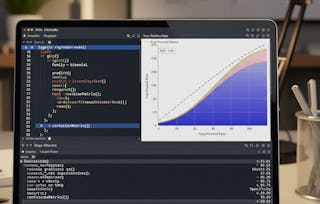
By completing this course, learners will be able to implement logistic regression models in SAS, prepare datasets through missing value imputation and categorical encoding, analyze predictors using clustering and screening, and evaluate models with confusion matrices and logit plots. Designed for aspiring data scientists, analysts, and business professionals, this course blends statistical rigor with hands-on SAS demonstrations.
Learners will benefit by gaining both technical knowledge and practical skills to solve real-world classification problems, such as predicting customer behavior, assessing risk, or identifying fraud. Unlike generic statistical tutorials, this course uniquely emphasizes feature engineering, subset selection, and SAS-specific implementation to ensure models are not only accurate but also interpretable and business-ready.
Through structured modules, learners progress from foundational concepts to advanced evaluation, ensuring they can confidently build, optimize, and validate logistic regression models. By the end, participants will have mastered the end-to-end workflow of logistic regression in SAS, positioning themselves for success in data-driven roles across industries.
This module introduces learners to the foundations of logistic regression and the importance of data preparation when working in SAS. Students explore the basics of binary classification, apply logistic regression using PROC LOGISTIC, and prepare datasets by handling missing values and encoding categorical variables. By the end of this module, learners will have the skills to structure datasets correctly and build their first logistic regression models in SAS.
What's included
7 videos4 assignments
Show info about module content
7 videos•Total 114 minutes
Introduction to Logistic Regression Project using SAS Stat•10 minutes
Insurance Dataset Explanation and Exploration•16 minutes
Logistic Regression Demonstration Part 1•14 minutes
Logistic Regression Demonstration Part 2•27 minutes
Missing Values Imputation•23 minutes
Categorical Inputs•11 minutes
Categorical Inputs Continue•13 minutes
4 assignments•Total 60 minutes
Introduction and Business Context•10 minutes
Building the First Logistic Models•10 minutes
Preparing Raw Data for Modeling•10 minutes
Geaded-Logistic Regression Foundations and Data Setup – Graded Quiz•30 minutes
Feature Engineering and Predictor Selection
Module 2•2 hours to complete
Module details
This module focuses on advanced data preparation techniques to improve logistic regression performance. Learners examine variable clustering to reduce redundancy, use screening techniques to evaluate predictor importance, and explore subset selection methods to refine model inputs. The emphasis is on selecting the most relevant predictors, improving efficiency, and ensuring model stability in SAS.
What's included
8 videos4 assignments
Show info about module content
8 videos•Total 79 minutes
Variable Clustering Part 1•12 minutes
Variable Clustering Part 2•7 minutes
Variable Clustering Part 3•8 minutes
Variable Screening•11 minutes
Variable Screening Continue•9 minutes
Exploring Nonlinear Relationships in Subset Selection•12 minutes
Data Transformation for Linear Subset Selection•11 minutes
Problem Framing and Logic Plots in Subset Selection•10 minutes
4 assignments•Total 60 minutes
Variable Clustering for Data Reduction•10 minutes
Screening Predictors for Importance•10 minutes
Subset Selection Foundations•10 minutes
Graded -Feature Engineering and Predictor Selection •30 minutes
Model Building and Performance Evaluation
Module 3•2 hours to complete
Module details
This module advances into model building strategies and performance evaluation. Students explore stepwise and backward elimination techniques to refine predictors, implement models using PROC LOGISTIC and ODS, and assess model performance with misclassification analysis, confusion matrices, and logit plots. Learners will gain the ability to build robust logistic regression models and validate them effectively in SAS.
What's included
6 videos3 assignments
Show info about module content
6 videos•Total 65 minutes
Stepwise Subset Selection: Initial Screening of Variables•9 minutes
Intercept-Only vs. Covariate Models in Subset Selection•11 minutes
Backward Elimination Method for Subset Selection•11 minutes
PROC Implementation and ODS Output in Subset Selection•9 minutes
Evaluating Subset Models with Misclassification and Confusion Matrix•10 minutes
Logit Plots•15 minutes
3 assignments•Total 50 minutes
Advanced Subset Selection Methods•10 minutes
SAS Implementation and Model Assessment•10 minutes
Graded-Model Building and Performance Evaluation•30 minutes
Welcome to EDUCBA, a place where knowledge is limitless! We provide a wide selection of instructive and engaging programmes designed to empower students of all ages and experiences. From the convenience of your home, start a revolutionary educational experience with our cutting-edge technologies courses and experienced instructors.
When will I have access to the lectures and assignments?
To access the course materials, assignments and to earn a Certificate, you will need to purchase the Certificate experience when you enroll in a course. You can try a Free Trial instead, or apply for Financial Aid. The course may offer 'Full Course, No Certificate' instead. This option lets you see all course materials, submit required assessments, and get a final grade. This also means that you will not be able to purchase a Certificate experience.
What will I get if I purchase the Certificate?
When you purchase a Certificate you get access to all course materials, including graded assignments. Upon completing the course, your electronic Certificate will be added to your Accomplishments page - from there, you can print your Certificate or add it to your LinkedIn profile.
Is financial aid available?
Yes. In select learning programs, you can apply for financial aid or a scholarship if you can’t afford the enrollment fee. If fin aid or scholarship is available for your learning program selection, you’ll find a link to apply on the description page.