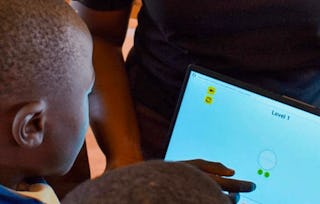
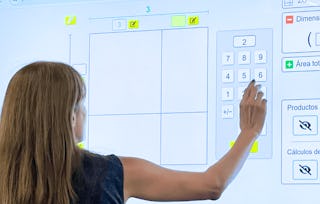
PhET Interactive Simulations (https://phet.colorado.edu/), a project of the University of Colorado Boulder, provides fun, free, interactive, research-based science and mathematics simulations for use across, primary, secondary, and higher education levels. We extensively test and evaluate each simulation to ensure educational effectiveness. All simulations are open source and free to all students and teachers.
In this course, you will (a) acquire teaching and facilitation strategies for how to use PhET simulations in a K-2 classroom, (b) explore how PhET simulations can support multilingual students, and (c) engage with lessons supporting students’ learning of counting, number sense, and place value.
To finish this course, you need to complete one assignment with peer review: complete one early math teacher guide (using a template) to plan a lesson on numeracy using one of the PhET simulations introduced in this course.
In this module, you will activate your prior knowledge of what it means to have number sense, and brainstorm ways to support all students.
Teachers Summarize Their Reflections on Teaching Number Sense•2 minutes
Teachers Share Features Discovered in Number Play•6 minutes
10 readings•Total 17 minutes
Course Updates and Accessibility Support•1 minute
Welcome!•1 minute
Teaching Foundational Math•2 minutes
Teaching Number Sense•1 minute
Poster Reflections•2 minutes
Open Play•5 minutes
Intentional Design Features of a PhET Simulation•1 minute
Benefits of Open Play•2 minutes
Facilitation Tips for Open Play•1 minute
Introducing the Next Modules•1 minute
8 assignments•Total 39 minutes
Activate Prior Knowledge•5 minutes
Practical Guidelines for Supporting Multilingual Students•2 minutes
Introduction to the Five Counting Principles•5 minutes
Principle #1: Standard Order•5 minutes
Principle #2: One to One Correspondence•5 minutes
Principle #3: Cardinality•5 minutes
Principle #4: Conservation of Cardinality•7 minutes
Principle #5: The Successor•5 minutes
3 discussion prompts•Total 15 minutes
Supporting Multilingual Students while Building Number Sense•5 minutes
Features of Number Play•5 minutes
Benefits of Open Play•5 minutes
1 plugin•Total 3 minutes
Pre-Survey•3 minutes
Exploring Math Identity
Module 2•19 minutes to complete
Module details
It is common for many students–and their teachers–to approach math with some trepidation. This module aims to help you unpack how you and your students might approach math, and what you can do to shift from math anxiety toward mathematical curiosity and joy.
What's included
1 reading1 assignment2 discussion prompts
Show info about module content
1 reading•Total 5 minutes
K-2 Teacher Responses•5 minutes
1 assignment•Total 5 minutes
Math Identity•5 minutes
2 discussion prompts•Total 9 minutes
Reflecting on Your Own Math Identity•5 minutes
Building Students’ Positive Math Identities•4 minutes
Teaching Early Math to Diverse Student Populations
Module 3•18 minutes to complete
Module details
In this module, you will learn the importance of providing a strong foundation of number sense for early mathematics learners, specifically to diverse populations.
What's included
2 readings2 discussion prompts
Show info about module content
2 readings•Total 8 minutes
Teaching Diverse Student Populations - Multilingual Learners•3 minutes
Asset Versus Deficit Thinking•5 minutes
2 discussion prompts•Total 10 minutes
My Context•5 minutes
Multilingual Learners in Your Classroom•5 minutes
Number Play
Module 4•3 hours to complete
Module details
In this module, you will learn how to effectively facilitate a lesson using the Number Play simulation.
Teachers Discussing the New Arrangement of 18•6 minutes
My Mystery Number Setup•1 minute
Changing Puppy Arrangements with Play Area Closed•1 minute
Teachers Discuss Representations in My Mystery Number•4 minutes
Teachers Analyze Knowledge and Brainstorm Facilitation Moves•5 minutes
Teachers’ Discoveries from the Lab Screen, and 13 - 8 Solutions•7 minutes
Teachers Discuss Contexts•4 minutes
19 readings•Total 70 minutes
Introduction to the Activity•1 minute
Drag and Count (Part I)•10 minutes
Drag and Count (Part II)•5 minutes
Mapping Drag and Count to Standards•3 minutes
Drag and Count Lesson Plan•1 minute
Establishing a Growth Mindset •4 minutes
My Mystery Number•1 minute
My Mystery Number (Part I) •2 minutes
Cognitive Dissonance•1 minute
Mapping the Standards to My Mystery Number•5 minutes
My Mystery Number Lesson Plan•1 minute
Facilitation Moves•1 minute
Student Scenario with My Mystery Number•10 minutes
Lab Screen Open Play•5 minutes
Lab Screen Design•2 minutes
Introduction to Subtraction Stories•5 minutes
Subtraction Stories •10 minutes
Mapping the Standards to Subtraction Stories•2 minutes
Subtraction Stories Lesson Plan•1 minute
1 assignment•Total 20 minutes
Mathematical Mindset•20 minutes
17 discussion prompts•Total 85 minutes
Pause – Analyze as a Student•5 minutes
Pause – Analyze as a Teacher•5 minutes
Pause – Analyze as a Student•5 minutes
Pause – Analyze as a Teacher•5 minutes
Pros and Cons to Secretly Manipulating the Puppies’ Arrangement•5 minutes
Connecting Cognitive Dissonance to Growth Mindset•5 minutes
Reflecting on Standards•5 minutes
My Mystery Number (Part II)•5 minutes
Analyze My Mystery Number•5 minutes
Analyzing the Student Scenario•5 minutes
Extending the Student Scenario•5 minutes
Lab Screen•5 minutes
Pause – Analyze as a Student•5 minutes
Lab Screen and 13 – 8•5 minutes
Reflecting on the Lab Screen•5 minutes
Final Reflection on Number Play•5 minutes
Number Pairs
Module 5•1 hour to complete
Module details
In this module, you will learn how to effectively facilitate a lesson utilizing the simulation, Number Pairs, which will continue to build a foundation for composing and decomposing numbers within 0-20, and adding two numbers to create sums from 0-20. Multiple contexts allow for learners to engage in two problem types in which both addends are unknown: location-based and attribute-based (Champagne et al., 2014). In location-based problems, the addends are separated in distinct ways, such as in separate piles, or on the left and right side of a simulation. In attribute-based problems, the addends are distinguished by an attribute, such as color. Number Pairs includes both problem types to better connect to each student’s thinking, regardless of how they visualize two addends. Reference: Champagne, Z. M., Schoen, R., & Riddle, C. M. (2014, September). Variations in both addends unknown problems. Teaching Children Mathematics, 21(2), 114–121.
What's included
6 readings5 discussion prompts
Show info about module content
6 readings•Total 50 minutes
Open Play with Number Pairs•5 minutes
How Many Apples?•10 minutes
How Many Apples? (continued)•10 minutes
Setup and Lesson Plan for How Many Apples?•5 minutes
5 discussion prompts•Total 25 minutes
Reflecting on Open Play•5 minutes
Pause - Reflect as a Learner•5 minutes
Pause - Reflect as a Teacher•5 minutes
Reflect on How Many Apples?•5 minutes
Number Compare
Module 6•2 hours to complete
Module details
In this module, you will learn how to leverage the functionality of Number Compare to support students’ learning of how to compare numbers in multiple ways.
What's included
4 videos16 readings8 discussion prompts
Show info about module content
4 videos•Total 12 minutes
Teachers Debrief Number Compare Open Play•3 minutes
Teacher Solutions for True or False?•4 minutes
Teachers Debrief True or False? Extensions•3 minutes
Teachers Brainstorm How to Establish 1-to-1 Correspondence•1 minute
16 readings•Total 75 minutes
Open Play with Number Compare•5 minutes
Summarizing Number Compare Open Play•1 minute
Activity 1: True or False?•2 minutes
Teacher Solutions for True or False?•1 minute
Mapping the Standards to True or False?•4 minutes
Extending True or False?•5 minutes
Preparing for a Video•10 minutes
Lesson Plan for True or False?•4 minutes
Introduction to Compare the Vertical Number Line•2 minutes
Mapping the Standards to Compare Vertical Number Line•3 minutes
Facilitation of Compare the Vertical Number Line•10 minutes
Pause - Reflect as a Teacher•3 minutes
Facilitation of the Lesson Continued•10 minutes
Lesson Plan: Compare the Vertical Number Line•3 minutes
Introducing Two More Puppies•2 minutes
Two More Puppies Vignette•10 minutes
8 discussion prompts•Total 41 minutes
Reflecting on Open Play•5 minutes
Pause - Reflect as a Learner•5 minutes
Reflect as a Teacher on True or False?•5 minutes
True or False?•5 minutes
Pause - Reflect as a Learner•3 minutes
Reflect: Compare the Vertical Number Line•8 minutes
Compare and Contrast Question Types•5 minutes
Summarizing Number Compare•5 minutes
PhET's Instructional Approach
Module 7•1 hour to complete
Module details
In this module, you will learn about PhET’s teaching philosophy and how this philosophy is supported with meaningful sim-based lessons.
What's included
1 video12 readings4 discussion prompts
Show info about module content
1 video•Total 5 minutes
PhET Founder on the Impact of Simulations•5 minutes
12 readings•Total 16 minutes
Foundations of PhET’s Teaching Philosophy•1 minute
Positive Learning Environment and Equity•2 minutes
PhET’s Philosophy and Relationship to Learning Environment and Equity •1 minute
PhET’s Equity Framework•2 minutes
Relevance, Representation, and Accessibility •2 minutes
Active Learning with PhET as a Foundation for Equity •2 minutes
Address Students’ Prior Knowledge •1 minute
Connect to Context •1 minute
Support Collaboration•1 minute
Promote Belonging •1 minute
Provide Scaffolding•1 minute
Assessments as Learning Opportunities•1 minute
4 discussion prompts•Total 20 minutes
Equity in Your Classroom•5 minutes
Reflecting on Positive Learning Environment •5 minutes
Equity Framework•5 minutes
Active Learning•5 minutes
Make a Ten
Module 8•2 hours to complete
Module details
In this module, we now return to sample lessons, with which you will learn how to effectively facilitate a lesson utilizing another simulation called Make a Ten.
What's included
4 videos15 readings10 discussion prompts
Show info about module content
4 videos•Total 15 minutes
Teachers Debrief Open Play with Make a Ten•6 minutes
Number Talk with Make a Ten•3 minutes
Watch a Student Play with Make a Ten•4 minutes
Teachers Debrief Video of Student Playing•2 minutes
15 readings•Total 70 minutes
Make a Ten Simulation•2 minutes
Open Play with Make a Ten•5 minutes
Choral Counting•5 minutes
Mapping the Standards to Choral Counting•2 minutes
Choral Counting Lesson Plan•2 minutes
What is Greater or Less? (Part I – Lesson Setup)•5 minutes
Which is Greater or Less? (Part II – Lesson Discourse)•5 minutes
Which is Greater or Less? (Part III - Selecting and Sequencing)•5 minutes
Which is Greater or Less? (Part IV – Summarizing)•10 minutes
Mapping the Standards to What is Greater or Less?•1 minute
Which is Greater or Less? Lesson Plan•1 minute
What Is a Number Talk?•2 minutes
Number Talk with 12•5 minutes
Watch a Number Talk (Part I)•18 minutes
Observing Students•2 minutes
10 discussion prompts•Total 50 minutes
Reflecting on Open Play•5 minutes
Analyze Choral Counting•5 minutes
Pause - Reflect as a Teacher•5 minutes
Pause - Analyze as a Student•5 minutes
Pause - Analyze as a Teacher•5 minutes
Selecting and Sequencing•5 minutes
Which is Greater or Less?•5 minutes
Number Talks with Make a Ten•5 minutes
Observing Students•5 minutes
Final Reflection for Make a Ten•5 minutes
Creating Your Own Sim-Based Lessons
Module 9•2 hours to complete
Module details
In this module, you will learn how to build effective sim-based lessons in different contexts.
What's included
17 readings6 discussion prompts
Show info about module content
17 readings•Total 74 minutes
Lesson Types•2 minutes
Learning Goals•5 minutes
Teacher-Led Investigation (TLI)•1 minute
Student-Led Investigation (SLI)•2 minutes
Combining TLI and SLI•1 minute
Prediction Questions vs. Challenge Prompts•5 minutes
Open Play with Area Builder•5 minutes
Prediction Questions (Part I)•5 minutes
Prediction Questions (Part II)•10 minutes
Summary of Facilitation a Prediction Question•3 minutes
Challenge Prompts (Part I)•5 minutes
Challenge Prompts (Part II)•2 minutes
Challenge Prompt via an SLI (Part I)•5 minutes
Challenge Prompt via an SLI (Part II)•15 minutes
Challenge Prompt Summary•1 minute
Summarizing Facilitation of a Challenge Prompt•3 minutes
Challenge Prompt Types•4 minutes
6 discussion prompts•Total 30 minutes
Write Example Learning Goals•5 minutes
Reflecting on Open Play•5 minutes
Benefits of Prediction Questions•5 minutes
Pause - Provide Your Solution•5 minutes
Benefits of Challenge Prompts and Prediction Questions•5 minutes
Create a Challenge Prompt•5 minutes
The PhET Website
Module 10•1 hour to complete
Module details
In this module, you will learn about resources available on the PhET website that can support you as you plan to use simulations with your students.
What's included
7 readings1 assignment1 discussion prompt
Show info about module content
7 readings•Total 32 minutes
Teacher Access to PhET Sims•5 minutes
Student Access to PhET Sims•2 minutes
Create a PhET Teacher Account•5 minutes
Using Teacher Tips•5 minutes
Example Customized URLs•5 minutes
Customize a URL•5 minutes
Activities for Number Play•5 minutes
1 assignment•Total 2 minutes
Activities for Number Play•2 minutes
1 discussion prompt•Total 5 minutes
Using a Customization Option•5 minutes
Pulling It All Together
Module 11•2 hours to complete
Module details
This module is a summary and wrap-up of the simulations and resources with which you have engaged in this course. As you think about your experience with the simulations and accompanying lessons, reflect on ways the sims and lessons support student confidence, agency, ownership, growth mindset, and positive mathematical identity in all learners.
What's included
4 readings1 peer review2 discussion prompts
Show info about module content
4 readings•Total 67 minutes
Key Concepts•2 minutes
Planning a Lesson•5 minutes
Choose Your Sim and Draft Your Lesson!•30 minutes
Supporting Multilingual Learners - Applying the Practice•30 minutes
1 peer review•Total 60 minutes
Submit Lesson and Peer Review Others' Lessons•60 minutes
2 discussion prompts•Total 10 minutes
Synthesizing the Concepts•5 minutes
Brainstorming Other Activities•5 minutes
Conclusion and Next Steps
Module 12•26 minutes to complete
Module details
In this module, you will take appropriate steps to complete the course and download your certificate.
What's included
1 reading1 assignment1 plugin
Show info about module content
1 reading•Total 1 minute
Get Your Certificate•1 minute
1 assignment•Total 20 minutes
Self-Assessing against Learning Objectives•20 minutes
CU Boulder is a dynamic community of scholars and learners on one of the most spectacular college campuses in the country. As one of 34 U.S. public institutions in the prestigious Association of American Universities (AAU), we have a proud tradition of academic excellence, with five Nobel laureates and more than 50 members of prestigious academic academies.
When will I have access to the lectures and assignments?
To access the course materials, assignments and to earn a Certificate, you will need to purchase the Certificate experience when you enroll in a course. You can try a Free Trial instead, or apply for Financial Aid. The course may offer 'Full Course, No Certificate' instead. This option lets you see all course materials, submit required assessments, and get a final grade. This also means that you will not be able to purchase a Certificate experience.
What will I get if I purchase the Certificate?
When you purchase a Certificate you get access to all course materials, including graded assignments. Upon completing the course, your electronic Certificate will be added to your Accomplishments page - from there, you can print your Certificate or add it to your LinkedIn profile.
Is financial aid available?
Yes. In select learning programs, you can apply for financial aid or a scholarship if you can’t afford the enrollment fee. If fin aid or scholarship is available for your learning program selection, you’ll find a link to apply on the description page.