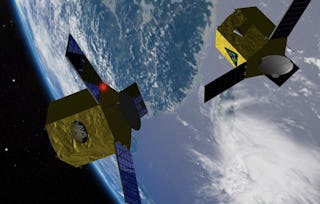
As they tumble through space, objects like spacecraft move in dynamical ways. Understanding and predicting the equations that represent that motion is critical to the safety and efficacy of spacecraft mission development. Kinetics: Modeling the Motions of Spacecraft trains your skills in topics like rigid body angular momentum and kinetic energy expression shown in a coordinate frame agnostic manner, single and dual rigid body systems tumbling without the forces of external torque, how differential gravity across a rigid body is approximated to the first order to study disturbances in both the attitude and orbital motion, and how these systems change when general momentum exchange devices are introduced.

Kinetics: Studying Spacecraft Motion
4 days left! Save on skills that make you shine with 40% off 3 months of Coursera Plus. Save now

Kinetics: Studying Spacecraft Motion
This course is part of Spacecraft Dynamics and Control Specialization

Instructor: Hanspeter Schaub
11,481 already enrolled
Included with
Gain insight into a topic and learn the fundamentals.
134 reviews
Advanced level
Designed for those already in the industry
Flexible schedule
2 weeks at 10 hours a week
Learn at your own pace
96%
Most learners liked this course
What you'll learn
Derive the rotational equations of motion and predict and determine torque-free motion equilibria and associated stabilities
Develop equations of motion for a rigid body with multiple spinning components and derive and apply the gravity gradient torque
Apply the static stability conditions of a dual-spinner configuration and predict changes as momentum exchange devices are introduced
Derive equations of motion for systems in which various momentum exchange devices are present
Details to know

Shareable certificate
Add to your LinkedIn profile
Taught in English
91%
of learners achieved a positive career outcome
See how employees at top companies are mastering in-demand skills

Build your subject-matter expertise
This course is part of the Spacecraft Dynamics and Control Specialization
When you enroll in this course, you'll also be enrolled in this Specialization.
- Learn new concepts from industry experts
- Gain a foundational understanding of a subject or tool
- Develop job-relevant skills with hands-on projects
- Earn a shareable career certificate

There are 4 modules in this course
Earn a career certificate
Add this credential to your LinkedIn profile, resume, or CV. Share it on social media and in your performance review.
Instructor
Instructor ratings
(31 ratings)Offered by


Explore more from Physics and Astronomy
University of Colorado Boulder
University of Colorado Boulder
University of Colorado Boulder
University of Colorado Boulder
Why people choose Coursera for their career

Felipe M.
Learner since 2018
"To be able to take courses at my own pace and rhythm has been an amazing experience. I can learn whenever it fits my schedule and mood."

Jennifer J.
Learner since 2020
"I directly applied the concepts and skills I learned from my courses to an exciting new project at work."

Larry W.
Learner since 2021
"When I need courses on topics that my university doesn't offer, Coursera is one of the best places to go."

Chaitanya A.
"Learning isn't just about being better at your job: it's so much more than that. Coursera allows me to learn without limits."
Learner reviews
- 5 stars
85.07%
- 4 stars
12.68%
- 3 stars
1.49%
- 2 stars
0%
- 1 star
0.74%
Showing 3 of 134
MK
Reviewed on Aug 28, 2020
great lectures highly recommended for space enthusiasts
JP
Reviewed on Sep 22, 2020
A good course to understand concept and practical evaluation process to useit on field.
RP
Reviewed on Aug 24, 2021
Good course. Buying the book by Prof. Schaub will help you a lot in succeeding in this course.




¹ Some assignments in this course are AI-graded. For these assignments, your data will be used in accordance with Coursera's Privacy Notice.