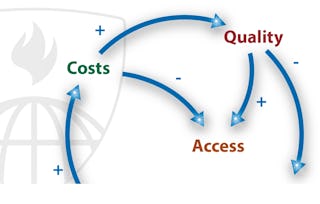
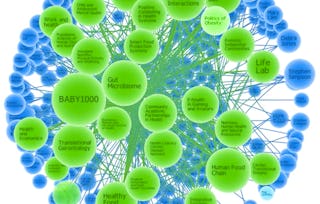
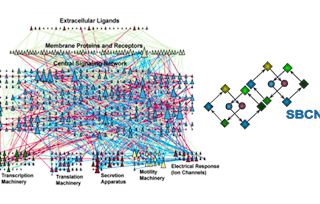
Systems science has been instrumental in breaking new scientific ground in diverse fields such as meteorology, engineering and decision analysis. However, it is just beginning to impact public health. This seminar is designed to introduce students to basic tools of theory building and data analysis in systems science and to apply those tools to better understand the obesity epidemic in human populations. There will also be a lab in which students will use a simple demonstration model of food acquisition behavior using agent-based modeling on standard (free) software (netlogo). The central organizing idea of the course is to examine the obesity epidemic at a population level as an emergent properties of complex, nested systems, with attention to feedback processes, multilevel interactions, and the phenomenon of emergence. While the emphasis will be on obesity, the goal will be to explore ways in which the systems approach can be applied to other non-communicable diseases both nationally and internationally.
Topics will include:
a) the epidemiology of obesity across time and place,
b) theories to explain population obesity,
c) the role of environments and economic resources in obesity
c) basic concepts and tools of systems science,
d) modeling energy-balance related behaviors in context,
e) agent-based models, systems dynamic models, and social network models
Obesity, the facts of the case, and human populations through a systems science lens.
What's included
7 videos1 assignment
Show info about module content
7 videos•Total 112 minutes
Welcome to the Course•3 minutes
Obesity, The Facts of the Case (Or Why Obesity Pushes Our Buttons) - Tom Glass•18 minutes
Beyond the Usual Suspect: Why This Case Is Hard To Crack•12 minutes
Explanations: The Food Supply, A System of Interest•18 minutes
Obesity in Human Populations Through a Systems Science Lens - Tom Glass•11 minutes
Taking a Systems Perspective: 5 Key Features•26 minutes
What is so "Systemy" About Obesity?•23 minutes
1 assignment•Total 30 minutes
Module 1•30 minutes
Module 2
Module 2•3 hours to complete
Module details
Complex systems, system dynamic models, and developing a stock and flow. This module includes a lab lesson.
What's included
6 videos1 reading2 assignments
Show info about module content
6 videos•Total 89 minutes
What Is a Complex System?•11 minutes
Nuts and Bolts of System Dynamics Models•12 minutes
Developing a Stock and Flow Model•12 minutes
Policy Resistance•11 minutes
Coding tutorial for systems dynamics model•22 minutes
From stock and flow diagram to developing a SD model in Vensim•20 minutes
1 reading•Total 10 minutes
Important: Models for Lab Assessment•10 minutes
2 assignments•Total 60 minutes
Module 2 Quiz•30 minutes
Lab 1 Quiz•30 minutes
Module 3
Module 3•3 hours to complete
Module details
Social networks and obesity, neighborhoods and noshing, and prices and poverty.
What's included
9 videos1 assignment
Show info about module content
9 videos•Total 123 minutes
What Are Social Networks?•6 minutes
Social Network Analysis•14 minutes
Obesity & Social Networks•14 minutes
Neighborhoods and Noshing: Foraging and the Food Environment•15 minutes
Why Should We Care About Neighborhoods for a Systems Science of Obesity•15 minutes
Foraging Theory: A Unifying Framework?•27 minutes
Lecture 6: What's price (and income) got to do with it?•11 minutes
Less money, more problems?•12 minutes
Taxman: Can Price Manipulations Be Used to Promote Healthful Eating•9 minutes
1 assignment•Total 30 minutes
Module 3 Quiz•30 minutes
Module 4
Module 4•3 hours to complete
Module details
Agent based modeling and conceptual motivation for agent based modeling. This module includes a lab lesson.
What's included
8 videos2 readings2 assignments
Show info about module content
8 videos•Total 125 minutes
Agent-based modeling: A simpler way to understand complexity•13 minutes
Why agent-based modeling?•24 minutes
Development of a Simple Model with Environment, Peer Networks, and Agent Behaviors•20 minutes
Food Foraging ABM:Embedded in a GIS-Based Environment•8 minutes
Lab 2 Part 1: Tutorial on building ABMs in Netlogo environment•35 minutes
Lab 2 Part 2: ABM for Food Store; Food Foraging ABM•8 minutes
Lab 2 Part 3: Income-Diet model example with extensions•16 minutes
Congratulations!•1 minute
2 readings•Total 20 minutes
Important: Models For Lab Assessment 2•10 minutes
Learn more about the Global Obesity Prevention Center•10 minutes
2 assignments•Total 60 minutes
Module 4 Quiz•30 minutes
Lab Quiz 2•30 minutes
Instructors
Instructor ratings
Instructor ratings
We asked all learners to give feedback on our instructors based on the quality of their teaching style.
The mission of The Johns Hopkins University is to educate its students and cultivate their capacity for life-long learning, to foster independent and original research, and to bring the benefits of discovery to the world.
"To be able to take courses at my own pace and rhythm has been an amazing experience. I can learn whenever it fits my schedule and mood."
Jennifer J.
Learner since 2020
"I directly applied the concepts and skills I learned from my courses to an exciting new project at work."
Larry W.
Learner since 2021
"When I need courses on topics that my university doesn't offer, Coursera is one of the best places to go."
Chaitanya A.
"Learning isn't just about being better at your job: it's so much more than that. Coursera allows me to learn without limits."
Learner reviews
4.6
205 reviews
5 stars
73.17%
4 stars
20%
3 stars
4.39%
2 stars
1.95%
1 star
0.48%
Showing 3 of 205
J
JN
5·
Reviewed on Oct 12, 2023
Greate Course - looking forward to the advanced System Science Course by JHU
C
CS
5·
Reviewed on Mar 31, 2019
Fantastic course. Really thought provoking, and well presented. Useful as an intro to systems thinking, and as a way to understand the obesity epidemic in a nuanced way.
H
HH
5·
Reviewed on Sep 11, 2017
Very interesting and useful tools for analyzing complex networks and designing interventions.
When will I have access to the lectures and assignments?
To access the course materials, assignments and to earn a Certificate, you will need to purchase the Certificate experience when you enroll in a course. You can try a Free Trial instead, or apply for Financial Aid. The course may offer 'Full Course, No Certificate' instead. This option lets you see all course materials, submit required assessments, and get a final grade. This also means that you will not be able to purchase a Certificate experience.
What will I get if I purchase the Certificate?
When you purchase a Certificate you get access to all course materials, including graded assignments. Upon completing the course, your electronic Certificate will be added to your Accomplishments page - from there, you can print your Certificate or add it to your LinkedIn profile.
Is financial aid available?
Yes. In select learning programs, you can apply for financial aid or a scholarship if you can’t afford the enrollment fee. If fin aid or scholarship is available for your learning program selection, you’ll find a link to apply on the description page.