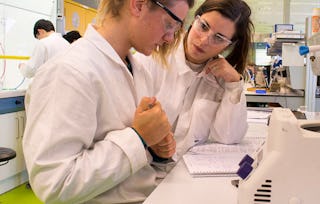
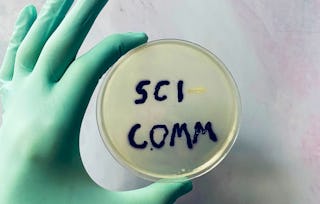
This course will prepare you for teaching science in higher education. In this MOOC you will learn to make your knowledge as an excellent researcher accessible to your students. We will show you how to communicate science to novices as well as advanced students in science. You will experience the value of teaching with analogies and you will be guided to train your students' competences. Based on up-to-date findings from research into teaching and learning science you will be able to
- implement evidence-based strategies into your own teaching,
- use students everyday-conceptions for the development of courses,
- prepare analogies and models to teach in your field,
- implement problem-based teaching,
- set up for experiments and teach the nature of science.
This course enables you to teach abstract science topics to your students and make them become active and successful learners. The course is based on lectures (videos), handouts (knowledge-to practice briefs), which supplement the knowledge taught in the lectures and assignments to implement the teaching strategies into your own practice.
Welcome to your first week of Teaching Science at University! In this first module we will give you an overview of what you will learn during our 5-week course and show you what you can achieve as an excellent lecturer or teaching assistant at your university! In the first lesson our focus is on evidence-based teaching. We will show you how you can base your lectures, lab classes, and courses on science education research. You will learn about main principles of visible learning and mind frames which will help you to embrace these principles. Then we will adapt learning theories to science teaching, starting with behaviorism up to cognitivism, constructivism, and neurodidactics. Interviews with a Professor in Animal Behaviour and a Professor in Neuroscience give further insight in the way we learn. At the end of the first week, you should be able to implement and reflect upon one evidence-based teaching strategy in your own teaching. Have fun!
What's included
7 videos7 readings1 peer review
Show info about module content
7 videos•Total 42 minutes
Course Overview•2 minutes
Evidence-based science teaching•6 minutes
Rate teaching strategies•7 minutes
How the brain computes information•7 minutes
from behaviourism...•5 minutes
...to constructivism•9 minutes
Encouraging higher order thinking•6 minutes
7 readings•Total 54 minutes
Join our research project on effective professional development!!•10 minutes
READ ME!! How to get the most out of our course•2 minutes
K2P Brief #1 Formative Assessment•10 minutes
K2P Brief #2 Powerful Feedback•10 minutes
READ ME - Help FLAG those who weaken the peer review system•10 minutes
READ ME, TOO - IMPORTANT general instructions for assignments and how they are graded•2 minutes
K2P Brief #15 Effective Peer Review•10 minutes
1 peer review•Total 120 minutes
Evidence-based teaching strategy•120 minutes
Conceptual Change
Module 2•2 hours to complete
Module details
Understanding scientific concepts is the core of learning science, but often our pre-instructional conceptions act as barriers to reach an appropriate understanding. In this module we will show how to guide students from their everyday conceptions to scientific ones. You will learn how to use your students’ pre-conceptions not as obstacles but as starting points for teaching science. We will show you some methods for a quick assessment of your students’ conceptions. We look at strategies how we can change our students’ conceptions and how we can help your students to change their ideas. Finally we consider how you as a teacher can foster student engagement in class. At the end of the second week you should be able to address the pre- instructional conceptions of your students in your teaching.
What's included
6 videos2 readings1 peer review
Show info about module content
6 videos•Total 41 minutes
Identifying everyday conceptions•5 minutes
No teaching without everyday conceptions•6 minutes
K2P Brief #4 Making Conceptual Change Happen•10 minutes
1 peer review•Total 60 minutes
Initiate a conceptual change•60 minutes
Teaching with analogies
Module 3•2 hours to complete
Module details
This week we would like to show how invisible concepts become visible. In everyday life we learn so many things by comparing and contrasting. From research we know that the use of analogies and metaphors are important features in the scientific endeavor, and their use in teaching science seems a natural extension. We raise the question whether analogies are just excellent communication tools or if they can generate new knowledge. What do the majority of students really understand when analogies are used to explain abstract and difficult ideas such as molecular structures, diffusion, and plate tectonics? We show that It is important to consider students’ personal constructions since no student enters the lecture hall as “tabula rasa.” Science classrooms are common settings in which analogies are used to enhance concept learning; therefore, improving the way analogies are used in science education has important teaching and learning consequences. At the end of the third week you should be able to choose good analogies for teaching science and implement them fruitfully.
What's included
5 videos4 readings1 peer review
Show info about module content
5 videos•Total 38 minutes
Why science is hard to grasp•10 minutes
Using analogies•7 minutes
How to teach analogies•5 minutes
Successful instructional analogies•9 minutes
Multiple representations in science•8 minutes
4 readings•Total 40 minutes
K2P Brief #5 Big Ideas in Science•10 minutes
K2P Brief #6 Backward Design•10 minutes
K2P Brief #7 - Teaching with Analogies - part 1•10 minutes
K2P Brief #8: Teaching with Analogies - part 2•10 minutes
1 peer review•Total 60 minutes
Develop an analogy•60 minutes
(Re-)Frame your science teaching
Module 4•3 hours to complete
Module details
This week we want to show you how we can frame our science teaching to increase interest, motivation, and understanding of the students. In the first lesson we ask how the framing of science teaching can help students see the relevance of science for society. We look at problems from everyday life and their potential to foster students understanding of science. Activating our students is one key to reducing failure rates in our classrooms. We look how to design a new course by setting the goals our students have to achieve and how to foster learning when supervising a thesis. Finally we look how to communicate risk and uncertainty in an appropriate way to foster understanding. At the end of this week you should be able to frame your science teaching to make it relevant for your students.
What's included
7 videos4 readings1 peer review
Show info about module content
7 videos•Total 53 minutes
Make science relevant•5 minutes
Active learning with socioscientific issues•8 minutes
Tasks for active learners•7 minutes
Active Learning with Digital Tools•8 minutes
Setting goals for students•5 minutes
Supervision of theses•9 minutes
Communication risk and uncertainity•9 minutes
4 readings•Total 40 minutes
K2P Brief #9 Connecting Science and Society•10 minutes
K2P Brief #10 Active Learning•10 minutes
K2P Brief #16 Teaching with Digital Tools•10 minutes
This week we focus on improving students’ learning in a lab or in the field. In the first lesson we show you how to design a lab class, then we focus on delivering a lab class. We show you how you can use design principles (known as “gestalt principles”) to present experiments in a manner which is easy for your students to understand. Then we look at a model on students’ competences on experimentation that you can use to track the development of your students’ conceptual development. From research we know that students often hold inadequate conceptions about the nature of science and the scientific endeavor. We show you how you can address these conceptions to enable your students to understand the meaning of experiments, models, and theories in science. Finally we focus on the role of models in science education. We look at a model for model competence you can use to analyse where your students stand and to train different dimensions of dealing with models. At the end of this week you should be able to design a lab class that improves the inquiry skills of your students.
What's included
8 videos4 readings1 peer review
Show info about module content
8 videos•Total 63 minutes
Conducting a lab class•9 minutes
Interview with a digital simulation user•6 minutes
Preparing a lab class•9 minutes
Design principles for experiments•7 minutes
Identifying and fostering students' experimental competences•10 minutes
Teaching practical skills with digital simulations•7 minutes
Changing students conceptions about the nature of science•7 minutes
Models and modelling in science•7 minutes
4 readings•Total 40 minutes
K2P Brief #11 Inquiry Teaching in the Lab•10 minutes
K2P Brief #12 Teaching the Nature of Science•10 minutes
K2P Brief #13 Teaching with Models•10 minutes
Be a part of our research (again!) - help us improve the course•10 minutes
1 peer review•Total 60 minutes
Foster students' inquiry skills•60 minutes
Instructors
Instructor ratings
Instructor ratings
We asked all learners to give feedback on our instructors based on the quality of their teaching style.
Founded in 1833, the University of Zurich (UZH) is Switzerland’s largest university, with a current enrollment of over 26,000 students. Made up of seven faculties covering approximately 100 different subject areas, UZH is proud to offer the most comprehensive academic program in the country.
"To be able to take courses at my own pace and rhythm has been an amazing experience. I can learn whenever it fits my schedule and mood."
Jennifer J.
Learner since 2020
"I directly applied the concepts and skills I learned from my courses to an exciting new project at work."
Larry W.
Learner since 2021
"When I need courses on topics that my university doesn't offer, Coursera is one of the best places to go."
Chaitanya A.
"Learning isn't just about being better at your job: it's so much more than that. Coursera allows me to learn without limits."
Learner reviews
4.6
196 reviews
5 stars
74.11%
4 stars
18.78%
3 stars
4.06%
2 stars
0.50%
1 star
2.53%
Showing 3 of 196
R
RV
5·
Reviewed on Mar 2, 2018
This is a very exceptional course for me as a teacher. Very helpful insights and learnings. Thanks Prof. Dr. Kai Niebert for you wonderful teaching methodologies. God bless you.
A
AS
5·
Reviewed on Nov 5, 2023
This course is very very information and it help me that in what ways I will convey science concepts to the students. Great experience. Thanks
R
RH
5·
Reviewed on Oct 31, 2023
This course is essential to any one who would like to make a difference with his students.
The course consists of lectures and assignments at the end of each week. The assignment is designed to let you implement the week's course content into your own teaching syllabus, for example when developing an analogy for your own course. By developing the assignments and giving feedback to others' assignments you can collect points to complete the course.
Can I get credit points ( e.g. ECTS) for the course?
The course is designed as a professional development course for people teaching in science contexts. For example PhD students often need to collect credit points in their programs. Unfortunately we cannot give credits. But universities often "translate" the course certificate into credits for your programs. Just ask your supervisors/program leaders.
When will I have access to the lectures and assignments?
To access the course materials, assignments and to earn a Certificate, you will need to purchase the Certificate experience when you enroll in a course. You can try a Free Trial instead, or apply for Financial Aid. The course may offer 'Full Course, No Certificate' instead. This option lets you see all course materials, submit required assessments, and get a final grade. This also means that you will not be able to purchase a Certificate experience.
What will I get if I purchase the Certificate?
When you purchase a Certificate you get access to all course materials, including graded assignments. Upon completing the course, your electronic Certificate will be added to your Accomplishments page - from there, you can print your Certificate or add it to your LinkedIn profile.
Is financial aid available?
Yes. In select learning programs, you can apply for financial aid or a scholarship if you can’t afford the enrollment fee. If fin aid or scholarship is available for your learning program selection, you’ll find a link to apply on the description page.