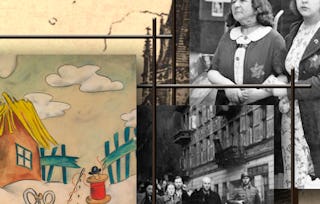
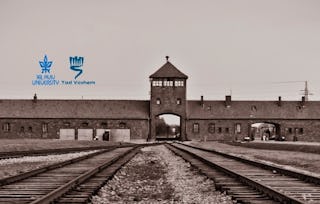
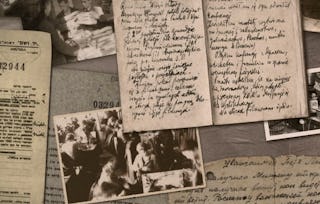
The Holocaust: The Destruction of European Jewry is an adaptation of an on-campus course that has been co-taught by Murray Baumgarten, Distinguished Professor of English and Comparative Literature (Literature Department), and Peter Kenez, Professor Emeritus (History Department), for over 20 years at UC Santa Cruz.
In this course, you will explore the Holocaust from the overlapping perspectives of literature and history—through memoirs, historical documents, poetry, documentary footage, filmic representations, and novels. You will expand your knowledge of the literature of the Holocaust, Eastern and Western European Jewish communities, the origins and development of antisemitism, the establishment of labor and extermination camps, resistance movements, and the Holocaust as a problem for world history.
There is more than one way to take this course: You can complete all of the activities (and earn a Verified Certificate) or only the activities that are most interesting to you. Whatever you choose to do, we encourage you to find a havruta (a study partner) in your community or in the Coursera community so that you can experience the course in a more interactive and meaningful way.
This module is an introduction to the study of the Holocaust and a prehistory of the Holocaust. Profs. Baumgarten and Kenez discuss the roots of modern antisemitism, the culture of European Jews in the 19th century, Nehama Tec’s Dry Tears, and the various genres of Holocaust literature. The module also contains general information about the course.
What's included
13 videos7 readings
Show info about module content
13 videos•Total 161 minutes
1.1.1 Introductions•14 minutes
1.1.2 Who were the Jews?•7 minutes
1.1.3 Why do we study the Holocaust?•12 minutes
1.1.4 Poetry and perspectives•16 minutes
1.2.1 Western European Jewry in the 19th century•10 minutes
1.2.2 Jewish success and European antisemitism•14 minutes
1.2.3 Jews in French society•14 minutes
1.2.4 Roots of modern antisemitism•7 minutes
1.2.5 Theodor Herzl•11 minutes
1.3.1 Expectations of reality•13 minutes
1.3.2 Hier ist kein warum•11 minutes
1.3.3 Yiddish culture•13 minutes
1.3.4 On Account of a Hat•18 minutes
7 readings•Total 70 minutes
Description•10 minutes
Books and films•10 minutes
Writing assignments•10 minutes
Acknowledgements•10 minutes
1.0.1 Topics, readings, and films•10 minutes
1.1.5 Written in Pencil in the Sealed Railway-Car (English translation)•10 minutes
1.3.5 On Account of a Hat (English translation)•10 minutes
Prelude to the Holocaust
Module 2•4 hours to complete
Module details
In this module Profs. Baumgarten and Kenez discuss the changing demographics and political landscape of early 20th century Eastern Europe, Jewish identity, the Bildungsroman, Silvano Arieti’s The Parnas, Primo Levi’s Survival in Auschwitz, Aharon Appelfeld’s Badenheim 1939, and Elie Wiesel’s Night.
What's included
19 videos1 reading
Show info about module content
19 videos•Total 231 minutes
2.1.1 Eastern Europe in the 20th century•9 minutes
2.1.2 Poland, part 1•10 minutes
2.1.3 Poland, part 2•8 minutes
2.1.4 Hungary, part 1•11 minutes
2.1.5 Hungary, part 2•12 minutes
2.1.6 Fear and hatred•6 minutes
2.2.1 Liberal European culture•10 minutes
2.2.2 Night, part 1•12 minutes
2.2.3 Night, part 2•15 minutes
2.2.4 Life in the Arbeitslager•15 minutes
2.3.1 Jewry of the Russian Empire•18 minutes
2.3.2 The Russian state•16 minutes
2.3.3 Changing demographics•9 minutes
2.3.4 Pogroms in the Russian Empire and the USSR•14 minutes
2.3.5 Jewish identity•7 minutes
2.4.1 The Bildungsroman, part 1•8 minutes
2.4.2 The Bildungsroman, part 2•19 minutes
2.4.3 The Bildungsroman, part 3•20 minutes
2.4.4 The Bildungsroman, part 4•12 minutes
1 reading•Total 10 minutes
2.0.1 Topics, readings, and films•10 minutes
Rise of the Nazis
Module 3•4 hours to complete
Module details
In this module Profs. Baumgarten and Kenez discuss the political and social environment of 1930s Germany, the Jewish question, and the treatment of evil in poetry.
What's included
14 videos7 readings
Show info about module content
14 videos•Total 173 minutes
3.1.1 Fascism•13 minutes
3.1.2 Hitler and the Jews•15 minutes
3.1.3 Germans and the Jews•13 minutes
3.1.4 The rise of the Nazis•12 minutes
3.1.5 Nazism in German culture•5 minutes
3.2.1 Poetry and evil, part 1•14 minutes
3.2.2 Poetry and evil, part 2•16 minutes
3.2.3 Poetry and evil, part 3•7 minutes
3.2.4 Todesfugue (Death Fugue)•17 minutes
3.3.1 Intentionalism and functionalism•20 minutes
3.3.2 What do we do with the Jews?•15 minutes
3.3.3 Why didn't they leave?•13 minutes
3.3.4 The Anschluß and German pogroms•6 minutes
3.2.7 Death Fugue (English translation)•10 minutes
3.2.8 Todesfuge (German)•10 minutes
3.2.9 Memento Mori (English translation)•10 minutes
3.2.10 Memento Mori (Yiddish)•10 minutes
Beginnings of war
Module 4•5 hours to complete
Module details
In this module Profs. Baumgarten and Kenez discuss the conditions that were necessary for the Holocaust to occur, the early events of World War II, Thomas Kenneally’s Schindlers List, Andres Schwartz-Bart’s The Last of the Just, and questions of guilt and responsibility.
What's included
15 videos1 reading1 peer review
Show info about module content
15 videos•Total 188 minutes
4.1.1 Questions for the Jews•14 minutes
4.1.2 Direct acts of violence•15 minutes
4.1.3 Fight for what?•13 minutes
4.1.4 Eroticization of violence•13 minutes
4.1.5 Resistance and agency•5 minutes
4.2.1 Beginnings of war•10 minutes
4.2.2 German war aims•11 minutes
4.2.3 Ghettoes•16 minutes
4.2.4 Jewish leadership•14 minutes
4.2.5 What did the neighbors say?•12 minutes
4.3.1 Language of trauma•15 minutes
4.3.2 Banality of evil•16 minutes
4.3.3 Schindler's List, part 1•10 minutes
4.3.4 Schindler's List, part 2•17 minutes
4.3.5 Guilt and responsibility•5 minutes
1 reading•Total 10 minutes
4.0.1 Topics, readings, and films•10 minutes
1 peer review•Total 120 minutes
The Holocaust is still with us•120 minutes
Witness to trauma
Module 5•3 hours to complete
Module details
In this module Profs. Baumgarten and Kenez discuss the invasion of the Soviet Union, Thomas Kenneally’s Schindler’s List, and questions of witnessing. Guest speaker Dora Sorell shares her own experience of the Holocaust.
What's included
16 videos1 reading
Show info about module content
16 videos•Total 185 minutes
5.1.1 Wartime lunacy•7 minutes
5.1.2 Einsatzgruppen, part 1•14 minutes
5.1.3 Einsatzgruppen, part 2•15 minutes
5.1.4 Pogroms in the east•7 minutes
5.1.5 Forms of resistance•18 minutes
5.2.1 Witness to trauma, part 1•13 minutes
5.2.2 Witness to trauma, part 2•15 minutes
5.2.3 Witness to trauma, part 3•18 minutes
5.2.4 Witness to trauma, part 4•12 minutes
5.3.1 Dora Sorell, part 1•9 minutes
5.3.2 Dora Sorell, part 2•7 minutes
5.3.3 Dora Sorell, part 3•8 minutes
5.3.4 Dora Sorell, part 4•9 minutes
5.3.5 Dora Sorell, part 5•9 minutes
5.3.6 Dora Sorell, part 6•13 minutes
5.3.7 Dora Sorell, part 7•11 minutes
1 reading•Total 10 minutes
5.0.1 Topics, readings, and films•10 minutes
Establishment of the camps
Module 6•4 hours to complete
Module details
In this module Profs. Baumgarten and Kenez discuss the establishment of labor and extermination camps, memorialization, Tadeusz Borowski’s This Way for the Gas, Ladies and Gentlemen, and Christopher Browning’s Ordinary Men.
What's included
11 videos1 reading1 peer review
Show info about module content
11 videos•Total 121 minutes
6.1.1 The heart of the matter•11 minutes
6.1.2 From labor to extermination•13 minutes
6.1.3 Bełżec, Sobibór and Treblinka•11 minutes
6.1.4 The task of killing•6 minutes
6.1.5 Auschwitz•11 minutes
6.1.6 Who knew about the murders?•9 minutes
6.2.1 This Way for the Gas, part 1•13 minutes
6.2.2 This Way for the Gas, part 2•7 minutes
6.2.3 This Way for the Gas, part 3•21 minutes
6.2.4 This Way for the Gas, part 4•11 minutes
6.2.5 Memorials and understanding•8 minutes
1 reading•Total 10 minutes
6.0.1 Topics, readings, and films•10 minutes
1 peer review•Total 120 minutes
Analysis of a Holocaust text or film•120 minutes
7.2.6 Never Say/Partisan Song (English translation)•10 minutes
7.2.7 Zog Nit Keyn Mol/Partizaner Lid (Yiddish)•10 minutes
The perpetrators, the neighbors, and the outside world
Module 8•4 hours to complete
Module details
In this module Profs. Baumgarten and Kenez discuss the unique case of Romania, the culpability of the outside world, and the end of World War II. The text of Adolf Hitler’s last testament is provided.
What's included
11 videos2 readings1 peer review
Show info about module content
11 videos•Total 107 minutes
8.1.1 Romania, part 1•15 minutes
8.1.2 Romania, part 2•8 minutes
8.1.3 Romania, part 3•11 minutes
8.1.4 Romania, part 4•13 minutes
8.1.5 A gigantic biological and social experiment•8 minutes
8.2.1 The perpetrators•8 minutes
8.2.2 Other types of madness•8 minutes
8.2.3 The surrounding population•8 minutes
8.2.4 The outside world•5 minutes
8.2.5 Isolation•13 minutes
8.2.6 Last testament•11 minutes
2 readings•Total 20 minutes
8.0.1 Topics, readings, and films•10 minutes
8.2.7 My Political Testament•10 minutes
1 peer review•Total 120 minutes
Explore your ideas from the discussion forum•120 minutes
Instructors
Instructor ratings
Instructor ratings
We asked all learners to give feedback on our instructors based on the quality of their teaching style.
UC Santa Cruz is an outstanding public research university with a deep commitment to undergraduate education. It’s a place that connects people and programs in unexpected ways while providing unparalleled opportunities for students to learn through hands-on experience.
"To be able to take courses at my own pace and rhythm has been an amazing experience. I can learn whenever it fits my schedule and mood."
Jennifer J.
Learner since 2020
"I directly applied the concepts and skills I learned from my courses to an exciting new project at work."
Larry W.
Learner since 2021
"When I need courses on topics that my university doesn't offer, Coursera is one of the best places to go."
Chaitanya A.
"Learning isn't just about being better at your job: it's so much more than that. Coursera allows me to learn without limits."
Learner reviews
4.6
192 reviews
5 stars
76.04%
4 stars
16.66%
3 stars
1.04%
2 stars
1.56%
1 star
4.68%
Showing 3 of 192
R
RM
5·
Reviewed on Aug 5, 2021
If I did not cite when rating this course, THANK YOU to both professors, Coursera, and all involved in making this valuable course available!! Rick
S
SB
5·
Reviewed on Aug 27, 2019
Lots of work, only 3 short papers, but lots of reading. Very interesting and enjoyable. Really went into depth with lots of history and literature discussed. Informative lectures.
B
BB
5·
Reviewed on Nov 5, 2015
The presentations raise vital questions , dis-aggregates historical experience and has generated interest in me to study the issues further . Many thanks to the Professors.
When will I have access to the lectures and assignments?
To access the course materials, assignments and to earn a Certificate, you will need to purchase the Certificate experience when you enroll in a course. You can try a Free Trial instead, or apply for Financial Aid. The course may offer 'Full Course, No Certificate' instead. This option lets you see all course materials, submit required assessments, and get a final grade. This also means that you will not be able to purchase a Certificate experience.
What will I get if I purchase the Certificate?
When you purchase a Certificate you get access to all course materials, including graded assignments. Upon completing the course, your electronic Certificate will be added to your Accomplishments page - from there, you can print your Certificate or add it to your LinkedIn profile.
Is financial aid available?
Yes. In select learning programs, you can apply for financial aid or a scholarship if you can’t afford the enrollment fee. If fin aid or scholarship is available for your learning program selection, you’ll find a link to apply on the description page.