When you enroll in this course, you'll also be enrolled in this Specialization.
Learn new concepts from industry experts
Gain a foundational understanding of a subject or tool
Develop job-relevant skills with hands-on projects
Earn a shareable career certificate
There are 3 modules in this course
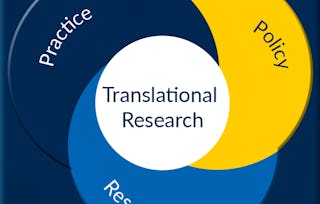
Health research must positively impact the lives of the general population, so the public must receive and interpret research findings in a meaningful way. That is why translating research discoveries into practice is an important phase of the translational research spectrum.
In this course, you’ll gain an introduction to the concepts of population health research and the ethical use of data science to drive advances in human health. Specifically, you’ll learn about the computational models used in population health research, the function of community partners in conducting translational research and disseminating findings, as well as the role of population health during health crises like the COVID-19 pandemic, Opioid crisis, and the Flint, Michigan, USA water crisis.
This is the fourth of five courses in the “Translational Science” series.
Welcome to the course Translating Research to Communities. The process of moving evidence-based clinical discoveries into widespread health practice is a critical part of the translational research spectrum. In this module you will learn how to 1) define the concept of a learning health system, and 2) define community engaged research including how the terms 'community' and 'stakeholder' are defined.
What's included
1 video9 readings2 assignments
Show info about module content
1 video•Total 5 minutes
Exploring the Role of Health Systems•5 minutes
9 readings•Total 120 minutes
Welcome to Translating Research to Communities •10 minutes
Pre-Course Survey•10 minutes
Syllabus•10 minutes
Acknowledgements•10 minutes
A Framework for Value: Creating Learning Health Systems•30 minutes
Defining a Learning Health System•10 minutes
What is Community Engagement?•10 minutes
U.S. Center for Disease Control: What is Community Engagement? •10 minutes
Blog: Community Partners and Community Engaged Research•20 minutes
2 assignments•Total 30 minutes
What is a Learning Health System?•15 minutes
Understanding Community Engagement•15 minutes
Module 2
Module 2•2 hours to complete
Module details
Welcome to Module 2 of the course Translating Research to Communities. In this module you will learn to 1) discuss the importance of the involvement of communities in research, 2) describe examples of research into practice (implementation science), and 3) identify common research techniques used in community engaged translational research.
What's included
3 videos6 readings2 assignments
Show info about module content
3 videos•Total 10 minutes
Interview with Rebecca Hasson: Forming Your Research Team •3 minutes
Interview with Donald Vereen: Building Trust•4 minutes
Interview with Rogerio Pinto: Forming Collaborations•2 minutes
6 readings•Total 92 minutes
Engaging Communities in Research: A Community Perspective•2 minutes
Why Science Needs Community Engagement•10 minutes
Why Community Engagement Matters•10 minutes
The Use of Community Engaged Research Principles to Improve Health: Community Academic Partnerships for Research•30 minutes
Community-Based Participatory Research (CBPR)•10 minutes
Racial Bias in Pulse Oximetry Measurement•30 minutes
2 assignments•Total 30 minutes
Recognizing Community Engagement•15 minutes
Identifying Study Team Members: Community Research•15 minutes
Module 3
Module 3•2 hours to complete
Module details
Welcome to Module 3 of the course Translating Research to Communities. In this module you will 1) discuss the role of the federal government in supporting and regulating community engaged translational research, and 2) discuss the role of culture on research/ pragmatic clinical studies.
What's included
5 readings1 assignment1 discussion prompt
Show info about module content
5 readings•Total 50 minutes
What is PCORI and what does it do? •10 minutes
The Value of Engagement•10 minutes
Dissemination of PCOR (Patient Centered Outcomes Research)•10 minutes
Post Course Survey•10 minutes
Keep Learning with Michigan Online•10 minutes
1 assignment•Total 15 minutes
Examples of Community Engaged Research that has been Translated back to Basic Science Discoveries•15 minutes
1 discussion prompt•Total 60 minutes
Revisiting Your Individual Development Plan (IDP)•60 minutes
Earn a career certificate
Add this credential to your LinkedIn profile, resume, or CV. Share it on social media and in your performance review.
The mission of the University of Michigan is to serve the people of Michigan and the world through preeminence in creating, communicating, preserving and applying knowledge, art, and academic values, and in developing leaders and citizens who will challenge the present and enrich the future.
When will I have access to the lectures and assignments?
To access the course materials, assignments and to earn a Certificate, you will need to purchase the Certificate experience when you enroll in a course. You can try a Free Trial instead, or apply for Financial Aid. The course may offer 'Full Course, No Certificate' instead. This option lets you see all course materials, submit required assessments, and get a final grade. This also means that you will not be able to purchase a Certificate experience.
What will I get if I subscribe to this Specialization?
When you enroll in the course, you get access to all of the courses in the Specialization, and you earn a certificate when you complete the work. Your electronic Certificate will be added to your Accomplishments page - from there, you can print your Certificate or add it to your LinkedIn profile.
Is financial aid available?
Yes. In select learning programs, you can apply for financial aid or a scholarship if you can’t afford the enrollment fee. If fin aid or scholarship is available for your learning program selection, you’ll find a link to apply on the description page.