Computer Courses
Computer courses can help you learn programming languages like Python and Java, data structures, algorithms, and web development fundamentals. You can build skills in software design, debugging, and database management, along with understanding cybersecurity principles. Many courses introduce tools such as Git for version control, SQL for database queries, and frameworks like React for building user interfaces, demonstrating how these skills are applied in real-world projects.
Popular Computer Courses and Certifications
 Status: Free Trial
University of London
Skills you'll gain: Computer Science, Debugging, Development Environment, Computer Systems, Web Applications, Arithmetic, Computer Literacy, General Networking, Javascript, Network Security, Computer Networking, Application Security, Computational Thinking, Computer Programming Tools, Visualization (Computer Graphics), Applied Mathematics, Computer Programming, General Mathematics, Numerical Analysis, Problem Solving
 Status: Free
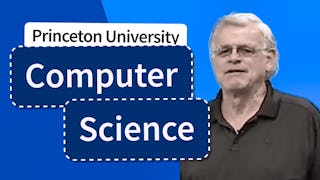
Princeton University
Skills you'll gain: Programming Principles, Computer Programming, Object Oriented Design, Object Oriented Programming (OOP), Performance Tuning, Data Structures, Code Reusability, Other Programming Languages, Java Programming, Java, Program Development, Computational Thinking, Computer Science, Algorithms, Theoretical Computer Science, Animations
 Status: Free Trial
Rice University
Skills you'll gain: Computational Thinking, Event-Driven Programming, Algorithms, Combinatorics, Graph Theory, Programming Principles, Application Development, Object Oriented Programming (OOP), Data Structures, Theoretical Computer Science, Probability, Video Game Development, Bioinformatics, Interactive Design, Animation and Game Design, Python Programming, Data Analysis, User Interface (UI), Computer Science, Computer Programming
 Status: Free Trial
University of London
Skills you'll gain: Arithmetic, Applied Mathematics, Computer Science, General Mathematics, Numerical Analysis, Mathematical Modeling, Algebra, Cryptography, Logical Reasoning, Geometry, Deductive Reasoning
 Status: Free Trial
University of Colorado Boulder
Skills you'll gain: Data Ethics, Security Awareness, Healthcare Ethics, Responsible AI, Ethical Standards And Conduct, Cybersecurity, Diversity Awareness, Generative AI, Artificial Intelligence, Diversity Training, Computer Science, Diversity Programs, digital literacy, Medical Privacy, Information Privacy, Diversity Equity and Inclusion Initiatives, Social Impact, AI Personalization, Media and Communications, Clinical Research Ethics
 Status: Free Trial
Birla Institute of Technology & Science, Pilani
Skills you'll gain: Computational Logic, Logical Reasoning, Deductive Reasoning, Theoretical Computer Science, Analytical Skills, Computer Science, Data Analysis, Computer Programming, Algorithms, Verification And Validation, Program Development, Software Development, Machine Learning
What brings you to Coursera today?
 Status: NewStatus: Free Trial
The Hong Kong University of Science and Technology
Skills you'll gain: Computational Logic, Logical Reasoning, Theoretical Computer Science, Deductive Reasoning, Mathematics and Mathematical Modeling, Computer Science, Algorithms
 Status: NewStatus: Free Trial
The Hong Kong University of Science and Technology
Skills you'll gain: Probability, Computational Logic, Combinatorics, Bayesian Statistics, Algorithms, Theoretical Computer Science, Mathematical Software, Mathematical Theory & Analysis, Cryptography, Logical Reasoning, Deductive Reasoning, Computational Thinking, Computer Science, Encryption, Data Structures, Arithmetic, General Mathematics, Public Key Cryptography Standards (PKCS), Problem Solving, Cybersecurity
 Status: NewStatus: Free Trial
University of London
Skills you'll gain: Computational Logic, Algorithms, Arithmetic, Applied Mathematics, Advanced Mathematics, Mathematics and Mathematical Modeling, Deductive Reasoning, Mathematical Theory & Analysis, Trigonometry, Geometry, Statistics, General Mathematics, Graphing, Computer Science, Mathematical Modeling, Programming Principles, Business Mathematics, Business Logic, Algebra, Problem Solving
 Status: Free Trial
Skills you'll gain: Python Programming, Algorithms, Computer Programming, Theoretical Computer Science, Linear Algebra, Mathematics and Mathematical Modeling, Computer Science, Algebra, Object Oriented Programming (OOP), IBM Cloud, Scripting, Probability, Artificial Intelligence and Machine Learning (AI/ML), Data Processing, Mathematical Modeling, Data Structures, Data Manipulation, Probability & Statistics, Applied Mathematics, Software Installation

Skills you'll gain: Programming Principles, Debugging, Computer Programming, Application Design, Cloud Applications, Computer Science, Code Reusability, Maintainability, Computer Systems, Program Development, Computer Programming Tools, Object Oriented Programming (OOP), Software Development, Data Management, Functional Design, Package and Software Management
 Status: NewStatus: Free Trial
The Hong Kong University of Science and Technology
Skills you'll gain: Bayesian Statistics, Analysis, Computer Science
In summary, here are 10 of our most popular computer courses
- Introduction to Computer Science and Programming: University of London
- Computer Science: Programming with a Purpose: Princeton University
- Fundamentals of Computing: Rice University
- Mathematics for Computer Science: University of London
- Computing, Ethics, and Society: University of Colorado Boulder
- Logic for Computer Science: Birla Institute of Technology & Science, Pilani
- Discrete Math for Computer Science - Logic & Set Theory: The Hong Kong University of Science and Technology
- Discrete Mathematical Tools for Computer Science: The Hong Kong University of Science and Technology
- Essential Mathematics for Computer Science: University of London
- The Complete Quantum Computing Course for Beginners: Packt










