Results for "advanced statistics"
 Status: Free Trial
Johns Hopkins University
Skills you'll gain: Statistical Hypothesis Testing, Sampling (Statistics), Regression Analysis, Bayesian Statistics, Statistical Analysis, Probability & Statistics, Statistical Inference, Statistical Methods, Statistical Modeling, Linear Algebra, Probability, Probability Distribution, R Programming, Biostatistics, Data Analysis, Data Science, Statistics, Mathematical Modeling, Analysis, Data Modeling
 Status: Free Trial
Google
Skills you'll gain: A/B Testing, Sampling (Statistics), Data Analysis, Analytics, Statistics, Descriptive Statistics, Statistical Analysis, Statistical Hypothesis Testing, Probability & Statistics, Statistical Software, Advanced Analytics, Probability Distribution, Data Science, Statistical Inference, Statistical Programming, Statistical Methods, Probability, Python Programming
 Status: NewStatus: Free Trial
Skills you'll gain: Pivot Tables And Charts, Microsoft Excel, Excel Formulas, Data Validation, Spreadsheet Software, Data Manipulation, Data Analysis, Statistical Analysis, Data Visualization Software, Descriptive Statistics, Interactive Data Visualization, Data Processing, Data Integrity
 Status: Free Trial
Illinois Tech
Skills you'll gain: Machine Learning Algorithms, Model Evaluation, Statistical Analysis, Bayesian Statistics, Data Visualization, Statistical Inference, Exploratory Data Analysis, Statistical Methods, Data Presentation, Analysis, Probability & Statistics, Data Cleansing, Applied Machine Learning, Regression Analysis, Analytics, Statistical Programming, Data Analysis, Logistic Regression, R Programming, Verification And Validation
 Status: Free Trial
University of Michigan
Skills you'll gain: Statistical Hypothesis Testing, Sampling (Statistics), Statistical Modeling, Statistical Methods, Statistical Inference, Statistics, Bayesian Statistics, Data Visualization, Plot (Graphics), Matplotlib, Statistical Visualization, Statistical Software, Probability & Statistics, Model Evaluation, Statistical Programming, Data-Driven Decision-Making, Seaborn, Statistical Analysis, Jupyter, Python Programming
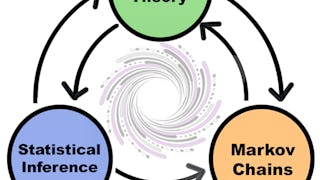 Status: Free Trial
University of Colorado Boulder
Skills you'll gain: Probability, Statistical Inference, Estimation, Probability & Statistics, Statistical Methods, Probability Distribution, Statistics, Bayesian Statistics, Markov Model, Statistical Analysis, Sampling (Statistics), Applied Mathematics, Artificial Intelligence, Machine Learning Methods, Generative AI, Data Analysis, Correlation Analysis, Data Science, Machine Learning Algorithms, Mathematical Theory & Analysis
What brings you to Coursera today?
 Status: Free Trial
Macquarie University
Skills you'll gain: Data-Driven Decision-Making, Microsoft Excel, Forecasting, Regression Analysis, Data Literacy, Excel Formulas, Statistical Analysis, Data Analysis Software, Time Series Analysis and Forecasting, Spreadsheet Software, Analytics, Data Visualization, Statistical Methods, Data Analysis, Statistics, Statistical Hypothesis Testing, Probability & Statistics, Statistical Inference, Statistical Modeling, Variance Analysis
 Status: Free Trial
Vanderbilt University
Skills you'll gain: Prompt Engineering, Prompt Patterns, ChatGPT, Multimodal Prompts, Data Visualization, Plot (Graphics), Data Presentation, Statistical Visualization, File Management, Artificial Intelligence, AI Workflows, File I/O, Generative AI, Marketing Automation, Data Analysis, Business Process Automation, Document Management, Text Mining, Data Transformation, Automation
 Status: Free Trial
Skills you'll gain: A/B Testing, Statistical Hypothesis Testing, Statistical Methods, Advanced Analytics, Statistical Analysis, Statistical Reporting, Correlation Analysis, Data Analysis, Report Writing, Analytics, Analysis, Analytical Skills, Quantitative Research, People Analytics, Workflow Management, Business Analytics, Data-Driven Decision-Making, Business Process Automation
 Status: Free Trial
Skills you'll gain: Regression Analysis, Statistical Analysis, Time Series Analysis and Forecasting, Logistic Regression, R Programming, Statistical Hypothesis Testing, Probability & Statistics, Statistical Modeling, R (Software), Statistical Methods, Predictive Modeling, Generative AI, Forecasting, Power BI, Model Evaluation
 Status: Free Trial
Duke University
Skills you'll gain: Statistical Hypothesis Testing, Statistical Inference, Statistical Reporting, R (Software), Statistical Methods, Statistics, R Programming, Statistical Software, Statistical Analysis, Probability & Statistics, Statistical Programming, Data Analysis, Sampling (Statistics), Probability Distribution, Software Installation
 Status: Free Trial
Illinois Tech
Skills you'll gain: Statistical Analysis, Data Analysis, Data Science, Statistical Programming, Statistical Methods, Statistical Machine Learning, Statistical Modeling, Applied Machine Learning, Model Evaluation, Regression Analysis, Statistics, Machine Learning Methods, Machine Learning Algorithms, Bayesian Statistics, Supervised Learning, Statistical Inference, Machine Learning, Unsupervised Learning, Predictive Modeling, Logistic Regression
In summary, here are 10 of our most popular advanced statistics courses
- Advanced Statistics for Data Science: Johns Hopkins University
- The Power of Statistics: Google
- Excel 365 Intermediate – Data Analysis & Advanced Functions: Packt
- Advanced Statistical Techniques for Data Science: Illinois Tech
- Statistics with Python: University of Michigan
- Foundations of Probability and Statistics: University of Colorado Boulder
- Statistics and Data Analysis with Excel: Advanced: Macquarie University
- ChatGPT Advanced Data Analysis: Vanderbilt University
- Beyond basics: Advanced Data Analysis with Python: Coursera
- Statistical Analysis and Advanced Techniques: Microsoft










