Quality Management Courses
Quality management courses can help you learn process improvement, quality assurance techniques, and statistical analysis. You can build skills in root cause analysis, performance measurement, and implementing quality control systems. Many courses introduce tools like Six Sigma methodologies, Lean principles, and quality management software, showing how these skills can enhance operational efficiency and customer satisfaction.
Popular Quality Management Courses and Certifications

Board Infinity
Skills you'll gain: Quality Management, Quality Management Systems, ISO 9000 Series, Statistical Process Controls, Product Quality (QA/QC), Quality Improvement, Quality Monitoring, Service Improvement, Customer experience strategy (CX), Customer experience improvement, Quality Assurance and Control, Continuous Quality Improvement (CQI), Quality Control, User Feedback, Product Improvement, Continuous Improvement Process, Technical Standard, Process Improvement

Skills you'll gain: Statistical Process Controls, Six Sigma Methodology, Lean Methodologies, Quality Management, Quality Improvement, Lean Six Sigma, Quality Monitoring, Kaizen Methodology, Quality Management Systems, Quality Control, Brainstorming, Benchmarking, Process Improvement, Continuous Quality Improvement (CQI), Run Chart, Continuous Improvement Process, Pareto Chart, Root Cause Analysis, Analysis

Skills you'll gain: Quality Management, Project Closure, Scope Management, Team Management, Project Management Life Cycle, Product Quality (QA/QC), Sprint Retrospectives, Project Management, Project Planning, Agile Project Management, Quality Assessment, Quality Assurance, Backlogs, Team Leadership, Project Scoping, Agile Software Development, Stakeholder Communications, Change Management, Web Presence, Interviewing Skills
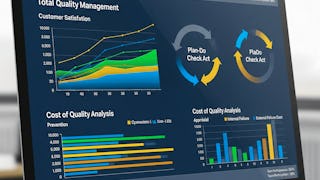
Skills you'll gain: Quality Management, Culture Transformation, Quality Improvement, Quality Management Systems, Continuous Improvement Process, Quality Assessment, Organizational Development, Operational Excellence, Quality Assurance, Process Improvement, Cost Management, Quality Control, Organizational Change, Customer experience improvement, Team Oriented, Organizational Effectiveness, Decision Making, Culture

University of California, Irvine
Skills you'll gain: Conflict Management, Mediation, Negotiation, Communication Strategies, Intercultural Competence, Cultural Diversity, De-escalation Techniques, Cultural Responsiveness, Verbal Communication Skills, Verbal Strategic Communication, Interpersonal Communications, Strategic Communication, Diversity Awareness, Active Listening, Communication Planning, Teamwork, Case Studies, Collaboration, Stakeholder Management, Communication

What brings you to Coursera today?
Skills you'll gain: Process Analysis, Process Modeling, Business Process, Business Analysis, Process Mapping, Process Management, Process Flow Diagrams, Business Process Modeling, Business Modeling, Stakeholder Management, Stakeholder Analysis, Computer Literacy

University of Pennsylvania
Skills you'll gain: Operations Management, Operations, Operational Efficiency, Operational Excellence, Process Improvement and Optimization, Process Analysis, Process Management, Process Optimization, Lean Manufacturing, Process Improvement, Lean Methodologies, Process Mapping, Quality Improvement, Continuous Improvement Process, Capacity Planning, Quality Management, Capacity Management, Supply Chain Management, Quality Control, Statistical Process Controls

Microsoft
Skills you'll gain: Software Testing, Software Quality Assurance, Test Script Development, Test Automation, Acceptance Testing, Test Tools, Test Case, System Testing, Test Planning, Functional Testing, Quality Assurance, Issue Tracking, Test Data, Performance Stress Testing, Browser Compatibility, User Acceptance Testing (UAT), Quality Assurance and Control, Quality Assessment, Interviewing Skills, Quality Management Systems

Rutgers the State University of New Jersey
Skills you'll gain: Strategic Sourcing, Lean Six Sigma, Lean Manufacturing, Demand Planning, Procurement, Supplier Relationship Management, Manufacturing Operations, Forecasting, Supply Chain Planning, Lean Methodologies, Process Improvement, Supplier Management, Production Management, Operations Management, Customer Demand Planning, Inventory Management, Warehousing, Supply Chain, Warehouse Management, Logistics

Skills you'll gain: Dashboard, Data Warehousing, Extract, Transform, Load, Data Storytelling, SQL, Data Visualization, Dashboard Creation, Database Design, Data Security, Data Governance, Data Presentation, Descriptive Statistics, Data Migration, Data Store, Relational Databases, Data Management, Data Architecture, Databases, Excel Formulas, Business Intelligence
Johns Hopkins University
Skills you'll gain: Clinical Data Management, Data Quality, Quality Assurance, Clinical Trial Management Systems, Case Report Forms, Clinical Trials, Data Maintenance, Clinical Monitoring, Data Cleansing, Data Management, Data Integrity, Clinical Research, Microsoft Excel, Data Compilation, Data Collection, Data Sharing, Data Security, Treatment Planning, Statistical Analysis

Skills you'll gain: Earned Value Management, Risk Analysis, Project Risk Management, Quality Assurance and Control, Project Controls, Quality Assurance, Procurement, Product Quality (QA/QC), Cost Management, Purchasing, Quality Control, Data-Driven Decision-Making, Cost Estimation, Project Management, Quality Management, Project Management Life Cycle, Contract Management, Risk Management, Cost Control, Managed Services
What brings you to Coursera today?
Best free Quality Management courses
High-quality free Quality Management courses you can start today.
- Quality Improvement and ManagementBoard InfinityBeginner1 - 4 WeeksFree
- Business Analysis & Process ManagementCourseraBeginnerLess Than 2 HoursFree
Best Quality Management courses from EDUCBA
Top-rated Quality Management courses offered by EDUCBA on Coursera.
- Master Quality Management: Apply SPC, Six Sigma & LeanEDUCBAMixed1 - 4 WeeksEDUCBA
- Mastering Total Quality Management: Analyze, Apply & ImproveEDUCBAMixed1 - 4 WeeksEDUCBA
Best Quality Management certificate programs
Earn a certificate in Quality Management from top universities and companies.
- Google Project ManagementGoogleBeginner3 - 6 MonthsProfessional Certificate
- Conflict ManagementUniversity of California, IrvineBeginner3 - 6 MonthsSpecialization
- Microsoft Junior QA/Software TesterMicrosoftBeginner3 - 6 MonthsProfessional Certificate
Best Quality Management courses for beginners
Top-rated beginner-friendly Quality Management courses with no prerequisites.
- Introduction to Operations ManagementUniversity of PennsylvaniaBeginner1 - 4 WeeksNo prerequisites
- Supply Chain ManagementRutgers the State University of New JerseyBeginner3 - 6 MonthsNo prerequisites
- IBM Data ManagementIBMBeginner3 - 6 MonthsNo prerequisites










