This course is primarily aimed at students of conference interpreting, or people who wish to begin studying conference interpreting. It is based on a long-standing lecture course given by the oldest interpreting school in the world, the Faculty of Translation and Interpreting at the University of Geneva.
Our course looks at organizations from a viewpoint which very few people ever get to see; international organizations seen from the interpreting booth. You will learn about the history, development, structure and functions of international organizations, and of course the question of multilingualism.
The purpose of this course is to help you, as a budding interpreter or translator, to gain basic knowledge about the institutions which may be your future employers, and to give you the essential tools that you will need to easily and efficiently prepare yourself for working at an international organization.
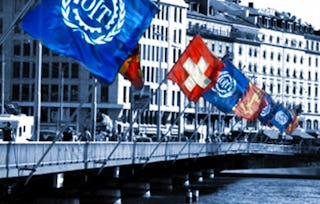
Naturally, Geneva – renowned for its uniquely high concentration of international organizations – takes centre stage in this course. Throughout this course, we will take you with us to visit a number of these organizations, and to benefit from interviews with various experts who will give us an insider’s view of multilateralism, multilingualism and the other topics broached in the course.
Welcome to Module 1 of our course. In this Module you will find out how Geneva became a centre of multilateralism, learn about the main international organizations in Geneva, and learn how to identify different kinds of international organization.
What's included
8 videos3 readings7 assignments
Show info about module content
8 videos•Total 55 minutes
Trailer•2 minutes
Course introduction•5 minutes
Introduction •3 minutes
International Geneva•11 minutes
Interview with Ambassador Jürg Lauber•11 minutes
International organizations in Geneva•7 minutes
What is an international organization?•8 minutes
Joining an international organization•9 minutes
3 readings•Total 32 minutes
📢 Important preliminary information: Evaluations •1 minute
International organizations around the world•30 minutes
📢 Important preliminary information: Evaluations •1 minute
7 assignments•Total 105 minutes
Module 1 final quiz•30 minutes
Lesson 1•10 minutes
International organizations in Geneva•10 minutes
Lesson 2•10 minutes
Categorising international organizations•15 minutes
Country name changes•15 minutes
Lesson 4•15 minutes
History, Evolution and Trends
Module 2•3 hours to complete
Module details
Welcome to Module 2 of our course. In this Module you will learn about the founding of the first international organizations and the growth of the multilateral system. We will focus in particular on the League of Nations, the International Labour Organization (ILO) and the UN system as a whole.
The ILO: interview with Dorothea Hoehtker•12 minutes
The lead-up to the founding of the United Nations•6 minutes
The founding of the United Nations•6 minutes
The expansion of the United Nations •10 minutes
The growth of the multilateral system part 1•6 minutes
The growth of the multilateral system part 2 •7 minutes
The growth of the multilateral system part 3 •6 minutes
4 readings•Total 22 minutes
The successes and failures of the League of Nations•0 minutes
The history of the ILO•10 minutes
The populations of UN member States•10 minutes
External podcast advisory notice•2 minutes
5 assignments•Total 70 minutes
Module 2 final quiz•30 minutes
Lesson 1•10 minutes
Lesson 2•10 minutes
Lesson 3•10 minutes
Lesson 4•10 minutes
2 app items•Total 10 minutes
UN member States•5 minutes
Why were international organizations founded?•5 minutes
1 plugin•Total 15 minutes
The ILO at work•15 minutes
The Structure of International Organizations
Module 3•3 hours to complete
Module details
Welcome to Module 3 of our course. In this Module you will learn about the legal status of international organizations and the functions of their basic texts. We will then examine the structure of organizations, focussing on identifying the various kinds of body found within them. Finally, you will learn about the different kinds of entity that make up the UN system, in particular the UN specialized agencies.
The legal status of international organizations•11 minutes
Interview with Danielle Werthmüller •13 minutes
The basic texts of international organizations •6 minutes
Analysis of a speech by ILO Director-General Guy Ryder•16 minutes
The typical structure of intergovernmental organizations•6 minutes
Intergovernmental bodies •6 minutes
Who represents States within international organizations?•7 minutes
Integrated bodies•7 minutes
The UN system and specialized agencies •5 minutes
UN specialized agencies part 1•5 minutes
UN specialized agencies part 2•5 minutes
1 reading•Total 30 minutes
Analysis of a speech by ILO Director-General Guy Ryder•30 minutes
4 assignments•Total 60 minutes
Module 3 final quiz•30 minutes
Lesson 1•10 minutes
Lesson 2•10 minutes
Lesson 6•10 minutes
2 app items•Total 15 minutes
International organization bodies•10 minutes
Different kinds of UN entity•5 minutes
1 discussion prompt•Total 10 minutes
Analysis of a speech by ILO Director-General Guy Ryder: post your work•10 minutes
The Competencies and Functioning of International Organizations
Module 4•2 hours to complete
Module details
Welcome to Module 4 of our course. In this Module you will learn about the mandates and roles of international organizations. We will look at the tendency of organizations' mandates to gradually expand, and the problems that can ensue. You will also learn how international organizations make decisions.
Mandate overlap case study: the WHO and the IAEA•10 minutes
6 assignments•Total 75 minutes
Module 4 final quiz•30 minutes
Lesson 1•10 minutes
EU texts•5 minutes
Lesson 3•10 minutes
Voting terms definitions•10 minutes
Lesson 4•10 minutes
1 app item•Total 5 minutes
International organization roles•5 minutes
1 discussion prompt•Total 10 minutes
The principle of speciality•10 minutes
Multilingualism in International Organizations
Module 5•3 hours to complete
Module details
Welcome to Module 5 of our course. The Module focusses on topics that are of particular interest to future conference interpreters: languages and multilingualism. You will first learn how the current multilingual system at the UN came to be, which, of course, would not have been possible without simultaneous interpreting. You will learn about the founding of our profession, and the important distinction between official and working languages. We will then examine two important issues linked to multilingualism: the increasing dominance of English and the cost of multilingualism within international organizations.
What's included
10 videos2 readings3 assignments
Show info about module content
10 videos•Total 85 minutes
Introduction•3 minutes
The history of multilingualism part 1•5 minutes
The history of multilingualism part 2•7 minutes
The history of simultaneous interpretation•11 minutes
Language systems•11 minutes
Official and working languages•9 minutes
Interview with Ian Newton •9 minutes
The dominance of English•13 minutes
Interview with François Grin part 1•11 minutes
Interview with François Grin part 2•6 minutes
2 readings•Total 30 minutes
Globish•10 minutes
Le multilinguisme dans les organisations internationales: une perspective économique•20 minutes
3 assignments•Total 50 minutes
Module 5 final quiz•30 minutes
Lesson 1•10 minutes
Lesson 2•10 minutes
Conclusion
Module 6•2 hours to complete
Module details
Welcome to the final Module of our course. This Module will help you assess the benefits and shortcomings of international organizations. We will look at the numerous flaws of international organizations, and the cost of the multilateral system — including typical IO budgets — but we will also assess the importance of international organizations and the multilateral system as a whole.
What's included
6 videos2 readings3 assignments1 app item
Show info about module content
6 videos•Total 50 minutes
Introduction•3 minutes
National sovereignty and multilateralism•10 minutes
The flaws of international organizations •8 minutes
Is multilateralism in crisis?•8 minutes
The importance of international organizations •8 minutes
The cost of international organizations•14 minutes
2 readings•Total 20 minutes
Recommended reading: Les évolutions de l'ONU : Concurrences et intégration•10 minutes
GRAM (Groupement de recherche sur l'action multilatérale)•10 minutes
3 assignments•Total 50 minutes
Module 6 final quiz•30 minutes
Lesson 1•10 minutes
Lesson 3•10 minutes
1 app item•Total 5 minutes
Orders of magnitude•5 minutes
Instructors
Instructor ratings
Instructor ratings
We asked all learners to give feedback on our instructors based on the quality of their teaching style.
Founded in 1559, the University of Geneva (UNIGE) is one of Europe's leading universities. Devoted to research, education and dialogue, the UNIGE shares the international calling of its host city, Geneva, a centre of international and multicultural activities with a venerable cosmopolitan tradition.
When will I have access to the lectures and assignments?
To access the course materials, assignments and to earn a Certificate, you will need to purchase the Certificate experience when you enroll in a course. You can try a Free Trial instead, or apply for Financial Aid. The course may offer 'Full Course, No Certificate' instead. This option lets you see all course materials, submit required assessments, and get a final grade. This also means that you will not be able to purchase a Certificate experience.
What will I get if I purchase the Certificate?
When you purchase a Certificate you get access to all course materials, including graded assignments. Upon completing the course, your electronic Certificate will be added to your Accomplishments page - from there, you can print your Certificate or add it to your LinkedIn profile.
Is financial aid available?
Yes. In select learning programs, you can apply for financial aid or a scholarship if you can’t afford the enrollment fee. If fin aid or scholarship is available for your learning program selection, you’ll find a link to apply on the description page.