When you enroll in this course, you'll also be enrolled in this Specialization.
Learn new concepts from industry experts
Gain a foundational understanding of a subject or tool
Develop job-relevant skills with hands-on projects
Earn a shareable career certificate
There are 3 modules in this course
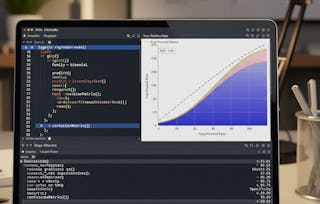
This course introduces learners to the analysis of binary/dichotomous outcomes. Learners will become familiar with fundamental tests for two-group comparisons and statistical inference plus prediction more broadly using logistic regression. They will understand the connection between prevalence, risk ratios, and odds ratios. By the end of this course, learners will be able to understand how binary outcomes arise, how to use R to compare proportions between two groups, how to fit logistic regressions in R, how to make predictions using logistic regression, and how to assess the quality of these predictions. All concepts taught in this course will be covered with multiple modalities: slide-based lectures, guided coding practice with the instructor, and independent but structured exercises.
This module introduces you to binary outcomes, including how they arise, how to calculate proportions, and how to compare proportions between two groups.
Data Science for Health Research: Specialization Introduction•6 minutes
How and When Binary Outcomes Can Arise•7 minutes
A Need for Models Beyond Linear Regression•4 minutes
Binary Outcomes, Comparing Between Two Groups (Part 1)•10 minutes
Binary Outcomes, Comparing Between Two groups (part 2)•6 minutes
Binary Outcomes, Comparing Between Two groups (part 3)•2 minutes
Guided Practice: Z-Test•15 minutes
Guided Practice: Fisher's Exact Test•13 minutes
Analyzing a Binary Outcome and Binary Exposure with the Odds Ratio•6 minutes
Interpreting the Odds Ratio•5 minutes
2x2 Example: The WCGS Cardiovascular Study•6 minutes
8 readings•Total 73 minutes
Meet Your Instructors•3 minutes
Welcome & Course Syllabus•10 minutes
Pre-Course Survey•10 minutes
Introduction To and How To Use Independent Guides •10 minutes
Introduction to the BPUrban Data•10 minutes
1.2 Independent Guide•10 minutes
1.2 Discussion Prompt Suggested Answer•10 minutes
End of Module 1 Discussion Prompt Suggested Answer•10 minutes
2 assignments•Total 90 minutes
1.2 Practice Quiz•30 minutes
Module 1 Quiz•60 minutes
3 discussion prompts•Total 30 minutes
Meet Your Fellow Global Classmates•10 minutes
1.2 Discussion Prompt•10 minutes
End of Module 1 Discussion Prompt•10 minutes
Introducing Logistic Regression
Module 2•3 hours to complete
Module details
In this module, you will be introduced to the ubiquitous logistic regression, one of the most common tools for measuring the association between one or more predictors and a binary outcome.
What's included
11 videos2 readings3 assignments
Show info about module content
11 videos•Total 80 minutes
Limitations of the 2x2 Table Analysis•2 minutes
Logistic Regression: A First Look•7 minutes
Visualizing and Interpreting a Logistic Regression•9 minutes
Revising the 2x2 Example: WCGS Cardiovascular Study•6 minutes
Guided practice: Fitting a Simple Logistic Regression Against One Variable•11 minutes
Extending the WCGS Cardiovascular Model with Multivariable Logistic Regression•7 minutes
Prediction with Multivariable Logistic Regression•5 minutes
Logistic Regression: A Recap and Review•7 minutes
Guided Practice: Fitting a Logistic Regression Against More Than One Variable•7 minutes
The mission of the University of Michigan is to serve the people of Michigan and the world through preeminence in creating, communicating, preserving and applying knowledge, art, and academic values, and in developing leaders and citizens who will challenge the present and enrich the future.
When will I have access to the lectures and assignments?
To access the course materials, assignments and to earn a Certificate, you will need to purchase the Certificate experience when you enroll in a course. You can try a Free Trial instead, or apply for Financial Aid. The course may offer 'Full Course, No Certificate' instead. This option lets you see all course materials, submit required assessments, and get a final grade. This also means that you will not be able to purchase a Certificate experience.
What will I get if I subscribe to this Specialization?
When you enroll in the course, you get access to all of the courses in the Specialization, and you earn a certificate when you complete the work. Your electronic Certificate will be added to your Accomplishments page - from there, you can print your Certificate or add it to your LinkedIn profile.
Is financial aid available?
Yes. In select learning programs, you can apply for financial aid or a scholarship if you can’t afford the enrollment fee. If fin aid or scholarship is available for your learning program selection, you’ll find a link to apply on the description page.