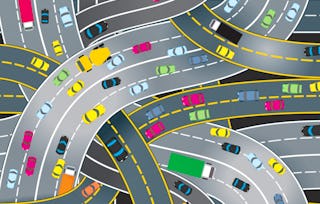
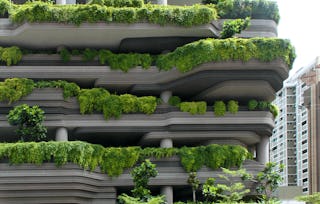
Our streetscape, despite its feeling of permanence in our environment, is an ideal venue for experimentation. We have come to accept traffic movement as the default function for the street. Therefore, we need to rethink its design and space distribution, go back to its original and basic function and see them as public spaces - Transform them into places for social activities, where conversations can take place and places where kids can play. This course shows you examples of remarkable changes and gives you a toolbox for implementing and evaluating street experiments yourself. We invite you on this journey to reimagine what is possible if we dare to use our public space differently.
This week, we will explore how the COVID-19 pandemic served as a catalyst to open people's thinking about using streets for more social purposes and answer the question, "can functions of mobility and public space co-exist and simultaneously increase the liveability of cities?" We will visit a brief history of the evolution of streets, both in concept and using historical examples, and see how ideology influences people's willingness to reshape the street for different functions. Surprisingly, even automakers see the limitations of cars and are taking steps to hedge against different mobility futures by investing in street experiments and shared mobility.
What's included
6 videos9 readings1 assignment2 plugins
Show info about module content
6 videos•Total 41 minutes
What will this course be about? A four-week overview•2 minutes
Introduction to the Technical University of Munich •3 minutes
Introduction: The need of experimenting with streets•1 minute
The Pandemic as a Street Experiment•6 minutes
Why should we experiment with streets?•12 minutes
Shaping Urban Mobility, an Automaker's Surprising Perspective•17 minutes
9 readings•Total 68 minutes
About this Course•2 minutes
About EIT Urban Mobility•2 minutes
Street Experiments Course Roadmap •10 minutes
Main Takeaways: The Pandemic as a Street Experiment•2 minutes
Urban Streets between Public Space and Mobility•10 minutes
Urban mobility and public space. A challenge for the sustainable liveable city of the future•15 minutes
Introduction to the final assignment •10 minutes
A Street You Go To, Not Just Through: Principles for Fostering Streets as Places•15 minutes
Week 1 in a nutshell•2 minutes
1 assignment•Total 20 minutes
Understanding the Street as Public Space•20 minutes
2 plugins•Total 30 minutes
Make Way for the 'One-Minute City'•15 minutes
The importance of Public Spaces: Place Value by Matthew Carmona•15 minutes
Getting to Know Street Experiments
Module 2•2 hours to complete
Module details
This week, we go around the world to see practical examples of street experiments in action. In doing so, we see how experiments can be categorized into 4 different typologies in ascending functional complexity: simple street re-markings, alternative uses of parking spaces, reconversion of sections of streets, and the opening of entire streets to uses other than motorized traffic. We then pose the question, "How can tactical urbanism help create healthier streets?" leading us to find that bottom-up initiatives can be powerful instigators of change.
What's included
3 videos2 readings1 assignment3 plugins
Show info about module content
3 videos•Total 17 minutes
Introduction: Getting to know Street Experiments •1 minute
4 Types of Street Experiments by Luca Bertolini, Part 1•4 minutes
4 Types of Street Experiments by Benjamin Büttner, Part 2•12 minutes
2 readings•Total 32 minutes
From “streets for traffic” to “streets for people”: can street experiments transform urban mobility?•30 minutes
Week 2 in a nutshell •2 minutes
1 assignment•Total 20 minutes
Getting to know Street Experiments •20 minutes
3 plugins•Total 45 minutes
How can tactical urbanism help create healthier streets? •15 minutes
Janette Sadik-Khan TED Talk•15 minutes
Architect's hands: how can we design better streets | Evelina Ozola | TEDxRiga•15 minutes
Implementing Street Experiments
Module 3•2 hours to complete
Module details
This week explores how street experiments are implemented, from start to finish, and we will learn about the challenges along the way. We find that street experiments are often the starting point for the transition of public space, and these experiments give people the chance to experience, to really feel the changes immersively, rather than just seeing plans on a board. We learn how to approach strategic problems by using tactical urbanism techniques, and how colorful and eyecatching spaces can do its own marketing. Finally, we make the connection between culture and street design, framing experiments in the context of "mobility culture" and asking us how real world laboratories can explore existing culture and explore new cultures.
What's included
4 videos3 readings1 assignment
Show info about module content
4 videos•Total 73 minutes
Introduction: Implementing Street Experiments•1 minute
Experimenting with Streets in Munich, Germany - Melanie Grötsch •15 minutes
Experimenting with Streets in Milan - Rossella Ferorell•26 minutes
Experimenting with Streets in Stuttgart - Jesús Martínez•31 minutes
3 readings•Total 27 minutes
Enhancing the Value of Urban Spaces by Re-Shaping Mobility: What Makes Street Experiments Successful?•20 minutes
The Wisdom of Practitioners in Munich, Milan, and Stuttgart•5 minutes
Week 3 in a nutshell •2 minutes
1 assignment•Total 20 minutes
Key aspects of successful Street Experiments•20 minutes
Evaluating Street Experiments
Module 4•6 hours to complete
Module details
This week, we ask "are we really challenging mobility systems with these relatively small scale experiments?" Despite all the colorful experimentation taking place around the world, not all experiments lead to permanent changes. We will explore how experiments can serve as short term actions through which alternative structure, cultures and practices are explored. We then look at the five characteristics of the city street experiments: Are they... radical, change-driven, feasible, strategic, and communicative? They are an initial step in the assessment framework since street experiments are so complex. Finally, we are challenged to involve citizens in the experimentation process, and you will learn that buy-in of the community is essential to the long-term success of making experiments permanent.
What's included
5 videos3 readings1 assignment1 peer review
Show info about module content
5 videos•Total 41 minutes
Introduction: From evaluation to systemic change•3 minutes
Evaluating Street Experiments•7 minutes
Experimentation, participation, & the right to reimagine the city Lior Steinberg (Humankind)•14 minutes
Five Essential Characteristics of Street Experiments•8 minutes
Experiencing Piazza Zenetti in Munich, Germany•8 minutes
3 readings•Total 32 minutes
From temporary arrangements to permanent change: Assessing the transitional capacity of city street experiments.•20 minutes
Making great strides: Learning from the revolution on Milan's post pandemic streets•10 minutes
Week 4 in a nutshell •2 minutes
1 assignment•Total 20 minutes
From temporary arrangements to systemic change •20 minutes
1 peer review•Total 240 minutes
Reflections about Street Experiments•240 minutes
Instructors
Instructor ratings
Instructor ratings
We asked all learners to give feedback on our instructors based on the quality of their teaching style.
Technical University of Munich (TUM) is one of Europe’s top universities. It is committed to excellence in research and teaching, interdisciplinary education and the active promotion of promising young scientists. The university forges strong links with companies and scientific institutions across the world. TUM was one of the first universities in Germany to be named a University of Excellence. TUM does not pass any personal data to the platform providers. If you take part in one of our MOOCs, please refer to the data protection guidelines in the terms and conditions of the provider.
This online course is supported by the EIT Urban Mobility’s Competence Hub. EIT Urban Mobility is an initiative of the European Institute of Innovation and Technology (EIT) that has been working since January 2019 to encourage positive changes in the way people move around cities in order to make them more sustainable and liveable places.
Within EIT Urban Mobility’s Academy, the Competence Hub provides training programmes and content for professionals working in the field of urban mobility. We leverage the expertise of EIT Urban Mobility’s unique network of 85+ European companies, research institutions, universities and cities, to identify trends and new technologies, highlight key issues and controversies, as well as to create innovative and useful training programmes. By helping urban mobility professionals around Europe acquiring the right knowledge and developing the relevant skills, we will close the urban mobility knowledge gap and make our cities more resilient and viable.
When will I have access to the lectures and assignments?
To access the course materials, assignments and to earn a Certificate, you will need to purchase the Certificate experience when you enroll in a course. You can try a Free Trial instead, or apply for Financial Aid. The course may offer 'Full Course, No Certificate' instead. This option lets you see all course materials, submit required assessments, and get a final grade. This also means that you will not be able to purchase a Certificate experience.
What will I get if I purchase the Certificate?
When you purchase a Certificate you get access to all course materials, including graded assignments. Upon completing the course, your electronic Certificate will be added to your Accomplishments page - from there, you can print your Certificate or add it to your LinkedIn profile.
Is financial aid available?
Yes. In select learning programs, you can apply for financial aid or a scholarship if you can’t afford the enrollment fee. If fin aid or scholarship is available for your learning program selection, you’ll find a link to apply on the description page.