GPU Courses
GPU courses can help you learn parallel computing, graphics rendering, machine learning applications, and deep learning techniques. You can build skills in optimizing algorithms, enhancing computational efficiency, and utilizing frameworks for AI development. Many courses introduce tools like TensorFlow, CUDA, and PyTorch, that support implementing GPU-accelerated applications and conducting data analysis.
Popular GPU Courses and Certifications

Johns Hopkins University
Skills you'll gain: Artificial Neural Networks, Image Analysis, Event-Driven Programming, Scalability, Applied Machine Learning, Deep Learning, C and C++, Memory Management, Performance Tuning, C++ (Programming Language), Digital Signal Processing, Linear Algebra, Distributed Computing, Hardware Architecture, Programming Principles, Computer Architecture, System Programming, Program Development, OS Process Management, Machine Learning
Coursera
Skills you'll gain: Model Deployment, Containerization, Application Deployment, MLOps (Machine Learning Operations), AI Orchestration, Docker (Software), Cloud Deployment, Kubernetes, AI Workflows, Model Training, Distributed Computing, Cloud Computing, Scalability, Cloud Infrastructure
Birla Institute of Technology & Science, Pilani
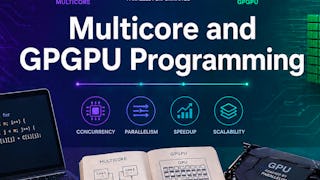
Skills you'll gain: Microarchitecture, Computer Architecture, Hardware Architecture, System Programming, Distributed Computing, C and C++, Performance Tuning, Memory Management, Algorithms, OS Process Management, Program Development, Scalability, Data Sharing, Performance Testing
Skills you'll gain: C and C++, C++ (Programming Language), Development Environment, Performance Tuning, Test Tools, Docker (Software), Computer Architecture, Containerization, Development Testing, Programming Principles, Software Development Tools, Hardware Architecture, Performance Testing, Algorithms, Computer Programming, Python Programming, Debugging, Memory Management, Software-Defined Networking, Scripting
Skills you'll gain: Data Preprocessing, Unsupervised Learning, Model Evaluation, Time Series Analysis and Forecasting, Supervised Learning, Machine Learning, Machine Learning Methods, Artificial Intelligence and Machine Learning (AI/ML), Applied Machine Learning, Machine Learning Algorithms, Data Processing, Model Training, Feature Engineering, Artificial Intelligence, Deep Learning, Classification Algorithms, Model Optimization, Regression Analysis

What brings you to Coursera today?

Pragmatic AI Labs
Skills you'll gain: Prompt Engineering, Hugging Face, Fine-tuning, Model Deployment, MLOps (Machine Learning Operations), CI/CD, Continuous Deployment, Model Evaluation, Applied Machine Learning, Continuous Integration, Transfer Learning, Agentic Workflows, Data Preprocessing, Generative AI Agents, Model Training, Large Language Modeling, Image Analysis, Rust (Programming Language), Model Optimization, AI Orchestration

Skills you'll gain: Computer Graphics, Software Architecture, Development Environment, Software Design, Maintainability, Software Visualization, Systems Architecture, Software Design Patterns, Code Reusability, Graphics Software, Visualization (Computer Graphics), Systems Design, Cross Platform Development, Computer Graphic Techniques, Image Quality, System Design and Implementation, Video Game Development, Dataflow, Performance Tuning, Scalability

Google Cloud
Skills you'll gain: Hardware Architecture, Google Cloud Platform, Cloud Infrastructure, Model Optimization, Application Specific Integrated Circuits, Performance Tuning, Computing Platforms, Cloud Hosting, Model Training, Cloud Platforms, System Configuration

Johns Hopkins University
Skills you'll gain: Performance Tuning, Memory Management, System Programming, Hardware Architecture, Program Development, Performance Testing, Computer Hardware, Algorithms

Johns Hopkins University
Skills you'll gain: C and C++, C++ (Programming Language), Hardware Architecture, Programming Principles, Computer Architecture, OS Process Management, Data Access, Program Development, Algorithms, Python Programming, Data Sharing, Development Environment

Skills you'll gain: PyTorch (Machine Learning Library), Model Optimization, Transfer Learning, Convolutional Neural Networks, Artificial Neural Networks, Deep Learning, Model Training, Logistic Regression, Image Analysis, Applied Machine Learning, Model Evaluation, Computer Vision, Classification Algorithms, Supervised Learning, Artificial Intelligence and Machine Learning (AI/ML), Machine Learning, Statistical Methods

Duke University
Skills you'll gain: MLOps (Machine Learning Operations), GitHub Copilot, Responsible AI, Model Deployment, Containerization, Web Frameworks, Rust (Programming Language), AI Workflows, DevOps, Hugging Face, Applied Machine Learning, Cloud Solutions, Cloud-Native Computing, Machine Learning, Serverless Computing, Application Deployment, GitHub, Command-Line Interface, Big Data
What brings you to Coursera today?
Best Gpu courses from Johns Hopkins University
Top-rated Gpu courses offered by Johns Hopkins University on Coursera.
- GPU ProgrammingJohns Hopkins UniversityIntermediate3 - 6 MonthsJohns Hopkins University
- Introduction to Parallel Programming with CUDAJohns Hopkins UniversityIntermediate1 - 3 MonthsJohns Hopkins University
- Introduction to Concurrent Programming with GPUsJohns Hopkins UniversityBeginner1 - 3 MonthsJohns Hopkins University
Best Gpu certificate programs
Earn a certificate in Gpu from top universities and companies.
- Next-Gen AI Development with Hugging FacePragmatic AI LabsBeginner3 - 6 MonthsSpecialization
- Apply OpenGL Rendering Pipeline ArchitectureEDUCBABeginner3 - 6 MonthsSpecialization










