Cours en Data Science
Les cours en data science peuvent vous aider à comprendre comment analyser des données, créer des modèles et évaluer leurs performances. Vous pouvez développer des compétences en statistique, apprentissage automatique, préparation des données et visualisation. De nombreux cours utilisent des langages et bibliothèques courants pour travailler sur des projets pratiques.
Cours et certificats populaires en Data Science

University of Colorado Boulder
Skills you'll gain: Prompt Engineering, New Product Development, Sustainability Reporting, Model Based Systems Engineering, Model Evaluation, Generative AI, Agile Project Management, Sustainable Business, Data Mining, Field-Programmable Gate Array (FPGA), Delegation Skills, Strategic Decision-Making, Real-Time Operating Systems, Object Oriented Design, Sampling (Statistics), Failure Analysis, Data Ethics, Goal Setting, Database Design, Data Visualization

University of Huddersfield
Skills you'll gain: Data Literacy, Linear Algebra, Graph Theory, Statistical Software, Big Data, Computational Logic, Back-End Web Development, Integral Calculus, Analytics, Matplotlib, Data Visualization, Probability & Statistics, Statistical Programming, Plot (Graphics), Calculus, Scatter Plots, Data Mining, R Programming, Relational Databases, Applied Mathematics

University of Illinois at Urbana-Champaign
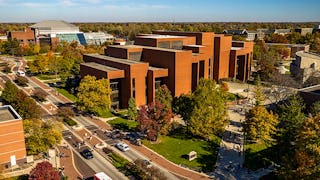
Ball State University
Skills you'll gain: Data Ethics, Responsible AI, Software Engineering, Full-Stack Web Development, Graph Theory, Data Wrangling, Statistical Machine Learning, File Systems, Database Systems, Spatial Analysis, Exploratory Data Analysis, Theoretical Computer Science, Statistical Hypothesis Testing, SAS (Software), Statistical Methods, Cryptography, Statistical Inference, Object Oriented Programming (OOP), Artificial Intelligence, Text Mining

University of Leeds
Skills you'll gain: Data Ethics, Bayesian Statistics, Data Storytelling, Social Network Analysis, Exploratory Data Analysis, Statistical Machine Learning, Classification And Regression Tree (CART), Predictive Analytics, Statistical Hypothesis Testing, Dimensionality Reduction, Data Visualization, Statistical Visualization, Data Analysis, Machine Learning Methods, Statistical Programming, Web Scraping, Probability Distribution, File I/O, Statistical Modeling, Linear Algebra

What brings you to Coursera today?

University of London
Skills you'll gain: Human Computer Interaction, Virtual Reality, Game Design, Full-Stack Web Development, Mobile Development, Agile Software Development, Animations, Data Ethics, Event-Driven Programming, Git (Version Control System), Web Applications, Incident Response, Data Science, Natural Language Processing, Data Transformation, Combinatorics, Database Design, Model Evaluation, Web Development, Generative AI

University of Pittsburgh
Skills you'll gain: LLM Application, Bayesian Statistics, Large Language Modeling, Generative AI, Data Ethics, Data Visualization, Database Management, Database Design, SQL, Supervised Learning, Database Theory, Web Services, Time Series Analysis and Forecasting, Database Systems, Databases, Data Visualization Software, Retrieval-Augmented Generation, Unsupervised Learning, Linear Algebra, Technical Communication

Ball State University
Skills you'll gain: Data Ethics, Responsible AI, Software Engineering, Full-Stack Web Development, Graph Theory, Data Wrangling, Statistical Machine Learning, File Systems, Database Systems, Spatial Analysis, Exploratory Data Analysis, Theoretical Computer Science, SAS (Software), Statistical Methods, Cryptography, Statistical Inference, Object Oriented Programming (OOP), Artificial Intelligence, Text Mining, Financial Data

Illinois Institute of Technology
Skills you'll gain: Database Design, Database Systems, Statistical Analysis, Time Series Analysis and Forecasting, Relational Databases, Database Software, Databases, Database Application, Database Management, Database Theory, Data Analysis, NoSQL, Database Management Systems, Database Development, Machine Learning Algorithms, Recurrent Neural Networks (RNNs), Bayesian Statistics, Statistical Inference, Technical Communication, Model Evaluation

IIT Guwahati
Skills you'll gain: Relational Databases, Package and Software Management, Generative AI, Data Visualization, Time Series Analysis and Forecasting, Linear Algebra, C (Programming Language), Java Programming, Cloud Computing, Data Structures, R (Software), Data Warehousing, Database Management, Social Network Analysis, Econometrics, File I/O, Probability, Bayesian Network, English Language, Algorithms

O.P. Jindal Global University
Skills you'll gain: Design Thinking, Operations Management, Active Listening, Working Capital, Database Management, Environmental Social And Corporate Governance (ESG), Sampling (Statistics), Project Estimation, Dashboard, Business Strategy, Business Analytics, Human Resources Management and Planning, Data Visualization, Capital Budgeting, Marketing Management, Financial Accounting, Business Economics, Predictive Analytics, Financial Statements, Big Data

University of London
Skills you'll gain: Process Design, Global Marketing, Consumer Behaviour, Statistical Analysis, Organizational Change, Supply Management, Process Mapping, Statistical Methods, Integrated Marketing Communications, Innovation, Mergers & Acquisitions, Performance Measurement, Training and Development, Virtual Teams, Databases, International Finance, Research, Branding, Economic Development, Cultural Diversity
What brings you to Coursera today?
Best Data Science courses from Ball State University
Top-rated Data Science courses offered by Ball State University on Coursera.
- Master of Science in Data ScienceBall State University1 - 4 YearsBall State University
- Master of Science in Computer ScienceBall State University1 - 4 YearsBall State University










