Cours en Data Science
Les cours en data science peuvent vous aider à comprendre comment analyser des données, créer des modèles et évaluer leurs performances. Vous pouvez développer des compétences en statistique, apprentissage automatique, préparation des données et visualisation. De nombreux cours utilisent des langages et bibliothèques courants pour travailler sur des projets pratiques.
Cours et certificats populaires en Data Science

Coursera
Skills you'll gain: Applied Machine Learning, Predictive Modeling, Jupyter, Predictive Analytics, Model Evaluation, Model Optimization, Data Analysis, Machine Learning, Data Science, Python Programming
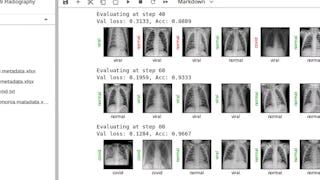
Skills you'll gain: PyTorch (Machine Learning Library), Model Training, Convolutional Neural Networks, Transfer Learning, Image Analysis, Predictive Modeling, Deep Learning, Radiology, Medical Imaging, Machine Learning, Computer Vision, Data Preprocessing, Data Transformation
Skills you'll gain: Pandas (Python Package), NumPy, Data Analysis, Data Science, Python Programming, Data Structures, Data Manipulation, Analysis
Coursera
Skills you'll gain: Amazon S3, Amazon Web Services, Cloud Hosting, Cloud Storage, Version Control, Encryption, Data Storage, Cloud Security
Skills you'll gain: Microsoft Excel, Excel Formulas, Pivot Tables And Charts, Data Analysis, Data Manipulation, Microsoft Office, Data Mining

What brings you to Coursera today?
Skills you'll gain: Google Analytics, Web Analytics and SEO, Statistical Reporting, Data-Driven Marketing, Analytics, Data Analysis, User Accounts

Coursera
Skills you'll gain: Portfolio Risk, Investment Management, Risk Management, Financial Analysis, Financial Management, Risk Modeling, Risk Analysis, Portfolio Management, Financial Market, Investments, Statistics
Skills you'll gain: Model Deployment, Decision Tree Learning, Applied Machine Learning, Predictive Modeling, Machine Learning Software, Microsoft Azure, No-Code Development, Machine Learning, Data Preprocessing, Predictive Analytics, Model Training, Cloud Deployment, Feature Engineering, Machine Learning Algorithms, Model Evaluation, Data Science, Data Analysis, Classification Algorithms
Coursera
Skills you'll gain: Statistical Reporting, Data Visualization, Big Data, SQL, Interactive Data Visualization, Query Languages, Data Import/Export, Google Cloud Platform, Data Warehousing, Data Sharing, Analytics
Skills you'll gain: Fine-tuning, Tensorflow, Keras (Neural Network Library), Model Training, Model Evaluation, Transfer Learning, Natural Language Processing, Data Preprocessing, Deep Learning, Data Pipelines
Skills you'll gain: Google Sheets, Data Visualization, Spreadsheet Software, Data Presentation, Plot (Graphics), Statistical Visualization, Data Analysis, Business Analytics, Descriptive Analytics, Productivity Software, Business Analysis, Data Manipulation, Google Workspace, Analytics, Descriptive Statistics, Statistics, Data Cleansing

Skills you'll gain: Technical Analysis, Google Sheets, Spreadsheet Software, Market Data, Cloud Computing, Data Visualization, Trend Analysis
What brings you to Coursera today?
Best free Data Science courses
High-quality free Data Science courses you can start today.
- AWS S3 BasicsCourseraBeginnerLess Than 2 HoursFree
- Introduction to Data Analysis using Microsoft ExcelCourseraIntermediateLess Than 2 HoursFree
- Getting Started in Google AnalyticsCourseraBeginnerLess Than 2 HoursFree
Best Data Science courses from Coursera
Top-rated Data Science courses offered by Coursera on Coursera.
- Data Science ChallengeCourseraIntermediateLess Than 2 HoursCoursera
- Detecting COVID-19 with Chest X-Ray using PyTorchCourseraIntermediateLess Than 2 HoursCoursera
- Python for Data Analysis: Pandas & NumPyCourseraBeginnerLess Than 2 HoursCoursera
Best Data Science courses for beginners
Top-rated beginner-friendly Data Science courses with no prerequisites.
- Machine Learning Pipelines with Azure ML StudioCourseraBeginnerLess Than 2 HoursNo prerequisites
- Working with BigQueryCourseraBeginnerLess Than 2 HoursNo prerequisites
- Introduction to Business Analysis Using Spreadsheets: BasicsCourseraBeginnerLess Than 2 HoursNo prerequisites
Best short Data Science courses
Quick Data Science courses you can complete in a few hours or less.
- Investment Risk ManagementCourseraIntermediateLess Than 2 HoursQuick completion
- Fine Tune BERT for Text Classification with TensorFlowCourseraIntermediateLess Than 2 HoursQuick completion
- Building Candlestick Charts with Google SheetsCourseraBeginnerLess Than 2 HoursQuick completion










