Data Visualization Courses
Data visualization courses cover how to present data visually to convey information clearly. You’ll learn about various techniques, including charts, graphs, and dashboards, along with tools like Tableau and Power BI. These skills will enable you to transform raw data into visuals that make insights easier to understand.
Popular Data Visualization Courses and Certifications

Coursera
Skills you'll gain: Data Visualization, Data Presentation, Google Sheets, Data Compilation, Data Visualization Software, Graphing, Spreadsheet Software
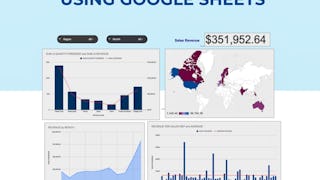
Skills you'll gain: Dashboard Creation, Google Sheets, Spreadsheet Software, Pivot Tables And Charts, Data Visualization, Data Analysis, Data Cleansing

Skills you'll gain: Data Storytelling, Plotly, Matplotlib, Interactive Data Visualization, Seaborn, Plot (Graphics), Data Visualization, Statistical Visualization

Coursera
Skills you'll gain: Plot (Graphics), Data Visualization Software, Data Visualization, Geospatial Mapping, Software Installation, Python Programming

Skills you'll gain: Google Analytics, Analytics, Data Analysis, User Accounts
Skills you'll gain: Stored Procedure, SQL, Data Presentation, Relational Databases, Database Administration, Data Science
What brings you to Coursera today?

Skills you'll gain: Exploratory Data Analysis, Box Plots, Data Visualization, Ggplot2, Data Visualization Software, Scatter Plots, Histogram, Python Programming

Skills you'll gain: Microsoft Excel, Spreadsheet Software, Data-Driven Decision-Making, Strategic Decision-Making, Microsoft Office
Skills you'll gain: Data Visualization, Microsoft Excel, Data Visualization Software, Data Import/Export, Report Writing, Microsoft 365

Coursera
Skills you'll gain: Plotly, Exploratory Data Analysis, Scatter Plots, Plot (Graphics), Data Visualization, Data Visualization Software, Interactive Data Visualization, Data Analysis, Python Programming

Coursera
Skills you'll gain: Google Ads, Keyword Research, Target Audience, Advertising Campaigns, Campaign Management, Advertising, Online Advertising, Marketing, Digital Marketing
Skills you'll gain: Matplotlib, Histogram, Plot (Graphics), Data Visualization, Seaborn, Scatter Plots, Data Visualization Software, Interactive Data Visualization, Graphing, Python Programming
How to choose the right Data Visualization course
Start with your goals. If you want to use Tableau for interactive dashboards, look for courses that emphasize Tableau features, dashboard design principles, and data storytelling techniques. For business analytics and reporting, choose courses that cover business-oriented visualization strategies, KPI tracking, and data-driven decision making.
Best free Data Visualization courses
High-quality free Data Visualization courses you can start today.
- Overview of Data VisualizationCourseraBeginnerLess Than 2 HoursFree
- Create Charts and Dashboard using Google SheetsCourseraBeginnerLess Than 2 HoursFree
- Data Visualization using BokehCourseraIntermediateLess Than 2 HoursFree
Best Data Visualization courses from Coursera
Top-rated Data Visualization courses offered by Coursera on Coursera.
- Data Visualization & Storytelling in PythonCourseraBeginnerLess Than 2 HoursCoursera
- Getting Started in Google AnalyticsCourseraBeginnerLess Than 2 HoursCoursera
- Advanced Relational Database and SQLCourseraAdvancedLess Than 2 HoursCoursera
Best Data Visualization courses for beginners
Top-rated beginner-friendly Data Visualization courses with no prerequisites.
- Data Visualization using Microsoft ExcelCourseraBeginnerLess Than 2 HoursNo prerequisites
- Google Ads for BeginnersCourseraBeginnerLess Than 2 HoursNo prerequisites
- Python for Data Visualization: Matplotlib & SeabornCourseraBeginnerLess Than 2 HoursNo prerequisites
Best short Data Visualization courses
Quick Data Visualization courses you can complete in a few hours or less.
- Data Visualization using Plotnine and ggplotCourseraIntermediateLess Than 2 HoursQuick completion
- Finding, Sorting, & Filtering Data in Microsoft ExcelCourseraIntermediateLess Than 2 HoursQuick completion
- Data Visualization using PlotlyCourseraIntermediateLess Than 2 HoursQuick completion










