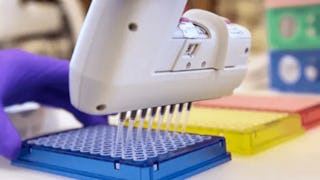
Medicinal chemistry courses can help you learn drug design, chemical synthesis, and pharmacology principles. You can build skills in structure-activity relationships, molecular modeling, and analytical techniques like chromatography and spectroscopy. Many courses introduce tools such as computational chemistry software and laboratory equipment, that support analyzing compounds and optimizing drug formulations.

Skills you'll gain: Pre-Clinical Development, Drug Interaction, Clinical Trials, Pharmacology, Drug Development, Pharmaceuticals, Patient Safety, Clinical Research, Competitive Intelligence, Safety Standards, Laboratory Testing, Biochemical Assays, Medication Administration, Pharmacotherapy, Pharmaceutical Terminology, Safety Assurance, Biotechnology, Biochemistry, Laboratory Research, Chemistry
Intermediate · Specialization · 3 - 6 Months

University of Manchester
Skills you'll gain: Analytical Chemistry, Biochemistry, Laboratory Techniques, Chemistry, Laboratory Equipment, Vibrations, Engineering, Scientific, and Technical Instruments, Physics, Structural Analysis
Intermediate · Course · 1 - 4 Weeks

Novartis
Skills you'll gain: Drug Interaction, Pharmacology, Pharmaceuticals, Pre-Clinical Development, Drug Development, Medication Administration, Pharmaceutical Terminology, Clinical Research, Laboratory Research
Intermediate · Course · 1 - 4 Weeks

Nanyang Technological University, Singapore
Skills you'll gain: Criminal Investigation and Forensics, Scientific Methods, Chemistry, Investigation, Case Studies, Biochemistry, Analytical Chemistry, Pharmacology, Laboratory Testing, Hematology, Pathology, Molecular Biology
Mixed · Course · 1 - 3 Months
Rice University
Skills you'll gain: Chemistry, Biochemistry, Physics, Laboratory Research, Scientific Methods, Experimentation
Mixed · Course · 1 - 3 Months

Duke University
Skills you'll gain: Scientific Methods, Chemistry, Laboratory Research, Systems Of Measurement, Physics, Materials science, Analytical Chemistry
Beginner · Course · 1 - 3 Months

Novartis
Skills you'll gain: Pre-Clinical Development, Drug Development, Pharmaceuticals, Pharmacology, Clinical Research, Clinical Trials, Pharmacotherapy, Chemistry, Manufacturing and Production
Intermediate · Course · 1 - 4 Weeks

Technical University of Denmark (DTU)
Skills you'll gain: Chemical Engineering, Sustainable Technologies, Chemistry, Sustainable Engineering, Sustainable Development, Sustainable Systems, Process Engineering
Intermediate · Course · 1 - 4 Weeks

Novartis
Skills you'll gain: Pre-Clinical Development, Clinical Trials, Pharmacology, Drug Development, Clinical Research, Pharmaceuticals, Competitive Intelligence, Safety Assurance, Biotechnology, Biochemistry
Intermediate · Course · 1 - 4 Weeks

University of Geneva
Skills you'll gain: Biochemistry, Biochemical Assays, Fluoroscopy, Molecular Biology, Cell Biology, Chemistry, Biotechnology, Laboratory Research, Scientific Visualization, Biology, Specimen Labeling
Intermediate · Course · 1 - 3 Months

Skills you'll gain: Laboratory Experience, Laboratory Equipment, Laboratory Procedures, Laboratory Testing, Chemistry, Safety Standards, Analytical Chemistry, Safety Assurance, Materials science, Product Testing, Personal protective equipment, Record Keeping, Product Development, Systems Of Measurement, Innovation
Beginner · Course · 1 - 4 Weeks

The Hong Kong University of Science and Technology
Skills you'll gain: Cooking, Food and Beverage, Nutrition and Diet, Meal Planning And Preparation, Biochemistry, Aesthetics, Color Theory, Chemistry, Physiology, Physics, Psychology
Beginner · Course · 1 - 3 Months
Medicinal Chemistry is a scientific discipline that combines aspects of chemistry and pharmacology to design, develop, and synthesize new drugs and treatments. It involves the study of how chemicals interact with the biological systems in order to create medications that can be used to treat a variety of diseases and medical conditions. Medicinal chemists work towards discovering and optimizing compounds that can be effective in targeting specific molecular pathways or disease processes, with the ultimate goal of improving human health and well-being.‎
To excel in Medicinal Chemistry, you would need to acquire several key skills. Here are some essential skills to focus on:
Organic Chemistry: Understanding the principles and reactions of organic chemistry is fundamental in medicinal chemistry. It involves the study of carbon compounds and their structure, properties, and reactivity.
Biochemistry: Learning the basics of biochemistry is crucial for understanding how chemicals interact with biological systems. This includes knowledge of macromolecules like proteins, enzymes, nucleic acids, and their functions.
Pharmacology: Familiarize yourself with the concepts of pharmacology, which involves the study of how drugs interact with living organisms to produce therapeutic effects. This skill helps in understanding the mechanisms, actions, and adverse effects of drugs.
Analytical Chemistry: Proficiency in analytical techniques such as spectroscopy, chromatography, and mass spectrometry is essential for analyzing and identifying chemical compounds. These skills enable you to characterize and quantify drugs and their metabolites.
Computational Chemistry: Gaining knowledge of computational methods and software used in medicinal chemistry can be beneficial. This skill helps in virtual screening, molecular modeling, and drug design.
Pharmaceutical Sciences: Understanding pharmaceutical sciences provides insights into drug formulation, drug delivery systems, and drug development processes. This knowledge aids in comprehending the practical aspects of creating effective medications.
Critical Thinking and Problem-Solving: Developing strong critical thinking skills is necessary for analyzing complex problems and designing innovative solutions in medicinal chemistry. Being able to approach challenges from different perspectives is invaluable.
Remember, this list represents crucial skills for medicinal chemistry, and continually expanding your knowledge and staying updated with advancements in the field is vital for growth and success.‎
With Medicinal Chemistry skills, you can pursue various career opportunities in the pharmaceutical, biotechnology, and healthcare industries. Some potential job roles include:
Medicinal Chemist: As a medicinal chemist, you would be responsible for designing, synthesizing, and analyzing compounds to develop new drugs that can be used for treating diseases.
Pharmaceutical Scientist: In this role, you would work on developing and optimizing pharmaceutical formulations to ensure their safety, efficacy, and stability.
Drug Discovery Researcher: You could work as a researcher in drug discovery, utilizing your Medicinal Chemistry skills to identify potential drug targets, design and synthesize novel compounds, and evaluate their efficacy against specific diseases.
Analytical Chemist: Analytical chemists play a crucial role in quality control processes in the pharmaceutical industry. You would use your skills to develop and validate analytical methods for testing the purity and potency of drugs.
Toxicologist: In this field, you would study the adverse effects of chemicals and drugs on living organisms. You would use your knowledge of Medicinal Chemistry to evaluate the safety and toxicity of drugs.
Pharmaceutical Sales Representative: As a sales representative, you would use your understanding of Medicinal Chemistry to promote and sell pharmaceutical products to healthcare professionals.
Regulatory Affairs Specialist: In this role, you would be responsible for ensuring that pharmaceutical products adhere to regulatory guidelines and obtain the necessary approvals from regulatory authorities.
Quality Control/Quality Assurance Specialist: Quality control and assurance professionals ensure that drugs and pharmaceutical products meet the required quality standards and regulations.
These are just a few examples of job opportunities that can be pursued with Medicinal Chemistry skills. The field offers a wide range of options for individuals interested in making a significant impact in healthcare and pharmaceutical innovation.‎
People who are best suited for studying Medicinal Chemistry are those who have a strong interest in the field of chemistry and medicine. They should have a passion for understanding the chemical processes involved in drug development and the ability to apply this knowledge to solve complex problems. Additionally, individuals who possess strong analytical and critical thinking skills, as well as attention to detail, are well-suited for studying Medicinal Chemistry. It is also beneficial for students to have a strong foundation in chemistry, biology, and mathematics, as these subjects form the basis of Medicinal Chemistry.‎
There are several topics related to Medicinal Chemistry that you can study. Some of them include:
Organic Chemistry: Understanding the structure, properties, composition, reactions, and synthesis of organic compounds is essential in Medicinal Chemistry. This topic lays the foundation for medicinal chemistry research and drug development.
Pharmacology: This field focuses on how drugs interact with biological systems, their effects on the body, and the mechanisms of action. Studying pharmacology will help you understand how drugs are developed, tested, and used in treating various diseases.
Biochemistry: This subject explores the chemical processes and reactions that occur within living organisms. Understanding biochemistry is crucial in identifying and designing potential drug targets, as well as analyzing how drugs interact with biological molecules.
Drug Discovery and Development: This topic covers the entire process of discovering and developing new drugs, from target identification and lead optimization to preclinical and clinical trials. It involves concepts such as drug design, synthesis, formulation, and safety assessment.
Pharmacokinetics and Drug Metabolism: These subjects focus on how drugs are absorbed, distributed, metabolized, and eliminated by the body. Studying pharmacokinetics and drug metabolism is key to determining proper dosage regimens and understanding drug-drug interactions.
These topics provide a comprehensive understanding of Medicinal Chemistry and equip you with the knowledge and skills necessary to contribute to the development and optimization of novel drugs.‎
Online Medicinal Chemistry courses offer a convenient and flexible way to enhance your knowledge or learn new Medicinal Chemistry is a scientific discipline that combines aspects of chemistry and pharmacology to design, develop, and synthesize new drugs and treatments. It involves the study of how chemicals interact with the biological systems in order to create medications that can be used to treat a variety of diseases and medical conditions. Medicinal chemists work towards discovering and optimizing compounds that can be effective in targeting specific molecular pathways or disease processes, with the ultimate goal of improving human health and well-being. skills. Choose from a wide range of Medicinal Chemistry courses offered by top universities and industry leaders tailored to various skill levels.‎
Coursera's entire course catalog is offered to Enterprise customers with no limitations. Choosing the best Medicinal Chemistry course depends on your employees' needs and skill levels. Leverage our Skills Dashboard to understand skill gaps and determine the most suitable course for upskilling your workforce effectively. Learn more about Coursera for Business here.‎