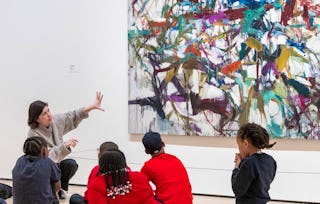
This course is your launchpad into the power of interdisciplinary thinking—a dynamic approach that transforms how you understand and engage with complex challenges. You will learn to actively draw from multiple disciplines, evaluate the unique strengths of different perspectives, and synthesize these insights to forge new, more comprehensive understandings. The result is the ability to generate integrated knowledge, pioneer alternative solutions, and develop novel approaches to the issues that matter.
Who is this for?
This course is designed for forward-thinking individuals ready to break down silos. It is ideal for:
Professionals aiming to sharpen their critical thinking, enhance creative problem-solving, and master more effective communication strategies.
Artists and Creatives seeking to bridge their practice with other disciplines, fueling innovation and discovering fresh, unexpected sources of inspiration.
Core Learning Domains:
The curriculum is built around three key areas of modern literacy:
Visual Literacy: Decoding and creating meaning from images, design, and visual media.
Audio Literacy: Developing a critical ear for sound, music, and the information conveyed through our auditory environment.
Creative Multimodal Thinking: Combining visual, audio, and other sensory elements to communicate and ideate in innovative, impactful ways.
Course Description and Target Audience•10 minutes
2 discussion prompts•Total 20 minutes
Assignments and Peer Review •10 minutes
Hi there!•10 minutes
Visual: Seeing , Perceiving, Analyzing, and Communicating
Module 2•4 hours to complete
Module details
This section of the course examines the elements of interpretation and perception of visual information. You will explore the reason why pictures are so effective as a means to communicate.
Visual Perception: how does our brain shape our perception of reality?•10 minutes
The Gestalt Principles of Visual Perception•10 minutes
EXTRA: When We Read, We Recognize Words as Pictures and Hear Them Spoken Aloud•10 minutes
Formal Visual Analysis: Elements and Principles of Art•10 minutes
Formal Visual Analysis: "The Snail" by Henri Matisse (1953)•10 minutes
VIDEO: Semiotics in Film •20 minutes
1 assignment•Total 10 minutes
Recognize the Gestalt principles in the given images•10 minutes
7 discussion prompts•Total 120 minutes
DaVinci Resolve Editing Practice•10 minutes
Questions / Ideas on the given articles?•10 minutes
Questions / Ideas •10 minutes
Formal Visual Analysis: Radio City by Eric Van Nynatten•60 minutes
Questions / Ideas •10 minutes
Assignment: 3 Photos•10 minutes
Questions / Ideas•10 minutes
Aural: Listening, Perceiving, Analyzing, and Communicating
Module 3•4 hours to complete
Module details
This section of the course discusses how humans perceive, process and communicate with sound. You will learn about the different types of listening, the properties of sound as a natural phenomenon, and the abilities of sound in storytelling.
In this section, we will talk about audiovisual fusion, the role of rhythm as connective tissue between media, and the ways audio and video together can create meaning.
What's included
5 videos3 readings3 discussion prompts
Show info about module content
5 videos•Total 32 minutes
Understanding the Equation: A+V = AV+•10 minutes
Understanding the Equation: x = Rhythm (As Connective Tissue)•5 minutes
Rhythm as the Intermediary Between Audiovisual Fusions•4 minutes
Tips on Decision-Making, Workspace and Material.•7 minutes
Meaning in an Audiovisual Work: All For a Helen by K. Gkoudina•7 minutes
3 readings•Total 30 minutes
EXTRA: EyeMusic and EyeMusic SSD•10 minutes
Our Storytelling Nature: The Heider-Simmel Experiment•10 minutes
ΕΧTRA: Effects of Musical Soundtracks on Attitudes Toward Animated Geometric Figures •10 minutes
3 discussion prompts•Total 30 minutes
Questions / Ideas•10 minutes
Final Project! yay!•10 minutes
Outro
Module 5•20 minutes to complete
Module details
Outro: What did you learn in this course?
What's included
1 reading1 discussion prompt
Show info about module content
1 reading•Total 10 minutes
Used bibliography and more books to read!•10 minutes
Michigan State University has been advancing the common good with uncommon will for more than 150 years.
One of the top research universities in the world, MSU pushes the boundaries of discovery and forges enduring partnerships to solve the most pressing global challenges while providing life-changing opportunities to a diverse and inclusive academic community through more than 200 programs of study in 17 degree-granting colleges.
When will I have access to the lectures and assignments?
To access the course materials, assignments and to earn a Certificate, you will need to purchase the Certificate experience when you enroll in a course. You can try a Free Trial instead, or apply for Financial Aid. The course may offer 'Full Course, No Certificate' instead. This option lets you see all course materials, submit required assessments, and get a final grade. This also means that you will not be able to purchase a Certificate experience.
What will I get if I purchase the Certificate?
When you purchase a Certificate you get access to all course materials, including graded assignments. Upon completing the course, your electronic Certificate will be added to your Accomplishments page - from there, you can print your Certificate or add it to your LinkedIn profile.
Is financial aid available?
Yes. In select learning programs, you can apply for financial aid or a scholarship if you can’t afford the enrollment fee. If fin aid or scholarship is available for your learning program selection, you’ll find a link to apply on the description page.