When you enroll in this course, you'll also be enrolled in this Professional Certificate.
Learn new concepts from industry experts
Gain a foundational understanding of a subject or tool
Develop job-relevant skills with hands-on projects
Earn a shareable career certificate from Google
There are 4 modules in this course
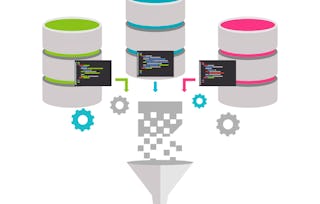
This is the second of four courses in the Google Business Intelligence Certificate. In this course, you'll explore data modeling and how databases are designed. Then you’ll learn about extract, transform, load (ETL) processes that extract data from source systems, transform it into formats that enable analysis, and drive business processes and goals.
Google employees who currently work in BI will guide you through this course by providing hands-on activities that simulate job tasks, sharing examples from their day-to-day work, and helping you build business intelligence skills to prepare for a career in the field.
Learners who complete the four courses in this certificate program will have the skills needed to apply for business intelligence jobs. This certificate program assumes prior knowledge of foundational analytical principles, skills, and tools covered in the Google Data Analytics Certificate.
By the end of this course, you will:
-Determine which data models are appropriate for different business requirements
-Describe the difference between creating and interacting with a data model
-Create data models to address different types of questions
-Explain the parts of the extract, transform, load (ETL) process and tools used in ETL
-Understand extraction processes and tools for different data storage systems
-Design an ETL process that meets organizational and stakeholder needs
-Design data pipelines to automate BI processes
You’ll start this course by exploring data modeling, common schemas, and database elements. You’ll consider how business needs determine the kinds of database systems that BI professionals implement. Then, you’ll discover pipelines and ETL processes, which are tools that move data and ensure that it’s accessible and useful.
What's included
19 videos16 readings9 assignments2 plugins
Show info about module content
19 videos•Total 69 minutes
Introduction to Course 2•3 minutes
Ed: Overcome imposter syndrome•2 minutes
Welcome to module 1•1 minute
Data modeling, design patterns, and schemas•4 minutes
Get the facts with dimensional models•5 minutes
Dimensional models with star and snowflake schemas•3 minutes
Different data types, different databases•7 minutes
The shape of the data•4 minutes
Design useful database schemas•5 minutes
Data pipelines and the ETL process•6 minutes
Maximize data through the ETL process•2 minutes
Choose the right tool for the job •4 minutes
Introduction to Dataflow•3 minutes
Coding with Python•4 minutes
Gather information from stakeholders•3 minutes
Wrap-up•1 minute
[Optional] Review Google Data Analytics Certificate content about data types•5 minutes
[Optional] Review Google Data Analytics Certificate content about primary and foreign keys•4 minutes
[Optional] Review Google Data Analytics Certificate content about BigQuery •4 minutes
16 readings•Total 92 minutes
Helpful resources and tips•4 minutes
Course 2 overview•4 minutes
Design efficient database systems with schemas•8 minutes
Database comparison checklist•4 minutes
Four key elements of database schemas•4 minutes
Review a database schema•8 minutes
Business intelligence tools and their applications•4 minutes
ETL-specific tools and their applications•4 minutes
Guide to Dataflow•8 minutes
Python applications and resources•8 minutes
Merge data from multiple sources with BigQuery•4 minutes
Unify data with target tables•4 minutes
Activity Exemplar: Create a target table in BigQuery•8 minutes
Case study: Wayfair - Working with stakeholders to create a pipeline•8 minutes
Glossary terms from course 2, module 1•4 minutes
[Optional] Review Google Data Analytics Certificate content about SQL best practices•8 minutes
9 assignments•Total 260 minutes
Module 1 challenge•60 minutes
Choose the best schema•30 minutes
Test your knowledge: Data modeling, schemas, and databases•20 minutes
Test your knowledge: Choose the right database•15 minutes
Test your knowledge: How data moves•15 minutes
[Optional] Activity: Create a Google Cloud account•30 minutes
[Optional] Activity: Create a streaming pipeline in Dataflow•30 minutes
Activity: Set up a sandbox and query a public dataset in BigQuery•30 minutes
Activity: Create a target table in BigQuery•30 minutes
2 plugins•Total 30 minutes
Inspect: Database models and schemas•15 minutes
Transport: More about the data pipeline•15 minutes
Dynamic database design
Module 2•3 hours to complete
Module details
You’ll learn more about database systems, including data marts, data lakes, data warehouses, and ETL processes. You’ll also investigate the five factors of database performance: workload, throughput, resources, optimization, and contention. Finally, you’ll consider how to design efficient queries that get the most from a system.
What's included
6 videos7 readings3 assignments2 plugins
Show info about module content
6 videos•Total 18 minutes
Welcome to module 2•1 minute
Data marts, data lakes, and the ETL process•3 minutes
The five factors of database performance•3 minutes
Optimize database performance•4 minutes
The five factors in action•5 minutes
Wrap-up•1 minute
7 readings•Total 48 minutes
ETL versus ELT•8 minutes
A guide to the five factors of database performance•4 minutes
Indexes, partitions, and other ways to optimize•8 minutes
Activity Exemplar: Partition data and create indexes in BigQuery•8 minutes
Case study: Deloitte - Optimizing outdated database systems•8 minutes
Determine the most efficient query•8 minutes
Glossary terms from course 2, module 2•4 minutes
3 assignments•Total 95 minutes
Module 2 challenge•50 minutes
Activity: Partition data and create indexes in BigQuery•30 minutes
Test your knowledge: Database performance•15 minutes
2 plugins•Total 30 minutes
Store: Understand data storage systems•15 minutes
Design: Optimize for database speed•15 minutes
Optimize ETL processes
Module 3•4 hours to complete
Module details
You’ll learn about optimization techniques including ETL quality testing, data schema validation, business rule verification, and general performance testing. You’ll also explore data integrity and learn how built-in quality checks defend against potential problems. Finally, you’ll focus on verifying business rules and general performance testing to make sure pipelines meet the intended business need.
What's included
10 videos10 readings5 assignments2 plugins
Show info about module content
10 videos•Total 34 minutes
Welcome to module 3•2 minutes
The importance of quality testing•5 minutes
Mana: Quality data is useful data•4 minutes
Conformity from source to destination•5 minutes
Check your schema•4 minutes
Verify business rules•4 minutes
Burak: Evolving technology•3 minutes
Wrap-up•2 minutes
[Optional] Review Google Data Analytics Certificate content about data integrity•3 minutes
[Optional] Review Google Data Analytics Certificate content about metadata•4 minutes
10 readings•Total 64 minutes
Seven elements of quality testing•4 minutes
Monitor data quality with SQL•8 minutes
Sample data dictionary and data lineage•8 minutes
Schema-validation checklist•4 minutes
Activity Exemplar: Evaluate a schema using a validation checklist•8 minutes
Business rules•8 minutes
Database performance testing in an ETL context•8 minutes
Defend against known issues•4 minutes
Case study: FeatureBase, Part 2: Alternative solutions to pipeline systems•8 minutes
Glossary terms from course 2, module 3•4 minutes
5 assignments•Total 125 minutes
Module 3 challenge•35 minutes
Test your knowledge: Optimize pipelines and ETL processes•15 minutes
Activity: Evaluate a schema using a validation checklist •50 minutes
Test your knowledge: Data schema validation•15 minutes
Test your knowledge: Business rules and performance testing •10 minutes
2 plugins•Total 30 minutes
Validate: Data quality and integrity•15 minutes
Evaluate: Performance test your data pipeline•15 minutes
Course 2 end-of-course project
Module 4•2 hours to complete
Module details
You’ll complete an end-of-course project by creating a pipeline process to deliver data to a target table and developing reports based on project needs. You’ll also ensure that the pipeline is performing correctly and that there are built-in defenses against data quality issues.
What's included
5 videos12 readings3 assignments
Show info about module content
5 videos•Total 10 minutes
Welcome to module 4•2 minutes
Continue your end-of-course project•2 minutes
Tips for ongoing success with your end-of-course project•2 minutes
Grow with Google is an initiative that draws on Google's decades-long history of building products, platforms, and services that help people and businesses grow. We aim to help everyone – those who make up the workforce of today and the students who will drive the workforce of tomorrow – access the best of Google’s training and tools to grow their skills, careers, and businesses.
Organizations of all types and sizes have business processes that generate massive volumes of data. Information is constantly created by computers, the internet, phones, texts, streaming video, photographs, sensors, and more. In the global digital landscape, data is increasingly imprecise, chaotic, and unstructured. As the speed and variety of data increase exponentially, organizations are struggling to keep pace.
Business intelligence is the work involved in gathering, structuring, interpreting, monitoring, and reporting this data in accessible formats that enable stakeholders to understand and use it effectively. Organizations rely on this information to make better strategic and operational business decisions. As a result, there is high demand in the marketplace for business intelligence professionals with the skills and expertise to achieve these goals.
What do business intelligence professionals do?
Business intelligence professionals are critical to many organizations today. They use data to help solve business problems, performing a variety of tasks that enable decision makers to understand and use data effectively. Some common responsibilities of BI professionals include gathering project requirements from stakeholders, retrieving and organizing large datasets, and creating visualizations and dashboards to report insights to others. Organizations use the intelligence they share to make decisions, develop new processes, create business strategies, and conduct deeper analyses.
Why start a career in business intelligence?
As businesses generate more and more data, there is increased demand for BI professionals to transform this data into meaningful business insights. BI skills are transferable to jobs across multiple industries, including financial services, education, healthcare, and manufacturing. The Google Business Intelligence Certificate will help you prepare for a job in the BI field.
Which jobs will this certificate help me prepare for?
After completing all three courses in this certificate program, you’ll have the skills required for jobs like BI analyst, BI engineer, and BI developer.
What tools and platforms are taught in the curriculum?
Business intelligence and data analytics share many of the same tools. During this certificate program, you’ll gain knowledge of tools and platforms including BigQuery, Dataflow, Python, Sheets, SQL, and Tableau.
What background is required?
This certificate program assumes prior knowledge of foundational analytical principles, skills, and tools. To succeed in this certificate program, you should already know about data types, data strategy, data integrity, data cleaning, data aggregation, data analysis, and best practices when sharing information. You should also have an understanding of spreadsheets, databases and structured query language, programming concepts, data visualization, and dashboards.
The content in this certificate program builds upon data analytics concepts taught in the Google Data Analytics Certificate. If you haven’t completed that program, or if you’re unsure whether you have the necessary prerequisites, you can take an ungraded assessment in Course 1 Week 1 of this certificate program to evaluate your readiness.
Why enroll in the Google Business Intelligence Certificate?
You’ll learn job-ready skills through interactive content — like activities, quizzes, and discussion prompts — in under two months, with less than 10 hours of flexible study a week. Along the way, you’ll work through a curriculum designed by Google employees who work in the field, with input from top employers and industry leaders. You’ll even have the opportunity to complete end-of-course projects that you can share with potential employers to showcase your business intelligence skills. After you’ve graduated from the program, you’ll have access to career resources and be connected directly with employers hiring for open entry-level roles in business intelligence.
Do I need to take the course in a certain order?
We highly recommend completing the three courses in the order presented because the content in each course builds on information covered in earlier courses.
Do I need to take the course in a certain order?
We highly recommend completing the three courses in the order presented because the content in each course builds on information covered in earlier courses.
When will I have access to the lectures and assignments?
To access the course materials, assignments and to earn a Certificate, you will need to purchase the Certificate experience when you enroll in a course. You can try a Free Trial instead, or apply for Financial Aid. The course may offer 'Full Course, No Certificate' instead. This option lets you see all course materials, submit required assessments, and get a final grade. This also means that you will not be able to purchase a Certificate experience.
What will I get if I subscribe to this Certificate?
When you enroll in the course, you get access to all of the courses in the Certificate, and you earn a certificate when you complete the work. Your electronic Certificate will be added to your Accomplishments page - from there, you can print your Certificate or add it to your LinkedIn profile.