Deep Learning Courses
Deep learning courses can help you learn neural networks, convolutional networks, and recurrent networks, along with their applications in image recognition and natural language processing. You can build skills in model training, hyperparameter tuning, and performance evaluation, which are crucial for developing effective AI solutions. Many courses introduce tools like TensorFlow and PyTorch, allowing you to implement algorithms and optimize models, making your learning experience hands-on and relevant to current industry practices.
Popular Deep Learning Courses and Certifications
 Status: Free Trial
Multiple educators
Skills you'll gain: Unsupervised Learning, Supervised Learning, Machine Learning Methods, Model Training, Applied Machine Learning, Machine Learning Algorithms, Transfer Learning, Machine Learning, Jupyter, Data Ethics, Decision Tree Learning, Model Evaluation, Responsible AI, Tensorflow, Scikit Learn (Machine Learning Library), NumPy, Predictive Modeling, Deep Learning, Artificial Intelligence, Classification Algorithms
 Status: Free Trial
Skills you'll gain: Model Evaluation, Convolutional Neural Networks, Model Training, Data Preprocessing, Image Analysis, Predictive Modeling, Deep Learning, Keras (Neural Network Library), Tensorflow, Data Processing, Model Optimization, Computer Vision, Artificial Neural Networks, Recurrent Neural Networks (RNNs), Data Transformation, Financial Forecasting, Applied Machine Learning, Feature Engineering, Statistical Visualization, Python Programming
 Status: Free Trial
Illinois Tech
Skills you'll gain: Recurrent Neural Networks (RNNs), Deep Learning, Generative AI, Convolutional Neural Networks, Transfer Learning, Model Optimization, Image Analysis, Artificial Neural Networks, Generative Model Architectures, Generative Adversarial Networks (GANs), Fine-tuning, Artificial Intelligence and Machine Learning (AI/ML), Machine Learning Methods, Network Architecture, Computer Vision, Network Model, Natural Language Processing, Model Training
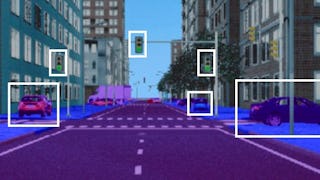 Status: Free Trial
MathWorks
Skills you'll gain: Model Evaluation, Computer Vision, Model Deployment, Anomaly Detection, Convolutional Neural Networks, Image Analysis, Transfer Learning, Model Training, Fine-tuning, Deep Learning, Generative AI, Artificial Neural Networks, Applied Machine Learning, Data Preprocessing, Matlab, Software Visualization, Classification Algorithms, Model Optimization, Predictive Modeling, Performance Tuning
 Status: Preview
DeepLearning.AI
Skills you'll gain: AI Product Strategy, Responsible AI, Data Ethics, AI Enablement, Applied Machine Learning, Artificial Intelligence, AI literacy, Machine Learning, Data Science, AI Integrations, Deep Learning, Artificial Neural Networks
 Status: Free Trial
Skills you'll gain: Responsible AI, Generative AI, Generative Model Architectures, LLM Application, AI literacy, Natural Language Processing, Robotics, Risk Mitigation
What brings you to Coursera today?
 Status: Free Trial
Skills you'll gain: Recurrent Neural Networks (RNNs), Artificial Neural Networks, Deep Learning, Matplotlib, Convolutional Neural Networks, Linear Algebra, Image Analysis, Plot (Graphics), Data Visualization, NumPy, Scientific Visualization, Machine Learning Algorithms, Keras (Neural Network Library), Statistical Visualization, Pandas (Python Package), Model Training, Applied Machine Learning, Data Science, Artificial Intelligence, Machine Learning
 Status: Free Trial
Imperial College London
Skills you'll gain: Dimensionality Reduction, Linear Algebra, Regression Analysis, NumPy, Calculus, Unsupervised Learning, Applied Mathematics, Statistical Methods, Descriptive Statistics, Model Optimization, Mathematical Software, Jupyter, Statistics, Numerical Analysis, Applied Machine Learning, Geometry, Artificial Neural Networks, Data Science, Data Manipulation, Data Transformation
 Status: Free Trial
Skills you'll gain: Prompt Engineering, Prompt Patterns, Data Wrangling, Large Language Modeling, LangChain, Retrieval-Augmented Generation, Exploratory Data Analysis, Unsupervised Learning, Generative Model Architectures, PyTorch (Machine Learning Library), ChatGPT, Generative AI, Restful API, Prompt Engineering Tools, LLM Application, Keras (Neural Network Library), Responsible AI, Vector Databases, Fine-tuning, Python Programming
 Status: Free Trial
DeepLearning.AI
Skills you'll gain: Unsupervised Learning, Machine Learning Methods, Applied Machine Learning, Responsible AI, Data Ethics, Machine Learning, Machine Learning Algorithms, Supervised Learning, Artificial Intelligence, Reinforcement Learning, AI Personalization, Artificial Neural Networks, Deep Learning, Anomaly Detection, Model Optimization, Dimensionality Reduction
 Status: Free Trial
Skills you'll gain: Embeddings, Natural Language Processing, Keras (Neural Network Library), Generative AI, Convolutional Neural Networks, Transfer Learning, Recurrent Neural Networks (RNNs), Model Evaluation, Generative Model Architectures, Image Analysis, Model Training, Artificial Neural Networks, Text Mining, Computer Vision, Model Optimization, Data Preprocessing, Fine-tuning, Tensorflow, Deep Learning, Model Deployment
 Status: Free Trial
MathWorks
Skills you'll gain: Computer Vision, Model Evaluation, Image Analysis, Convolutional Neural Networks, Deep Learning, Model Training, Matlab, Fine-tuning, Data Preprocessing, Software Visualization, Transfer Learning, Model Optimization, Data Analysis, Network Architecture
In summary, here are 10 of our most popular deep learning courses
- Machine Learning: DeepLearning.AI
- Deep Learning with Python: CNN, ANN & RNN: EDUCBA
- Deep Learning: Illinois Tech
- Deep Learning for Computer Vision: MathWorks
- AI For Everyone: DeepLearning.AI
- Introduction to Artificial Intelligence (AI): IBM
- Deep Learning with Real-World Projects: Packt
- Mathematics for Machine Learning: Imperial College London
- IBM Generative AI Engineering: IBM
- Unsupervised Learning, Recommenders, Reinforcement Learning: DeepLearning.AI










