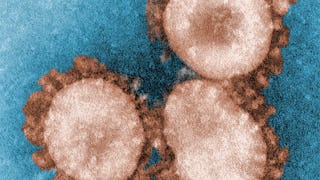
Ebola courses can help you learn about the virus's biology, transmission dynamics, outbreak response strategies, and public health implications. You can build skills in epidemiological modeling, risk assessment, and effective communication during health crises. Many courses introduce tools like statistical software for data analysis, geographic information systems (GIS) for mapping outbreaks, and case management protocols that are crucial for managing responses in affected regions.

University of Amsterdam
Skills you'll gain: Epidemiology, Infection Control, Infectious Diseases, Bloodborne Pathogens, Patient Evaluation, Public Health and Disease Prevention, Public Health, Pathology, Patient Treatment, Immunology, Drug Development, Medical Science and Research, Diagnostic Tests, Pharmacology, Microbiology, Personal protective equipment, Pharmaceuticals, Clinical Assessment
Mixed · Course · 1 - 3 Months

University of Leeds
Skills you'll gain: Infectious Diseases, Microbiology, Immunology, Pathology, Infection Control, Pharmacology, Epidemiology, Public Health and Disease Prevention, Molecular, Cellular, and Microbiology, Cell Biology
Beginner · Course · 1 - 4 Weeks

University of Geneva
Skills you'll gain: Media and Communications, Infectious Diseases, Epidemiology, Healthcare Ethics, Mathematical Modeling, Drug Development, Crisis Intervention, Public Health, International Relations, Social Sciences, Socioeconomics, Health Systems, Health Disparities, Clinical Research, Community Health
Mixed · Course · 1 - 3 Months

Emory University
Skills you'll gain: Laboratory Testing, Epidemiology, Infection Control, Laboratory Procedures, Public Health, Infectious Diseases, Public Health and Disease Prevention, Healthcare Ethics, Emergency Response, Health Policy, Patient Evaluation, Health Systems, Personal protective equipment, Clinical Practices, Drug Development, Immunology, Patient Treatment, Media and Communications
Mixed · Course · 1 - 3 Months

Imperial College London
Skills you'll gain: Immunology, Infectious Diseases, Molecular Biology, Epidemiology, Microbiology, Public Health, Drug Development, Biotechnology, Medical Science and Research, Climate Change Programs, Cell Biology, Health Disparities, Biology, Clinical Trials, Laboratory Research, Pharmacology, Public Health and Disease Prevention, New Product Development, Emerging Technologies, Manufacturing Processes
Intermediate · Specialization · 3 - 6 Months

Imperial College London
Skills you'll gain: Infectious Diseases, Epidemiology, Public Health and Disease Prevention, Public Health, Health Disparities, Cardiology, Social Determinants Of Health, Chronic Diseases, Microbiology, Health Care, Community Health, Health Systems, Socioeconomics, Preventative Care, Health Policy, Health Education, Health Assessment, Public Policies, Trend Analysis, Immunology
Beginner · Specialization · 1 - 3 Months

Johns Hopkins University
Skills you'll gain: Maternal Health, Advocacy, Training Programs, Health Systems, Health Policy, Primary Care, Education and Training, Community Health, Smart Goals, Intercultural Competence, Sanitation, Crisis Intervention, Epidemiology, Public Health and Disease Prevention, Health Promotion, Community Development, Health Care Administration, Behavioral Health, Public Health, Healthcare Ethics
Beginner · Specialization · 3 - 6 Months

University of Copenhagen
Skills you'll gain: Health Systems, Maternal Health, Child Health, Public Health, Health Policy, Infectious Diseases, Health Disparities, Water Resources, Health Promotion, Social Determinants Of Health, Epidemiology, Community Health, Environmental Policy, Sanitation, Nutrition and Diet, Climate Change Programs, Chronic Diseases, Mental Health Diseases and Disorders
Mixed · Course · 1 - 3 Months
Johns Hopkins University
Skills you'll gain: Health Policy, Public Health, Survey Creation, Public Health and Disease Prevention, Health Informatics, Data Collection, Health Assessment, Health Equity, Social Determinants Of Health, Health Disparities, Community Health, Health Information Management, Medical Records, Continuous Monitoring
Beginner · Course · 1 - 4 Weeks

Imperial College London
Skills you'll gain: Epidemiology, Mathematical Modeling, Statistical Modeling, Simulations, Risk Modeling, Infectious Diseases, Public Health, R Programming, Differential Equations, Data Modeling, Statistical Methods, Probability & Statistics
Intermediate · Specialization · 1 - 3 Months

Imperial College London
Skills you'll gain: Infectious Diseases, Epidemiology, Public Health, Microbiology, Health Disparities, Community Health, Social Determinants Of Health, Preventative Care, Health Care, Health Policy, Public Policies, Trend Analysis, Immunology
Beginner · Course · 1 - 4 Weeks

Imperial College London
Skills you'll gain: Health Policy, Advocacy, Health Disparities, Social Determinants Of Health, Health Equity, Climate Change Adaptation, Public Health, Policy Analysis, Health Systems, Environmental Policy, Health Care, Climate Change Programs, Environmental Issue, Sustainable Development, Climate Change Mitigation, International Relations, Socioeconomics, Policy Development, Governance, Environmental Science
Beginner · Specialization · 3 - 6 Months
Ebola is a highly infectious disease caused by the Ebola virus. It was first identified in 1976 in Sudan and the Democratic Republic of Congo. Ebola is transmitted through direct contact with the blood, body fluids, or organs of infected animals or people. The virus can cause severe symptoms, including fever, headache, muscle pain, weakness, diarrhea, vomiting, abdominal pain, and bleeding. In some cases, it can lead to organ failure and death. There is no specific treatment or vaccine for Ebola, but supportive care and early medical intervention can improve the chances of survival.
To learn about Ebola, it's important to develop various skills and acquire knowledge in the following areas:
Medical knowledge: Understanding the biology, transmission, and symptoms of Ebola is crucial. You should have a basic understanding of virology, infectious diseases, and epidemiology.
Medical research skills: Learning how to find and evaluate reliable sources of information, including scientific papers, clinical trials, and expert opinions, is essential in keeping up with the latest developments and understanding the disease comprehensively.
Public health preparedness: Acquiring knowledge about public health systems, emergency response planning, and disease surveillance will enable you to understand the broader context of Ebola and its impact on communities.
Data analysis and interpretation: Being able to analyze and interpret epidemiological data related to Ebola outbreaks can help in identifying patterns, understanding risk factors, and formulating appropriate prevention and control strategies.
Communication skills: Ebola outbreaks often involve educating and raising awareness among communities. Developing effective communication skills will enable you to disseminate accurate information, mitigate fear and stigma, and promote preventive measures efficiently.
Crisis management and coordination: Ebola outbreaks require a coordinated response from various stakeholders, including healthcare providers, government agencies, non-governmental organizations, and international bodies. Familiarizing yourself with crisis management principles and protocols is valuable in such situations.
Remember, studying these skills is just a starting point. It is highly recommended to consult reputable sources, enroll in relevant courses or programs, and seek guidance from healthcare professionals or organizations specializing in infectious diseases for comprehensive learning on Ebola.
Epidemiologist: With expertise in Ebola skills, you can work as an epidemiologist specializing in infectious diseases. You would study and track the spread of Ebola, analyze data to understand its patterns, and provide recommendations for control and prevention strategies.
Public Health Officer: Public health organizations actively recruit professionals with Ebola skills to manage outbreaks and implement preventive measures. As a public health officer, you will play a crucial role in developing policies, implementing educational campaigns, and coordinating response efforts to mitigate the impact of Ebola and other infectious diseases.
Healthcare Professional: As a healthcare professional, you can specialize in treating patients affected by Ebola. Acquiring specific skills related to Ebola treatment and management can enhance your capabilities in diagnosing, treating, and caring for individuals during outbreaks.
Research Scientist: Your expertise in Ebola skills can lead you to a career as a research scientist focused on developing vaccines, therapeutics, or diagnostic tools for Ebola. You may work in research institutions, pharmaceutical companies, or governmental agencies dedicated to advancing Ebola-related research.
Emergency Management Specialist: With knowledge of Ebola and its implications, you can work as an emergency management specialist. In this role, you would assist in developing response plans, coordinating resources, and providing guidance to organizations and communities during Ebola outbreaks or other public health emergencies.
NGO Worker: Non-governmental organizations (NGOs) actively engage in combating Ebola and supporting affected communities. Your skills can be valuable in roles such as project coordinator, community health worker, or program manager in NGOs focused on public health and disease prevention.
Remember, while these job options specifically relate to Ebola skills, it's essential to continue expanding your knowledge and expertise in broader public health and infectious disease areas to enhance your employability and contribute effectively in addressing other challenges as well.
People who are interested in public health, epidemiology, infectious diseases, or medical research would be best suited for studying Ebola. Additionally, individuals with a strong background in biology, microbiology, or virology would find studying Ebola to be a good fit. It is important for these individuals to have a passion for understanding and combating infectious diseases, as studying Ebola requires a deep understanding of its transmission, symptoms, prevention, and treatment.
Here are some topics that you can study related to Ebola:
Ebola Virus Disease (EVD): Learn about the nature of the disease, its transmission, and symptoms.
Ebola Outbreaks: Study the history of Ebola outbreaks and their impact on different regions.
Epidemiology: Explore the field of epidemiology and how it applies to studying and controlling Ebola outbreaks.
Virology: Understand the virology of Ebola, including its structure, replication cycle, and pathogenesis.
Public Health Response: Investigate the public health response to Ebola outbreaks, including containment strategies, treatment, and prevention measures.
Global Health: Examine the global health implications of Ebola and its potential impact on healthcare systems worldwide.
Social and Psychological Effects: Explore the social and psychological effects of Ebola on affected communities, including stigma, fear, and mental health.
Zoonotic Diseases: Study zoonotic diseases, including the transmission of Ebola from animals to humans.
Research and Development: Learn about ongoing research efforts to develop effective vaccines, treatments, and diagnostic tools for Ebola.
These topics will provide you with a comprehensive understanding of Ebola from various perspectives, ranging from the scientific to the social and public health aspects.
Online Ebola courses offer a convenient and flexible way to enhance your knowledge or learn new Ebola is a highly infectious disease caused by the Ebola virus. It was first identified in 1976 in Sudan and the Democratic Republic of Congo. Ebola is transmitted through direct contact with the blood, body fluids, or organs of infected animals or people. The virus can cause severe symptoms, including fever, headache, muscle pain, weakness, diarrhea, vomiting, abdominal pain, and bleeding. In some cases, it can lead to organ failure and death. There is no specific treatment or vaccine for Ebola, but supportive care and early medical intervention can improve the chances of survival. skills. Choose from a wide range of Ebola courses offered by top universities and industry leaders tailored to various skill levels.
When looking to enhance your workforce's skills in Ebola, it's crucial to select a course that aligns with their current abilities and learning objectives. Our Skills Dashboard is an invaluable tool for identifying skill gaps and choosing the most appropriate course for effective upskilling. For a comprehensive understanding of how our courses can benefit your employees, explore the enterprise solutions we offer. Discover more about our tailored programs at Coursera for Business here.