Big Data Courses
Big Data courses can help you learn data analysis, data visualization, statistical modeling, and data mining techniques. You can build skills in interpreting large datasets, designing data-driven strategies, and utilizing machine learning algorithms. Many courses introduce tools like Hadoop, Spark, and Tableau, that support processing vast amounts of information and presenting insights effectively. Additionally, you may explore topics such as data warehousing, predictive analytics, and the ethical implications of data usage.
Popular Big Data Courses and Certifications

University of Colorado Boulder
Skills you'll gain: Prompt Engineering, User Story, New Product Development, Model Based Systems Engineering, Model Evaluation, Failure Analysis, Sustainable Business, Data Mining, Field-Programmable Gate Array (FPGA), Delegation Skills, Strategic Decision-Making, Real-Time Operating Systems, Object Oriented Design, Project Schedules, Sampling (Statistics), Proposal Writing, Data Ethics, Sustainability Reporting, Database Design, Agentic systems
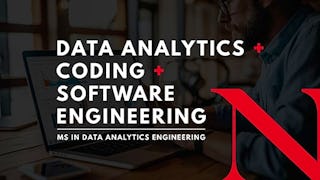
Northeastern University
Skills you'll gain: Data Storytelling, Generative AI, Text Mining, Data Warehousing, Unsupervised Learning, Database Design, Data Governance, Data Mining, Interactive Data Visualization, Data Presentation, Generative Model Architectures, Web Scraping, Classification Algorithms, PyTorch (Machine Learning Library), Operations Research, Natural Language Processing, NoSQL, Exploratory Data Analysis, Recurrent Neural Networks (RNNs), Time Series Analysis and Forecasting

Illinois Institute of Technology
Skills you'll gain: Database Design, Database Systems, Statistical Analysis, Time Series Analysis and Forecasting, Relational Databases, Database Software, Databases, Database Application, Database Management, Database Theory, Data Analysis, NoSQL, Database Management Systems, Database Development, Machine Learning Algorithms, Recurrent Neural Networks (RNNs), Bayesian Statistics, Statistical Inference, Technical Communication, Model Evaluation

University of Colorado Boulder
Skills you'll gain: Prompt Engineering, User Story, New Product Development, Model Based Systems Engineering, Model Evaluation, Failure Analysis, Sustainable Business, Data Mining, Field-Programmable Gate Array (FPGA), Delegation Skills, Strategic Decision-Making, Real-Time Operating Systems, Object Oriented Design, Project Schedules, Sampling (Statistics), Proposal Writing, Data Ethics, Sustainability Reporting, Database Design, Agentic systems
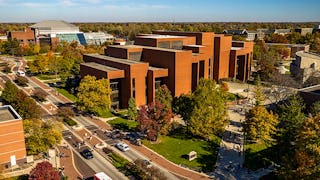
Ball State University
Skills you'll gain: Data Ethics, Graph Theory, Database Systems, Machine Learning Algorithms, Supervised Learning, Software Development Methodologies, File Systems, Data Visualization, Financial Statement Analysis, Statistical Hypothesis Testing, Statistical Methods, Spatial Data Analysis, Cryptography, Object Oriented Programming (OOP), SAS (Software), Text Mining, Artificial Intelligence, Predictive Modeling, Statistical Programming, Natural Language Processing

IIT Guwahati
Skills you'll gain: Package and Software Management, Time Series Analysis and Forecasting, Cloud Computing Architecture, Linear Algebra, Data Structures, R (Software), Data Warehousing, Database Design, Model Evaluation, Database Management, Social Network Analysis, Algorithms, Java Programming, Deep Learning, Portfolio Management, Oral Comprehension, C (Programming Language), Econometrics, Spreadsheet Software, Matplotlib
What brings you to Coursera today?

University of Colorado Boulder
Skills you'll gain: Prompt Engineering, User Story, New Product Development, Model Based Systems Engineering, Model Evaluation, Failure Analysis, Sustainable Business, Data Mining, Field-Programmable Gate Array (FPGA), Delegation Skills, Strategic Decision-Making, Real-Time Operating Systems, Object Oriented Design, Project Schedules, Sampling (Statistics), Proposal Writing, Data Ethics, Sustainability Reporting, Database Design, Agentic systems

University of Illinois at Urbana-Champaign

University of Illinois at Urbana-Champaign
Skills you'll gain: Business Strategy, Data Visualization, Data Storytelling, Management Accounting, Model Evaluation, Fund Accounting, Operations Management, Organizational Change, Audit Planning, Mergers & Acquisitions, Financial Statement Analysis, Project Closure, Risk Management, Social Determinants Of Health, Revenue Recognition, Entrepreneurship, Data Governance, Financial Auditing, Generative AI, Supply And Demand

BITS Pilani
Skills you'll gain: Relational Databases, User Research, Probability & Statistics, Data Storytelling, Bash (Scripting Language), Graph Theory, Theoretical Computer Science, Object Oriented Design, Operating Systems, Android Development, Database Design, Encryption, Bioinformatics, Software Development Methodologies, Amazon Web Services, Feature Engineering, Algorithms, TCP/IP, Java Programming, Data Structures

University of Illinois at Urbana-Champaign
Skills you'll gain: Business Strategy, Data Visualization, Data Storytelling, Management Accounting, Model Evaluation, Fund Accounting, Operations Management, Organizational Change, Audit Planning, Mergers & Acquisitions, Financial Statement Analysis, Project Closure, Risk Management, Social Determinants Of Health, Revenue Recognition, Entrepreneurship, Data Governance, Financial Auditing, Generative AI, Supply And Demand

University of Colorado Boulder
Skills you'll gain: Prompt Engineering, User Story, New Product Development, Model Based Systems Engineering, Model Evaluation, Failure Analysis, Sustainable Business, Data Mining, Field-Programmable Gate Array (FPGA), Delegation Skills, Strategic Decision-Making, Real-Time Operating Systems, Object Oriented Design, Project Schedules, Sampling (Statistics), Proposal Writing, Data Ethics, Sustainability Reporting, Database Design, Agentic systems
In summary, here are 10 of our most popular big data courses
- Master of Science in Data Science: University of Colorado Boulder
- Master of Science in Data Analytics Engineering: Northeastern University
- Master of Data Science: Illinois Institute of Technology
- Master of Science in Artificial Intelligence: University of Colorado Boulder
- Master of Science in Data Science: Ball State University
- Bachelor of Science in Data Science & AI: IIT Guwahati
- Master of Science in Electrical and Computer Engineering: University of Colorado Boulder
- Master of Computer Science (feat. Data Science Track): University of Illinois at Urbana-Champaign
- Master of Science in Management | iMSM: University of Illinois at Urbana-Champaign
- Bachelor of Science in Computer Science: BITS Pilani










