Big Data Courses
Big Data courses can help you learn data analysis, data visualization, statistical modeling, and data mining techniques. You can build skills in interpreting large datasets, designing data-driven strategies, and utilizing machine learning algorithms. Many courses introduce tools like Hadoop, Spark, and Tableau, that support processing vast amounts of information and presenting insights effectively. Additionally, you may explore topics such as data warehousing, predictive analytics, and the ethical implications of data usage.
Popular Big Data Courses and Certifications
Coursera
Skills you'll gain: Statistical Reporting, Data Visualization, Big Data, SQL, Interactive Data Visualization, Query Languages, Data Import/Export, Google Cloud Platform, Data Warehousing, Data Sharing, Analytics
Coursera
Skills you'll gain: Data Visualization, Data Literacy, Data Presentation, Google Sheets, Data Compilation, Data Visualization Software, Statistical Visualization, Graphing, Spreadsheet Software
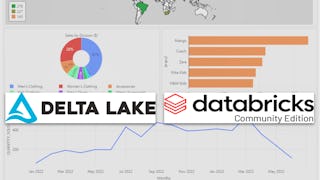
Skills you'll gain: Databricks, Data Lakes, Data Pipelines, Data Integration, JSON, Dashboard, SQL, Data Manipulation, Apache Spark, Dashboard Creation, Big Data, Data Management, Data Transformation, Data Architecture, Version Control
Skills you'll gain: Power BI, Data Transformation, Data Preprocessing, Data Manipulation, Data Cleansing, Data Integration, Data Wrangling, Predictive Modeling

Skills you'll gain: Data Cleansing, Data Quality, Data Wrangling, Data Transformation, Data Validation, Data Manipulation, Data Analysis, SQL, Big Data

What brings you to Coursera today?
Skills you'll gain: Databricks, Real Time Data, PySpark, Apache Hive, Apache Spark, Big Data, Data Processing, SQL, Data Manipulation, Pandas (Python Package)
Skills you'll gain: PySpark, Apache Spark, Data Synthesis, Data Visualization Software, Data Analysis, Exploratory Data Analysis, Data Cleansing, Data Wrangling, Data Processing, Data Manipulation, Big Data, Data Science, Jupyter, People Analytics

Skills you'll gain: Data Pipelines, Big Data, Microsoft Azure, Data Processing, Data Integration, Cloud Management, Cloud Services

Skills you'll gain: Microsoft Excel, Spreadsheet Software, Data-Driven Decision-Making, Strategic Decision-Making, Microsoft Office
Skills you'll gain: Data Visualization, Dashboard, Interactive Data Visualization, Dashboard Creation, Data Presentation, Data Visualization Software, Looker (Software), Collaborative Software, Data Sharing, Data Science, Data Analysis, Business Intelligence, Data Integration, Data Modeling, Data Import/Export

Skills you'll gain: Microsoft Excel, Excel Formulas, Spreadsheet Software, Microsoft 365, Analysis, Trend Analysis, User Accounts

Skills you'll gain: Presentations, Sales Presentations, Sales Presentation, Data Visualization, Productivity Software, Design
What brings you to Coursera today?
Best free Big Data courses
High-quality free Big Data courses you can start today.
- Working with BigQueryCourseraBeginnerLess Than 2 HoursFree
- Overview of Data VisualizationCourseraBeginnerLess Than 2 HoursFree
- Finding, Sorting, & Filtering Data in Microsoft ExcelCourseraIntermediateLess Than 2 HoursFree
Best Big Data courses from Coursera
Top-rated Big Data courses offered by Coursera on Coursera.
- Data Management with Databricks: Big Data with Delta LakesCourseraIntermediateLess Than 2 HoursCoursera
- PowerBI for Beginners: Data transformationCourseraBeginnerLess Than 2 HoursCoursera
- Data Cleaning in Snowflake: Techniques to Clean Messy DataCourseraIntermediateLess Than 2 HoursCoursera
Best Big Data courses for beginners
Top-rated beginner-friendly Big Data courses with no prerequisites.
- Data calculations in Microsoft ExcelCourseraBeginnerLess Than 2 HoursNo prerequisites
- Presenting Data Using Charts with CanvaCourseraBeginnerLess Than 2 HoursNo prerequisites
Best short Big Data courses
Quick Big Data courses you can complete in a few hours or less.
- Mejores prácticas para el procesamiento de datos en Big DataCourseraIntermediateLess Than 2 HoursQuick completion
- PySpark Foundations: Process, analyze, and summarize dataCourseraIntermediateLess Than 2 HoursQuick completion
- Introducción a Azure Data Factory para Big DataCourseraAdvancedLess Than 2 HoursQuick completion










