Biomedical Engineering Courses
Biomedical engineering courses can help you learn about medical imaging, biomaterials, and tissue engineering, as well as the principles of biomechanics and rehabilitation technologies. You can build skills in designing medical devices, conducting experiments, and analyzing biological data. Many courses introduce tools like CAD software for designing prosthetics, MATLAB for data analysis, and simulation software for modeling biological systems, all of that support applying your knowledge in practical settings.
Popular Biomedical Engineering Courses and Certifications

Indian Institute of Science
Skills you'll gain: Engineering Documentation, Biomedical Technology, Biomedical Engineering, Medical Devices, Electronics, Technical Documentation, Health Technology, Electronic Systems, Systems Design, Internet Of Things, Materials science, AI Personalization, Manufacturing Processes
Johns Hopkins University
MathWorks
Skills you'll gain: Medical Imaging, Magnetic Resonance Imaging, Image Analysis, Data Import/Export, Matlab, Deep Learning
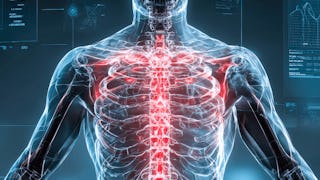
University of Glasgow
Skills you'll gain: 3D Modeling, Scientific Visualization, Anatomy, Animations, Virtual Reality, Medical Imaging, Data Visualization, Augmented and Virtual Reality (AR/VR), Human Musculoskeletal System, Image Analysis, Physiology, Biology, Technical Communication, Visual Design, Augmented Reality, Simulations

Skills you'll gain: Prompt Engineering, ChatGPT, Generative AI

University of Minnesota
Skills you'll gain: Competitive Analysis, Medical Devices, Intellectual Property, Commercialization, Pharmaceuticals, Product Management, Go To Market Strategy, New Product Development, Market Analysis, Risk Analysis, Innovation, Regulatory Requirements, Health Policy
What brings you to Coursera today?

Yale University
Skills you'll gain: Clinical Trials, Software Development Life Cycle, Medical Devices, Usability, Software Development, Medical Privacy, Verification And Validation, Biomedical Engineering, Risk Management, User Interface (UI), Software Design, Regulatory Compliance, Machine Learning, Software Testing, Entrepreneurship, Artificial Intelligence and Machine Learning (AI/ML), User Research, Cybersecurity

Skills you'll gain: Prompt Engineering, Apache Spark, Large Language Modeling, Retrieval-Augmented Generation, PyTorch (Machine Learning Library), Computer Vision, Unsupervised Learning, Generative Model Architectures, Generative AI, Model Optimization, Keras (Neural Network Library), Supervised Learning, LLM Application, Generative AI Agents, Model Evaluation, Vector Databases, Fine-tuning, Machine Learning, Python Programming, Data Science

Khalifa University
Skills you'll gain: Environmental Management Systems, Environment Health And Safety, Environmental Monitoring, Accident Reporting, Fire And Life Safety, Accident Prevention, Environmental Regulations, Health And Safety Standards, Hazard Analysis, Safety Standards, Environmental Engineering, Environmental Laws, Environmental Resource Management, Risk Management, Risk Management Framework, Environmental Engineering and Restoration, Risk Analysis, Environment and Resource Management, Engineering Management, Engineering
Skills you'll gain: Python Programming, NumPy, Data Analysis

Skills you'll gain: Data Store, Data Architecture, Apache Hadoop, Extract, Transform, Load, Relational Databases, Big Data, Data Storage, Databases, Apache Spark, Data Storage Technologies, Data Lakes, Data Warehousing, Data Governance, Data Pipelines, Data Integration, Data Processing, SQL, NoSQL, Data Security, Data Science

Best free Biomedical Engineering courses
High-quality free Biomedical Engineering courses you can start today.
- Biomedical VisualizationUniversity of GlasgowIntermediate1 - 4 WeeksFree
- Introduction to Medical SoftwareYale UniversityIntermediate3 - 6 MonthsFree
Best Biomedical Engineering courses from IBM
Top-rated Biomedical Engineering courses offered by IBM on Coursera.
- Prompt Engineering for Generative AI: Build Better AI PromptsIBMBeginner1 - 4 WeeksIBM
- IBM AI EngineeringIBMIntermediate3 - 6 MonthsIBM
- Python for Data Science & AI: Hands-On DevelopmentIBMBeginner1 - 3 MonthsIBM
Best Biomedical Engineering certificate programs
Earn a certificate in Biomedical Engineering from top universities and companies.
- Sensor Technologies for Biomedical ApplicationsIndian Institute of ScienceBeginner3 - 6 MonthsSpecialization
- Health, Safety, and Environmental (HSE) EngineeringKhalifa UniversityBeginner1 - 3 MonthsSpecialization
- Engineering Project ManagementRice UniversityBeginner3 - 6 MonthsSpecialization
Best Biomedical Engineering courses for beginners
Top-rated beginner-friendly Biomedical Engineering courses with no prerequisites.
- Medical Image ProcessingMathWorksBeginner1 - 4 WeeksNo prerequisites
- Pharmaceutical and Medical Device InnovationsUniversity of MinnesotaBeginner1 - 4 WeeksNo prerequisites
- Introduction to Data EngineeringIBMBeginner1 - 4 WeeksNo prerequisites










