• For Individuals
  • For Businesses
  • For Universities
  • For Governments
Degrees
​
Log In
Join for Free
  • Browse
  • Finite Element

Finite Element Courses

Finite Element courses can help you learn numerical methods, structural analysis, and material behavior principles. You can build skills in mesh generation, boundary condition application, and post-processing results. Many courses introduce tools like ANSYS, Abaqus, and COMSOL Multiphysics, that support simulating complex physical phenomena and validating design choices in engineering projects.


Popular Finite Element Courses and Certifications

  • Status: Preview
    Preview
    U

    University of Michigan

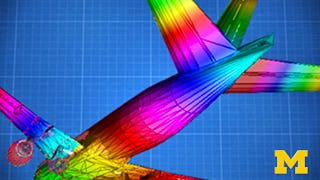
    The Finite Element Method for Problems in Physics

    Skills you'll gain: Finite Element Methods, Engineering Analysis, Mathematical Software, Numerical Analysis, Mathematical Modeling, Advanced Mathematics, C++ (Programming Language)

    4.6
    Rating, 4.6 out of 5 stars
    ·
    564 reviews

    Intermediate · Course · 3 - 6 Months

  • C

    Coursera

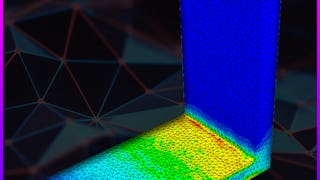
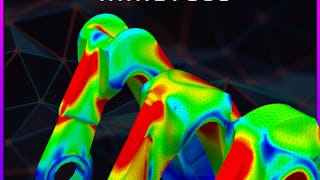
    Finite Element Analysis Convergence and Mesh Independence

    Skills you'll gain: Finite Element Methods, Simulation and Simulation Software, Engineering Analysis, Simulations, Mechanical Design, Process Engineering, Engineering, Verification And Validation
    4.6
    Rating, 4.6 out of 5 stars
    ·
    254 reviews

    Beginner · Guided Project · Less Than 2 Hours

  • C

    Coursera

    FEM - Linear, Nonlinear Analysis & Post-Processing

    Skills you'll gain: Finite Element Methods, Engineering Analysis, Simulation and Simulation Software, Engineering Calculations, Mathematical Modeling, Structural Analysis

    4.7
    Rating, 4.7 out of 5 stars
    ·
    213 reviews

    Intermediate · Guided Project · Less Than 2 Hours

  • Status: Free Trial
    Free Trial
    U

    University of Minnesota

    Introduction to Semiconductor and MEMS Fabrication

    Skills you'll gain: Semiconductors, Finite Element Methods, Medical Devices, Materials science, Electronics Engineering, Laboratory Testing, Electronics, Quality Assurance, Process Control, Biomedical Engineering, Electronic Systems, Product Testing, Mechanical Design, Manufacturing Processes, Electrical Engineering, Electronic Components, Computer Architecture, Process Engineering, Mechanical Engineering, Emerging Technologies

    4.9
    Rating, 4.9 out of 5 stars
    ·
    11 reviews

    Intermediate · Specialization · 3 - 6 Months

  • Status: Free Trial
    Free Trial
    L

    L&T EduTech

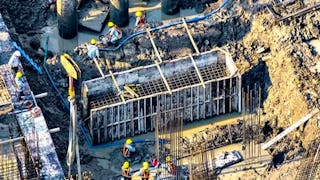
    Construction Practices in Deep excavations and Tunnels

    Skills you'll gain: Construction Engineering, Building Codes, Structural Engineering, Structural Analysis, Engineering Analysis, Construction, Engineering Calculations, Simulation and Simulation Software, Finite Element Methods, Civil Engineering, Construction Management, Engineering Practices, Environmental Monitoring, Safety Standards, Architecture and Construction, System Monitoring, Failure Analysis, Engineering Design Process, Engineering Drawings

    4.8
    Rating, 4.8 out of 5 stars
    ·
    9 reviews

    Advanced · Specialization · 3 - 6 Months

  • Status: Preview
    Preview
    C

    Coursera

    Innovate with ANSYS Simulation Tools

    Skills you'll gain: Engineering Design Process, Engineering Analysis, Mechanical Design, Simulation and Simulation Software, Structural Analysis, Mechanical Engineering, Numerical Analysis, Finite Element Methods, Materials science

    4.9
    Rating, 4.9 out of 5 stars
    ·
    32 reviews

    Beginner · Course · 1 - 4 Weeks

What brings you to Coursera today?

  • Status: New
    New
    Status: Preview
    Preview
    C

    Coursera

    STAR-CCM+: Fluid Flow & Thermal Simulation

    Skills you'll gain: Engineering Calculations, Applied Mathematics, Simulation and Simulation Software, Engineering, 3D Modeling, Thermal Management, Scientific Visualization, Geometry, Star Schema, Environment

    Intermediate · Course · 1 - 4 Weeks

  • Status: Preview
    Preview
    L

    Ludwig-Maximilians-Universität München (LMU)

    Computers, Waves, Simulations: A Practical Introduction to Numerical Methods using Python

    Skills you'll gain: Finite Element Methods, Numerical Analysis, Engineering Analysis, Jupyter, Engineering Calculations, Differential Equations, Applied Mathematics, Mathematical Modeling, Distributed Computing, Python Programming, Mechanics, Vibrations, Simulations

    4.8
    Rating, 4.8 out of 5 stars
    ·
    391 reviews

    Intermediate · Course · 1 - 3 Months

  • Status: Free Trial
    Free Trial
    M

    Microsoft

    Work Smarter with Microsoft Excel

    Skills you'll gain: Microsoft Excel, Excel Formulas, Data Visualization, Spreadsheet Software, Microsoft Office, Microsoft 365, Productivity Software, Data Import/Export, Data Management

    4.7
    Rating, 4.7 out of 5 stars
    ·
    3.3K reviews

    Beginner · Course · 1 - 3 Months

  • Status: New
    New
    Status: Free Trial
    Free Trial
    C

    Coursera

    Classify, Document & Validate Healthcare Data

    Skills you'll gain: Health Information Management, Electronic Medical Record, Medical Privacy, Clinical Data Management, Medical Records, Health Insurance Portability And Accountability Act (HIPAA) Compliance, Health Informatics, Data Validation, Data Dictionary, Data Quality, Clinical Documentation, Health Care, Metadata Management, Data Governance, Data Security, Taxonomy, Data Integrity, Regulatory Compliance

    Beginner · Course · 1 - 4 Weeks

  • Status: Free Trial
    Free Trial
    B

    Berklee

    Songwriting: Writing, Arranging, and Producing Music

    Skills you'll gain: File Management, Musical Composition, Music Theory, Music Performance, Music, Instrumental Music, Storytelling, Performing Arts, Media Production, Automation, digital literacy, Editing, Writing, Software Installation, Creativity

    4.8
    Rating, 4.8 out of 5 stars
    ·
    2.1K reviews

    Beginner · Specialization · 3 - 6 Months

  • Status: Free Trial
    Free Trial
    L

    L&T EduTech

    Bridge Infrastructure Design

    Skills you'll gain: Engineering Calculations, Structural Engineering, Structural Analysis, Construction Engineering, Civil Engineering, Construction, Engineering Analysis, Building Codes, Engineering Practices, Engineering, Materials science, Conceptual Design, Engineering Design Process, Architecture and Construction, Maintenance, Repair, and Facility Services, Finite Element Methods, Property Maintenance, Continuous Monitoring, Hydraulics, Failure Analysis

    4.7
    Rating, 4.7 out of 5 stars
    ·
    25 reviews

    Advanced · Specialization · 1 - 3 Months

1234…20

In summary, here are 10 of our most popular finite element courses

  • The Finite Element Method for Problems in Physics: University of Michigan
  • Finite Element Analysis Convergence and Mesh Independence: Coursera
  • FEM - Linear, Nonlinear Analysis & Post-Processing: Coursera
  • Introduction to Semiconductor and MEMS Fabrication: University of Minnesota
  • Construction Practices in Deep excavations and Tunnels: L&T EduTech
  • Innovate with ANSYS Simulation Tools: Coursera
  • STAR-CCM+: Fluid Flow & Thermal Simulation: Coursera
  • Computers, Waves, Simulations: A Practical Introduction to Numerical Methods using Python: Ludwig-Maximilians-Universität München (LMU)
  • Work Smarter with Microsoft Excel: Microsoft
  • Classify, Document & Validate Healthcare Data: Coursera

Frequently Asked Questions about Finite Element

Finite element refers to a numerical technique used for solving complex engineering and mathematical problems, particularly those involving physical phenomena. It breaks down large structures into smaller, manageable pieces called finite elements, allowing for detailed analysis of stress, heat transfer, fluid dynamics, and more. This method is crucial in fields such as structural engineering, aerospace, and automotive industries, as it enables engineers to predict how structures will behave under various conditions, ultimately leading to safer and more efficient designs.‎

A career in finite element analysis (FEA) can lead to various roles across multiple industries. Common job titles include finite element analyst, structural engineer, mechanical engineer, and simulation engineer. These positions often involve using FEA software to model and analyze physical systems, ensuring that designs meet safety and performance standards. Additionally, professionals in this field may work in research and development, contributing to innovative solutions in engineering and technology.‎

To excel in finite element analysis, you should develop a strong foundation in mathematics, particularly calculus and linear algebra. Familiarity with physics, especially mechanics, is also essential. Proficiency in FEA software tools, such as ANSYS or Abaqus, is crucial for practical application. Additionally, skills in programming languages like Python or MATLAB can enhance your ability to automate tasks and analyze data effectively.‎

Some of the best online finite element courses include The Finite Element Method for Problems in Physics, which provides a comprehensive introduction to the principles and applications of FEA. These courses typically cover both theoretical concepts and practical applications, allowing learners to gain hands-on experience with relevant software and methodologies.‎

Yes. You can start learning finite element on Coursera for free in two ways:

  1. Preview the first module of many finite element courses at no cost. This includes video lessons, readings, graded assignments, and Coursera Coach (where available).
  2. Start a 7-day free trial for Specializations or Coursera Plus. This gives you full access to all course content across eligible programs within the timeframe of your trial.

If you want to keep learning, earn a certificate in finite element, or unlock full course access after the preview or trial, you can upgrade or apply for financial aid.‎

To learn finite element analysis, start by enrolling in foundational courses that cover the basics of the finite element method and its applications. Engage with practical exercises and projects to apply your knowledge. Utilize online resources, such as forums and study groups, to connect with peers and seek guidance. Regular practice with FEA software will also enhance your understanding and proficiency.‎

Typical topics covered in finite element courses include the fundamentals of the finite element method, mesh generation, boundary conditions, and solving linear and nonlinear problems. Courses may also explore specific applications in structural analysis, thermal analysis, and fluid dynamics, providing a well-rounded understanding of how FEA is applied in various engineering contexts.‎

For training and upskilling employees in finite element analysis, courses like The Finite Element Method for Problems in Physics are highly beneficial. These programs are designed to equip professionals with the necessary skills to apply FEA in real-world scenarios, enhancing their capabilities and contributing to organizational success.‎

This FAQ content has been made available for informational purposes only. Learners are advised to conduct additional research to ensure that courses and other credentials pursued meet their personal, professional, and financial goals.

Other topics to explore

Arts and Humanities
338 courses
Business
1095 courses
Computer Science
668 courses
Data Science
425 courses
Information Technology
145 courses
Health
471 courses
Math and Logic
70 courses
Personal Development
137 courses
Physical Science and Engineering
413 courses
Social Sciences
401 courses
Language Learning
150 courses

Coursera Footer

Skills

  • Accounting
  • Artificial Intelligence (AI)
  • Cybersecurity
  • Data Analytics
  • Digital Marketing
  • Human Resources (HR)
  • Microsoft Excel
  • Project Management
  • Python
  • SQL

Professional Certificates

  • Google AI Certificate
  • Google Cybersecurity Certificate
  • Google Data Analytics Certificate
  • Google IT Support Certificate
  • Google Project Management Certificate
  • Google UX Design Certificate
  • IBM AI Engineering Certificate
  • IBM AI Product Manager Certificate
  • IBM Data Science Certificate
  • Intuit Academy Bookkeeping Certificate

Courses & Specializations

  • AI Essentials Specialization
  • AI For Business Specialization
  • AI For Everyone Course
  • AI in Healthcare Specialization
  • Deep Learning Specialization
  • Excel Skills for Business Specialization
  • Financial Markets Course
  • Machine Learning Specialization
  • Prompt Engineering for ChatGPT Course
  • Python for Everybody Specialization

Career Resources

  • Career Aptitude Test
  • CAPM Certification Requirements
  • CompTIA A+ Certification Requirements
  • CompTIA Security+ Certification Requirements
  • Essential IT Certifications
  • Free IT Certifications and Courses
  • High-Income Skills to Learn
  • How to Learn Artificial Intelligence
  • PMP Certification Requirements
  • Popular Cybersecurity Certifications

Coursera

  • About
  • What We Offer
  • Leadership
  • Careers
  • Catalog
  • Coursera Plus
  • Professional Certificates
  • MasterTrack® Certificates
  • Degrees
  • For Enterprise
  • For Government
  • For Campus
  • Become a Partner
  • Social Impact
  • Free Courses
  • Share your Coursera learning story

Community

  • Learners
  • Partners
  • Beta Testers
  • Blog
  • The Coursera Podcast
  • Tech Blog

More

  • Press
  • Investors
  • Terms
  • Privacy
  • Help
  • Accessibility
  • Contact
  • Articles
  • Directory
  • Affiliates
  • Modern Slavery Statement
  • Do Not Sell/Share
Learn Anywhere
Download on the App Store
Get it on Google Play
Logo of Certified B Corporation
© 2026 Coursera Inc. All rights reserved.
  • Coursera Facebook
  • Coursera Linkedin
  • Coursera Twitter
  • Coursera YouTube
  • Coursera Instagram
  • Coursera TikTok