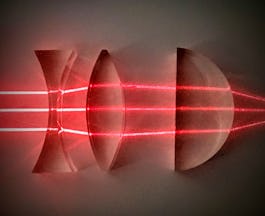
Optical engineering courses can help you learn about light propagation, lens design, optical systems, and imaging techniques. You can build skills in wave optics, photonics, and optical measurement methods. Many courses introduce tools such as ray tracing software, optical simulation programs, and design software that facilitate the creation and analysis of optical components. You'll also explore applications in telecommunications, medical imaging, and laser technology, enhancing your ability to solve practical problems in various industries.

University of Colorado Boulder
Skills you'll gain: Model Optimization, Electrical Engineering, electromagnetics, Image Quality, Equipment Design, Engineering Calculations, Systems Design, System Requirements, Engineering, Scientific, and Technical Instruments, Design Software, Simulation and Simulation Software, Engineering Analysis, Technical Design, System Design and Implementation, Systems Analysis, Numerical Analysis, Image Analysis, Graphical Tools, Human Factors, Medical Imaging
Build toward a degree
Advanced · Specialization · 3 - 6 Months

Rice University
Skills you'll gain: Physics, Mechanics, electromagnetics, Vibrations, Materials science, Applied Mathematics, Physical Science, Mathematical Modeling, Advanced Mathematics, Calculus, Differential Equations, Trigonometry, Linear Algebra, Integral Calculus, Problem Solving
Intermediate · Specialization · 1 - 3 Months

Skills you'll gain: Network Performance Management, Network Planning And Design, Wide Area Networks, Network Engineering, Network Architecture, Network Troubleshooting, Design Reviews, Network Infrastructure, Telecommunications, Test Equipment, System Configuration, Engineering, Scientific, and Technical Instruments, Hardware Troubleshooting, Failure Analysis, Network Security, Capacity Management, Verification And Validation, Estimation, Infrastructure Security, Scalability
Intermediate · Course · 1 - 4 Weeks

University of Colorado Boulder
Skills you'll gain: Image Quality, Engineering, Scientific, and Technical Instruments, Systems Design, Human Factors, Engineering Calculations, Technical Design, Simulation and Simulation Software, Mathematical Modeling, Applied Mathematics
Build toward a degree
Advanced · Course · 1 - 3 Months

University of Minnesota
Skills you'll gain: Materials science, Semiconductors, Process Control, Manufacturing Processes, Process Engineering, Chemical Engineering, Chemistry, Electronics, Mechanical Engineering, Electrical Engineering, Process Analysis
Intermediate · Course · 1 - 4 Weeks

Indian Institute of Science
Skills you'll gain: Semiconductors, Electronics, Electronic Hardware, Biomedical Technology, Hardware Design, Materials science, Mechanical Design, Manufacturing Processes, Communication Systems, Laboratory Equipment, Process Engineering, Laboratory Testing, 3D Modeling, Analytical Testing
Beginner · Course · 1 - 3 Months

Universitat Politècnica de València
Beginner · Course · 1 - 3 Months

L&T EduTech
Skills you'll gain: Construction, Safety Audits, Electrical Safety, Construction Inspection, Fall Protection
Intermediate · Course · 1 - 4 Weeks

Skills you'll gain: High Voltage, Low Voltage, Electrical Power, Electric Power Systems, Civil Engineering, Construction Engineering, Electrical Engineering, General Construction and Construction Labor, Matlab, Engineering Analysis, Mathematical Software, Electrical Equipment, Engineering Calculations, Electrical Safety, Surveys, Maintenance, Repair, and Facility Services, Environmental Engineering, Geospatial Information and Technology, Mathematical Modeling
Intermediate · Specialization · 1 - 3 Months
Khalifa University
Skills you'll gain: Environmental Management Systems, Environment Health And Safety, Environmental Monitoring, Accident Reporting, Fire And Life Safety, Accident Prevention, Hazardous Waste Operations And Emergency Response Standard (HAZWOPER), Environmental Regulations, Safety Assurance, Health And Safety Standards, Environmental Engineering, Environmental Laws, Environmental Resource Management, Risk Management, Risk Management Framework, Environmental Engineering and Restoration, Risk Analysis, Environment and Resource Management, Engineering Management, Engineering
Beginner · Specialization · 1 - 3 Months

L&T EduTech
Skills you'll gain: Root Cause Analysis, Accident Prevention, Safety Audits, Electrical Safety, Construction Inspection, Occupational Safety And Health, Fall Protection, Control Systems, Lifting Ability, Risk Analysis, Material Handling, Substance Abuse, First Aid
Intermediate · Specialization · 1 - 3 Months

Arizona State University
Skills you'll gain: Semiconductors, Electronic Components, Materials science, Electrical Engineering, Electronics Engineering, Manufacturing Processes, Mechanical Engineering, Electronics, Thermal Management, Chemical Engineering, Structural Analysis, Chemistry, Failure Analysis, Physical Science, Engineering Calculations
Intermediate · Specialization · 3 - 6 Months
Optical engineering is a branch of engineering that focuses on the design and application of optical systems, which include lenses, microscopes, telescopes, and fiber optics. This field is crucial because it plays a significant role in various industries, including telecommunications, healthcare, and manufacturing. Optical engineers work on technologies that enhance our ability to see and manipulate light, leading to advancements in imaging systems, laser technology, and optical sensors. The importance of optical engineering is underscored by its applications in everyday life, from the cameras in our smartphones to the sophisticated equipment used in medical diagnostics.‎
A career in optical engineering can lead to various job opportunities across multiple sectors. Common roles include optical engineer, systems engineer, research scientist, and product development engineer. These positions often involve working with cutting-edge technologies in industries such as telecommunications, aerospace, and healthcare. Additionally, optical engineers may find opportunities in academia, conducting research and teaching the next generation of engineers. The demand for skilled professionals in this field continues to grow, making it a promising career choice for those interested in technology and innovation.‎
To succeed in optical engineering, you will need a solid foundation in several key skills. These include a strong understanding of physics, particularly optics and light behavior, as well as proficiency in mathematics for modeling and analysis. Familiarity with computer-aided design (CAD) software is also essential for creating and testing optical systems. Additionally, skills in programming and data analysis can be beneficial, especially as optical engineering increasingly intersects with fields like artificial intelligence and machine learning. Developing problem-solving abilities and critical thinking skills will further enhance your effectiveness in this dynamic field.‎
For those looking to enhance their knowledge in optical engineering, the Optical Engineering Specialization offers a comprehensive curriculum. This specialization covers essential topics such as optical system design, imaging, and laser applications. Additionally, various online platforms provide courses that cater to different aspects of optical engineering, allowing learners to choose based on their specific interests and career goals. Exploring these options can help you build a strong foundation in this exciting field.‎
Yes. You can start learning optical engineering on Coursera for free in two ways:
If you want to keep learning, earn a certificate in optical engineering, or unlock full course access after the preview or trial, you can upgrade or apply for financial aid.‎
Typical topics covered in optical engineering courses include the fundamentals of light and optics, optical system design, wave optics, geometrical optics, and laser technology. Courses may also explore advanced subjects such as photonics, optical materials, and imaging systems. By studying these topics, you will gain a comprehensive understanding of how optical systems function and how to design and optimize them for various applications.‎
For training and upskilling employees in optical engineering, the Optical Engineering Specialization is an excellent resource. This program is designed to equip learners with both theoretical knowledge and practical skills, making it suitable for professionals looking to enhance their expertise. Additionally, organizations can consider tailored training programs that focus on specific technologies relevant to their industry, ensuring that employees are well-prepared to meet the demands of the evolving optical engineering landscape.‎