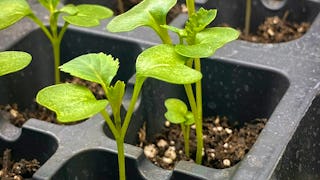
Courses in plants often teach botany, plant biology, ecology, and sustainable gardening practices. You can build skills in plant identification, cultivation techniques, and environmental conservation strategies. Many courses introduce tools such as soil testing kits, plant care apps, and environmental monitoring devices, showing how to apply your knowledge in real-world gardening or conservation projects.

Tel Aviv University
Skills you'll gain: Scientific Methods, Biology, Research, Biochemistry, Life Sciences, Psychology, Molecular Biology, Environment, Physiology, Cell Biology
Beginner · Course · 1 - 3 Months

Skillshare
Skills you'll gain: Creative Design, Creativity, Peer Review, Digital Design, Design Elements And Principles, Graphical Tools, Storyboarding, Storytelling, Design Software, Technical Drawing, Color Theory
Beginner · Specialization · 1 - 3 Months

University of Florida
Skills you'll gain: Land Management, Climate Change Mitigation, Sustainable Development, Environment and Resource Management, Water Resource Management, Water Sustainability, Sustainability Standards, Climate Change Adaptation, Environment, Natural Resource Management, Plant Operations and Management, Sustainable Systems, Water Resources, Systems Thinking, Environmental Science, General Science and Research, Taxonomy, Spatial Analysis, Socioeconomics, Biology
Intermediate · Specialization · 3 - 6 Months

Rice University
Skills you'll gain: Biology, Environment, Microbiology, Environmental Science, Life Sciences, Environmental Issue, Environment and Resource Management, Sustainable Development, Demography, Natural Resource Management, Physiology, Molecular Biology, Taxonomy, Cell Biology, Anatomy, Climate Change Adaptation, Estimation, Mathematical Modeling, Scientific Methods, Climate Change Mitigation
Beginner · Specialization · 3 - 6 Months

Skills you'll gain: Construction Inspection, Building Codes, Construction Engineering, Construction, Construction Management, Civil Engineering, Civil and Architectural Engineering, Structural Engineering, Hydrology, Engineering Practices, Hydraulics, Structural Analysis, Materials science, Engineering Plans And Specifications, Laboratory Testing, Engineering Software, Engineering Design Process, Plant Operations and Management, Safety Standards, Engineering Calculations
Advanced · Specialization · 3 - 6 Months

Tel Aviv University
Skills you'll gain: Biotechnology, Cell Biology, Life Sciences, Molecular Biology, Biochemistry, Biology, Anatomy, Food and Beverage, Environmental Science
Intermediate · Course · 1 - 4 Weeks
University of Toronto
Skills you'll gain: Bioinformatics, Network Analysis, Biostatistics, Molecular Biology, Analysis, Biotechnology, Data Visualization Software, Database Software, Data Analysis Software, Health Informatics, Data Analysis, Data Synthesis, Statistical Methods, Data Mining, Medical Science and Research, Exploratory Data Analysis, Technical Communication, Life Sciences, Data Processing, Scientific Visualization
Beginner · Specialization · 3 - 6 Months

University of Illinois Urbana-Champaign
Skills you'll gain: Infection Control, Microbiology, Epidemiology, Preventative Care, Environmental Science, Environmental Monitoring
Beginner · Course · 1 - 4 Weeks

University of New Mexico
Skills you'll gain: Cultural Diversity, Preventative Care, Health Care, Health Education, Pain Management, Nutrition and Diet, Stress Management
Beginner · Course · 1 - 3 Months

University of Illinois Urbana-Champaign
Skills you'll gain: Chemistry, Taxonomy, Production Process, Biochemistry, Biology, Anatomy, Laboratory Research, Scientific Methods
Beginner · Course · 1 - 3 Months

University of Florida
Skills you'll gain: Land Management, Water Quality, Water Resource Management, Hydrology, Environment and Resource Management, Environmental Regulations, Sustainable Development, Sustainability Standards, Environmental Science
Beginner · Course · 1 - 3 Months

Skills you'll gain: Creativity, Peer Review, Digital Design, Creative Design, Design Software, Design Elements And Principles, Color Theory
Mixed · Course · 1 - 4 Weeks
Plants are multicellular organisms belonging to the kingdom Plantae. They have the ability to produce their own food through a process called photosynthesis. Plants have specialized structures, such as leaves, stems, and roots, which help them in various functions like absorbing water and nutrients, conducting photosynthesis, and providing support.
Plants play a crucial role in maintaining the Earth's ecosystem. They release oxygen into the atmosphere and absorb carbon dioxide, helping to regulate the planet's climate. They also provide habitats for various other organisms and contribute to the overall biodiversity.
There are thousands of different plant species, ranging from small mosses to tall trees. They can be categorized into various groups such as flowering plants, ferns, mosses, and algae.
Studying plants can fall under various disciplines such as botany, horticulture, and ecology. It can be an interesting field of study for those interested in understanding the natural world, plant conservation, plant breeding, or even pursuing a career in agriculture or environmental sciences. There are numerous online courses and resources available for individuals interested in learning more about plants and their diverse characteristics.‎
To learn about plants, you will need to acquire the following skills:
Botany: Understanding the basic principles of botany is crucial to learning about plants. This includes knowledge of plant anatomy, taxonomy, physiology, and ecology.
Plant Identification: Developing the ability to identify different types of plants is essential. Focus on characteristics such as leaf shape, flower structure, and growth patterns.
Plant Care: Learning how to care for plants is important for their successful growth. This includes understanding proper watering techniques, soil requirements, light exposure, and pest control.
Gardening: Gaining skills in gardening will enable you to cultivate and maintain plants effectively. This includes knowledge of soil preparation, planting techniques, pruning, and propagation.
Plant Nutrition: Understanding plant nutrition is crucial for their health and growth. Learn about the essential nutrients plants need, including macronutrients (nitrogen, phosphorus, potassium) and micronutrients (iron, magnesium, etc.).
Plant Propagation: Mastering the art of plant propagation will allow you to successfully reproduce and expand your collection. Learn about different methods such as seed germination, cutting, layering, grafting, and division.
Plant Diseases and Pests: Developing knowledge in identifying and treating plant diseases and pests will help you maintain a healthy plant collection. Familiarize yourself with common diseases, pests, and the appropriate management practices.
Environmental Science: Understanding the impact of environmental factors on plants is essential. Learn about climate, soil types, and other ecological factors that influence plant growth and distribution.
Landscaping and Design: Acquiring skills in landscape design will help you create beautiful outdoor spaces using plants. Learn about principles such as balance, color schemes, focal points, and plant placement.
Remember, learning about plants is an ongoing process, and there is always more to explore and discover. Enjoy your journey of mastering the world of plants!‎
With plant skills, you can pursue various job opportunities in fields such as horticulture, botany, agriculture, environmental science, landscaping, and plant breeding. Some specific job roles you can explore include:
Botanist: Conduct research and study plants, including their growth, classification, and distribution.
Horticulturist: Design, manage, and maintain gardens, parks, or other green spaces. Provide expertise in plant selection, cultivation, and care.
Plant breeder: Develop new plant varieties with improved characteristics, such as disease resistance or higher yield.
Landscape architect: Design and plan outdoor spaces, including gardens, parks, and urban landscapes, considering the selection and placement of plants.
Agronomist: Improve agricultural practices by studying soil fertility, crop rotation, and pests. Ensure optimal plant growth and maximize crop production.
Environmental scientist: Analyze and assess the impact of plants on the ecosystem, including their role in mitigating climate change and preserving biodiversity.
Plant nursery manager: Oversee the production, care, and distribution of plants in a nursery setting, ensuring their health and quality.
Ecologist: Investigate the interactions between plants, animals, and their environment. Study plant communities and their ecological roles in ecosystems.
Plant geneticist: Study and manipulate plant genomes to improve plant traits and develop genetically modified crops.
It's important to note that the specific job opportunities may vary depending on your level of expertise, education, and geographical location. Exploring relevant courses and certifications in these fields will further enhance your plant skills and increase your career prospects.‎
People who have a passion for nature, gardening, and the environment are best suited for studying plants. Additionally, individuals who are curious about the various species, their growth patterns, and the role they play in ecosystems would find studying plants fulfilling. People who enjoy hands-on activities, such as planting and caring for plants, would also thrive in this field of study.‎
There are several topics related to plants that you can study. Here are some suggestions:
Botany: This field of study focuses on the scientific study of plants, including their physiology, structure, genetics, and more.
Horticulture: If you are interested in gardening and plant cultivation, horticulture would be a great topic to explore. It covers the science and art of growing plants, landscaping, and crop production.
Plant Ecology: This subject delves into the relationship between plants and their environment. It examines how plants interact with other organisms and how they influence ecosystems.
Plant Pathology: If you want to study plant diseases and methods to manage them, plant pathology is an ideal topic. It looks into the causes, mechanisms, and control of plant diseases.
Ethnobotany: This field explores the relationships between plants and different cultures. It examines how plants have been utilized for various purposes like medicine, food, clothing, and more by different societies throughout history.
Plant Genetics: If genetics interests you, studying plant genetics will help you understand how genetic information is inherited, transferred, and altered in plants.
Medicinal Plants: This topic focuses on the study of plants with potential medicinal properties. It explores the identification, properties, and uses of plants in traditional and modern medicine.
These are just a few examples, but there are many more fascinating topics related to plants that you can explore depending on your interests and career goals.‎
Online Plants courses offer a convenient and flexible way to enhance your knowledge or learn new Plants are multicellular organisms belonging to the kingdom Plantae. They have the ability to produce their own food through a process called photosynthesis. Plants have specialized structures, such as leaves, stems, and roots, which help them in various functions like absorbing water and nutrients, conducting photosynthesis, and providing support.
Plants play a crucial role in maintaining the Earth's ecosystem. They release oxygen into the atmosphere and absorb carbon dioxide, helping to regulate the planet's climate. They also provide habitats for various other organisms and contribute to the overall biodiversity.
There are thousands of different plant species, ranging from small mosses to tall trees. They can be categorized into various groups such as flowering plants, ferns, mosses, and algae.
Studying plants can fall under various disciplines such as botany, horticulture, and ecology. It can be an interesting field of study for those interested in understanding the natural world, plant conservation, plant breeding, or even pursuing a career in agriculture or environmental sciences. There are numerous online courses and resources available for individuals interested in learning more about plants and their diverse characteristics. skills. Choose from a wide range of Plants courses offered by top universities and industry leaders tailored to various skill levels.‎
When looking to enhance your workforce's skills in Plants, it's crucial to select a course that aligns with their current abilities and learning objectives. Our Skills Dashboard is an invaluable tool for identifying skill gaps and choosing the most appropriate course for effective upskilling. For a comprehensive understanding of how our courses can benefit your employees, explore the enterprise solutions we offer. Discover more about our tailored programs at Coursera for Business here.‎