Warehouse Management Courses
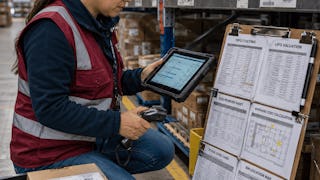
Warehouse management courses can help you learn inventory control, order fulfillment processes, logistics optimization, and supply chain coordination. You can build skills in demand forecasting, warehouse layout design, and effective team management. Many courses introduce tools like warehouse management systems (WMS), barcode scanning technology, and inventory tracking software, demonstrating how these skills enhance operational efficiency and accuracy in managing warehouse activities.
Popular Warehouse Management Courses and Certifications

University of California, Irvine
Skills you'll gain: Inventory Control, Inventory Management, Supply Chain Management, Microsoft Excel, Supply Chain Planning, Order Management, Warehouse Management, Demand Planning, Logistics Management, Service Level, Operations, Data Management, Customer Data Management, Forecasting, Data Collection

Rutgers the State University of New Jersey
Skills you'll gain: Strategic Sourcing, Transportation, Supply Chain, and Logistics, Lean Six Sigma, Lean Manufacturing, Demand Planning, Logistics Management, Procurement, Supplier Relationship Management, Manufacturing Operations, Forecasting, Lean Methodologies, Process Improvement, Supplier Management, Logistics, Operations Management, Operations, Purchasing, Operational Efficiency, Supply Chain, Supply Chain Planning

Amazon Web Services
Skills you'll gain: Supply Chain Systems, Reverse Logistics, Supply Chain Management, Transportation, Supply Chain, and Logistics, Supply Chain, Warehouse Operations, Supply Chain Planning, Operations Management, Inventory and Warehousing, Operations, Transportation Operations, Logistics Management, Warehouse Management, Transportation Management, Business Systems, Logistics, Order Management, Inventory Control, Enterprise Resource Planning, Customer Relationship Management
Skills you'll gain: Inventory and Warehousing, Inventory Management, Warehousing, Inventory Control Systems, Inventory Control, Materials Management, Warehouse Operations, Warehouse Management, Inventory Management System, Inventory Accounting, Reverse Logistics

Rutgers the State University of New Jersey
Skills you'll gain: Transportation, Supply Chain, and Logistics, Logistics Management, Logistics, Inventory and Warehousing, Warehousing, Transportation Operations, Warehouse Operations, Supply Chain, Inventory Management, Warehouse Management, Inventory Control, Customer Service, Operating Cost, Decision Making

Skills you'll gain: Inventory and Warehousing, Material Handling, Transportation, Supply Chain, and Logistics, Logistics Management, Inventory Management, Warehousing, Logistics, Transportation Management, Inventory Control Systems, Transportation Operations, Inventory Control, Materials Management, Warehouse Operations, Warehouse Management, Reverse Logistics, Inventory Management System, Inventory Accounting, Supply Chain Systems, Supply Chain Management, Procurement
What brings you to Coursera today?

Skills you'll gain: Data Warehousing, Extract, Transform, Load, IBM DB2, Star Schema, PostgreSQL, Snowflake Schema, Data Mart, Data Architecture, Data Modeling, Database Design, Database Systems, Data Lakes, Data Integration, Query Languages, Data Validation, Data Cleansing, Data Quality
Skills you'll gain: Process Analysis, Process Modeling, Business Process, Business Analysis, Process Management, Business Process Modeling, Stakeholder Analysis, Computer Literacy

Skills you'll gain: Quality Management, Project Closure, Scope Management, Team Management, Project Management Life Cycle, Project Management, Project Planning, Agile Project Management, Quality Assurance, Backlogs, Team Leadership, Project Scoping, Stakeholder Analysis, Project Risk Management, Stakeholder Communications, Project Implementation, Quality Assessment, Change Management, Web Presence, Interviewing Skills

Skills you'll gain: Demand Planning, Supply Chain Management, Supply Chain Planning, Process Improvement, Logistics, Analytics, Corporate Sustainability, Scheduling, Forecasting, Data Analysis, Risk Management, Data Visualization, Problem Solving

University of Colorado Boulder
Skills you'll gain: Agile Project Management, Earned Value Management, Agile Methodology, Work Breakdown Structure, Project Planning, Stakeholder Analysis, Project Management, Plan Execution, Sprint Planning, Matrix Management, Stakeholder Engagement, Resource Management, Timelines, Cost Estimation, Team Leadership, Scope Management, Project Coordination, Engineering Management, Stakeholder Communications, Risk Management

University of Michigan
Skills you'll gain: Talent Management, Goal Setting, Team Building, Teamwork, Team Management, Talent Pipelining, Influencing, Team Motivation, Visionary, People Development, Performance Appraisal, Team Performance Management, Motivational Skills, Smart Goals, Employee Onboarding, Employee Performance Management, Interviewing Skills, Persuasive Communication, Leadership, Team Leadership
Best Warehouse Management courses from Rutgers the State University of New Jersey
Top-rated Warehouse Management courses offered by Rutgers the State University of New Jersey on Coursera.
- Supply Chain ManagementRutgers the State University of New JerseyBeginner3 - 6 MonthsRutgers the State University of New Jersey
- Supply Chain LogisticsRutgers the State University of New JerseyBeginner1 - 4 WeeksRutgers the State University of New Jersey
Best Warehouse Management certificate programs
Earn a certificate in Warehouse Management from top universities and companies.
- Logistics and Inventory ManagementEDUCBABeginner3 - 6 MonthsSpecialization
- Google Project ManagementGoogleBeginner3 - 6 MonthsProfessional Certificate
- Project ManagementUniversity of Colorado BoulderBeginner1 - 3 MonthsSpecialization
Best Warehouse Management courses for beginners
Top-rated beginner-friendly Warehouse Management courses with no prerequisites.
- Supply Chain Operations and ManagementAmazon Web ServicesBeginner1 - 3 MonthsNo prerequisites
- Business Analysis & Process ManagementCourseraBeginnerLess Than 2 HoursNo prerequisites
- Supply Chain Management and AnalyticsUnileverBeginner1 - 3 MonthsNo prerequisites










