• For Individuals
  • For Businesses
  • For Universities
  • For Governments
Degrees
Log In
Join for Free
  • Browse
  • Octave

Octave Courses

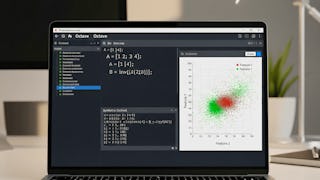
Octave courses can help you learn numerical computing, data visualization, algorithm implementation, and mathematical modeling. You can build skills in matrix operations, statistical analysis, and signal processing techniques. Many courses introduce tools like Octave's integrated development environment and libraries for optimization, enabling you to apply these skills in real-world projects and research.


Popular Octave Courses and Certifications


  • Status: New
    New
    Status: Free Trial
    Free Trial
    E

    EDUCBA

    Octave for Machine Learning: Data Analysis Mastery

    Skills you'll gain: Plot (Graphics), Scripting, Scientific Visualization, Visualization (Computer Graphics), Graphing, Scripting Languages, Scalability, Text Mining, Statistical Analysis, Time Series Analysis and Forecasting, Data Visualization, Descriptive Statistics, Mathematical Software, Software Installation, Numerical Analysis, Mathematical Modeling, Predictive Modeling, Programming Principles, Python Programming, Data Analysis

    Beginner · Specialization · 1 - 3 Months

  • Status: New
    New
    Status: Free Trial
    Free Trial
    E

    EDUCBA

    Octave for Machine Learning: Analyze & Visualize

    Skills you'll gain: Text Mining, Statistical Analysis, Data Visualization, Descriptive Statistics, Data Analysis, Computer Programming, Mathematical Software, Data Manipulation, Data Processing, Data Structures, Linear Algebra, Numerical Analysis, Software Installation

    Mixed · Course · 1 - 4 Weeks

  • Status: Free Trial
    Free Trial
    U

    University of Colorado System

    Applied Kalman Filtering

    Skills you'll gain: Bayesian Network, Linear Algebra, Numerical Analysis, Mathematical Modeling, Estimation, Matlab, Simulations, Advanced Mathematics, Engineering Analysis, Time Series Analysis and Forecasting, Global Positioning Systems, Probability & Statistics, Systems Of Measurement, Applied Mathematics, Statistical Methods, Probability Distribution, Predictive Analytics, Computational Thinking, Predictive Modeling, Control Systems

    4.9
    Rating, 4.9 out of 5 stars
    ·
    26 reviews

    Intermediate · Specialization · 3 - 6 Months

  • Status: New
    New
    Status: Free Trial
    Free Trial
    E

    EDUCBA

    GNU Octave: Apply, Implement & Design Functions

    Skills you'll gain: Mathematical Software, Software Installation, Numerical Analysis, Mathematical Modeling, Applied Mathematics, Trigonometry, Programming Principles, Data Manipulation, Engineering Calculations, Linear Algebra, Data Structures, Development Environment

    Mixed · Course · 1 - 4 Weeks

  • Status: New
    New
    Status: Free Trial
    Free Trial
    E

    EDUCBA

    Octave Programming: Analyze, Apply & Implement

    Skills you'll gain: Plot (Graphics), Scripting, Scientific Visualization, Visualization (Computer Graphics), Graphing, Scripting Languages, Programming Principles, Debugging, Matlab, Computational Thinking, Numerical Analysis, Object Oriented Programming (OOP), Data Manipulation, Linear Algebra

    Mixed · Course · 1 - 4 Weeks

  • Status: New
    New
    Status: Free Trial
    Free Trial
    E

    EDUCBA

    Octave Machine Learning: Apply, Analyze & Build

    Skills you'll gain: Scalability, Time Series Analysis and Forecasting, Predictive Modeling, Programming Principles, Data Import/Export, Exploratory Data Analysis, Scripting, Statistical Analysis, Data Analysis, Data Processing, Data Manipulation, Applied Machine Learning, File Management, Mathematical Software

    Mixed · Course · 1 - 4 Weeks

What brings you to Coursera today?

  • Status: Free Trial
    Free Trial
    G

    Google Cloud

    Gemini for Google Cloud Learning Path

    Skills you'll gain: Google Gemini, Google Cloud Platform, Kubernetes, Generative AI, Big Data, Software Development Life Cycle, Cloud Computing, Cloud Security, Development Testing, Application Deployment, Marketing Analytics, DevOps, Application Lifecycle Management, Application Development, Network Planning And Design, Data Analysis, Software Development Tools, Vulnerability Assessments, Security Controls, Security Engineering

    4.4
    Rating, 4.4 out of 5 stars
    ·
    28 reviews

    Intermediate · Specialization · 1 - 3 Months

  • Status: Free Trial
    Free Trial
    U

    Universidad Nacional Autónoma de México

    Programación musical con software libre

    Skills you'll gain: Musical Composition, Music, Electronic Components, Electronics, Music Theory, Hardware Design, Digital Design, Instrumental Music, Embedded Systems, System Configuration, Algorithms, Performance Tuning, Programming Principles, Digital Communications, Creative Design, Interoperability, Other Programming Languages, Development Environment, Physics, Object Oriented Programming (OOP)

    4.7
    Rating, 4.7 out of 5 stars
    ·
    55 reviews

    Beginner · Specialization · 1 - 3 Months

  • Status: Free Trial
    Free Trial
    G

    Google Cloud

    Gemini for Application Developers

    Skills you'll gain: Google Gemini, Generative AI, Google Cloud Platform, Software Development Tools, Application Development, Integrated Development Environments, Cloud Services, Code Review

    4.5
    Rating, 4.5 out of 5 stars
    ·
    15 reviews

    Beginner · Course · 1 - 4 Weeks

  • G

    Google Cloud

    Introduction to Vertex AI Studio

    Skills you'll gain: Prompt Engineering, Google Gemini, Multimodal Prompts, Generative AI, LLM Application, AI Product Strategy, Prototyping, Performance Tuning

    4.7
    Rating, 4.7 out of 5 stars
    ·
    234 reviews

    Beginner · Course · 1 - 4 Weeks

  • Status: Preview
    Preview
    B

    Berklee

    FL Studio Basics

    Skills you'll gain: Musical Composition, Music, Media Production, Instrumental Music, Music Performance, Editing, Creativity, Automation, File Management, Electronic Media

    4.5
    Rating, 4.5 out of 5 stars
    ·
    15 reviews

    Intermediate · Course · 1 - 4 Weeks

  • G

    Google Cloud

    Transformer Models and BERT Model

    Skills you'll gain: Large Language Modeling, Natural Language Processing, Generative Model Architectures, Artificial Neural Networks

    4.1
    Rating, 4.1 out of 5 stars
    ·
    124 reviews

    Advanced · Course · 1 - 4 Weeks

Searches related to octave

octave programming: analyze, apply & implement
octave for machine learning: data analysis mastery
octave for machine learning: analyze & visualize
octave machine learning: apply, analyze & build
gnu octave: apply, implement & design functions
1234…10

In summary, here are 10 of our most popular octave courses

  • Octave for Machine Learning: Data Analysis Mastery: EDUCBA
  • Octave for Machine Learning: Analyze & Visualize: EDUCBA
  • Applied Kalman Filtering: University of Colorado System
  • GNU Octave: Apply, Implement & Design Functions: EDUCBA
  • Octave Programming: Analyze, Apply & Implement: EDUCBA
  • Octave Machine Learning: Apply, Analyze & Build: EDUCBA
  • Gemini for Google Cloud Learning Path: Google Cloud
  • Programación musical con software libre: Universidad Nacional Autónoma de México
  • Gemini for Application Developers: Google Cloud
  • Introduction to Vertex AI Studio: Google Cloud

Skills you can learn in Marketing

Market (economics) (28)
Social Media (15)
Marketing Strategy (14)
Analytics (13)
Brand (13)
Digital Marketing (13)
Marketing Analytics (11)
Plan (11)
Advertising (9)
Modeling (9)
Social Media Marketing (9)
Brand Management (7)

Frequently Asked Questions about Octave

Octave is an open-source programming language, specifically designed for numerical computations. It is often used for scientific and engineering applications, allowing users to perform tasks such as data manipulation, simulation, and algorithm implementation. Octave provides a flexible environment for users to solve complex mathematical problems and analyze data efficiently.‎

To work with Octave, a high-level programming language for numerical computations and data analysis, there are several skills you should learn:

  1. Basic programming concepts: Familiarize yourself with programming principles like variables, loops, conditionals, and functions, as they form the foundation for working with Octave.

  2. Octave syntax: Learn the specific syntax of Octave, including how to declare variables, define functions, perform arithmetic and logical operations, work with vectors and matrices, etc.

  3. Numerical computation: Gain knowledge of mathematical concepts and algorithms used in numerical analysis, as Octave is extensively used for performing mathematical calculations.

  4. Data manipulation and visualization: Acquire skills in importing, manipulating, and analyzing data using Octave's built-in functions and libraries. Additionally, learn how to visualize data using plots, graphs, and charts.

  5. Statistical analysis: Understand the fundamental principles of statistical analysis to utilize Octave for performing various statistical computations, hypothesis testing, data modeling, and regression analysis.

  6. Problem-solving: Enhance your problem-solving abilities by practicing algorithmic thinking and applying it to real-world problems using Octave. Learning how to break down complex tasks into smaller solvable steps will greatly benefit your proficiency with Octave.

  7. Debugging and troubleshooting: Develop proficiency in finding and fixing errors in your code. Learning effective debugging techniques and troubleshooting methods will help you identify and overcome issues while using Octave.

  8. Collaboration and community engagement: Engage with the Octave community by participating in forums, attending meetups, or contributing to open-source projects. Collaborating with others can provide valuable insights, feedback, and resources to further improve your Octave skills.

Remember to explore Octave's documentation, online tutorials, and interactive exercises to deepen your knowledge and continuously improve your skills in working with this powerful programming language.‎

With Octave skills, you can pursue several job roles such as:

  1. Data Analyst: Octave is widely used in data analysis for performing statistical computations and generating visualizations, making it a valuable skill for data analysts.

  2. Quantitative Researcher: Octave is commonly used in quantitative research to analyze and model data, making it an essential skill for professionals in this field.

  3. Financial Analyst: Octave can be utilized for financial modeling, risk analysis, and portfolio optimization, making it valuable for individuals pursuing a career in finance.

  4. Machine Learning Engineer: Octave is often used in machine learning algorithms and modeling. Having Octave skills can be valuable in designing and implementing machine learning systems.

  5. Research Scientist: Octave is commonly used in scientific research, particularly in fields like physics, biology, and engineering. Proficiency in Octave can enhance your capabilities as a research scientist.

  6. Software Developer: Octave can be used for developing algorithms, prototyping ideas, and implementing numerical methods. Understanding Octave can be beneficial for software developers working on numerical programming.

  7. Academic Educator: Octave is a popular tool in academia for teaching and research purposes. Proficiency in Octave can equip you with the skills needed to teach courses or conduct research in various fields.

Remember, these are just some of the potential job roles where Octave skills can be advantageous. Other fields where Octave is used include image processing, signal analysis, and simulations. The versatility of Octave makes it a valuable skill for several industries.‎

People who are interested in data analysis, numerical computing, and programming are best suited for studying Octave. Octave is a high-level programming language that is particularly useful for solving complex mathematical problems and performing data analysis tasks. It is commonly used in fields such as engineering, physics, and finance. Therefore, individuals with a strong background or interest in these areas would find studying Octave beneficial. Additionally, individuals who are comfortable with programming concepts and have some experience with other programming languages may also find it easier to learn Octave.‎

Here are some topics that are related to Octave which you can study:

  1. Octave Programming: Learn the fundamentals of Octave programming language, including data types, variables, control structures, functions, and file input/output.

  2. Scientific Computing with Octave: Explore how to use Octave for numerical analysis, linear algebra, statistics, signal processing, and data visualization.

  3. Machine Learning with Octave: Dive into Octave's machine learning capabilities, covering topics like regression, classification, clustering, neural networks, and model evaluation.

  4. Image and Signal Processing with Octave: Study how to apply Octave for processing and manipulating digital images and signals, including techniques like filtering, edge detection, image segmentation, and Fourier analysis.

  5. Octave for Financial Modeling: Discover how to use Octave for financial analysis and modeling, including topics like portfolio optimization, risk assessment, and option pricing.

  6. Octave for Control Systems: Learn how to use Octave to analyze and design control systems, including topics such as feedback control, stability analysis, and frequency response.

  7. Octave for Data Analysis: Explore Octave's capabilities for data manipulation, cleaning, exploratory data analysis, and statistical modeling.

  8. Octave for Simulation and Modeling: Study how to use Octave for simulating and modeling various systems, including physical systems, chemical reactions, and biological processes.

By studying these topics, you can gain a comprehensive understanding of Octave and its applications in different fields.‎

Online Octave courses offer a convenient and flexible way to enhance your knowledge or learn new Octave is an open-source programming language, specifically designed for numerical computations. It is often used for scientific and engineering applications, allowing users to perform tasks such as data manipulation, simulation, and algorithm implementation. Octave provides a flexible environment for users to solve complex mathematical problems and analyze data efficiently. skills. Choose from a wide range of Octave courses offered by top universities and industry leaders tailored to various skill levels.‎

When looking to enhance your workforce's skills in Octave, it's crucial to select a course that aligns with their current abilities and learning objectives. Our Skills Dashboard is an invaluable tool for identifying skill gaps and choosing the most appropriate course for effective upskilling. For a comprehensive understanding of how our courses can benefit your employees, explore the enterprise solutions we offer. Discover more about our tailored programs at Coursera for Business here.‎

This FAQ content has been made available for informational purposes only. Learners are advised to conduct additional research to ensure that courses and other credentials pursued meet their personal, professional, and financial goals.

Other topics to explore

Arts and Humanities
338 courses
Business
1095 courses
Computer Science
668 courses
Data Science
425 courses
Information Technology
145 courses
Health
471 courses
Math and Logic
70 courses
Personal Development
137 courses
Physical Science and Engineering
413 courses
Social Sciences
401 courses
Language Learning
150 courses

Coursera Footer

Skills

  • Artificial Intelligence (AI)
  • Cybersecurity
  • Data Analytics
  • Digital Marketing
  • English Speaking
  • Generative AI (GenAI)
  • Microsoft Excel
  • Microsoft Power BI
  • Project Management
  • Python

Certificates & Programs

  • Google Cybersecurity Certificate
  • Google Data Analytics Certificate
  • Google IT Support Certificate
  • Google Project Management Certificate
  • Google UX Design Certificate
  • IBM Data Analyst Certificate
  • IBM Data Science Certificate
  • Machine Learning Certificate
  • Microsoft Power BI Data Analyst Certificate
  • UI / UX Design Certificate

Industries & Careers

  • Business
  • Computer Science
  • Data Science
  • Education & Teaching
  • Engineering
  • Finance
  • Healthcare
  • Human Resources (HR)
  • Information Technology (IT)
  • Marketing

Career Resources

  • Career Aptitude Test
  • Examples of Strengths and Weaknesses for Job Interviews
  • High-Income Skills to Learn
  • How Does Cryptocurrency Work?
  • How to Highlight Duplicates in Google Sheets
  • How to Learn Artificial Intelligence
  • Popular Cybersecurity Certifications
  • Preparing for the PMP Certification
  • Signs You Will Get the Job After an Interview
  • What Is Artificial Intelligence?

Coursera

  • About
  • What We Offer
  • Leadership
  • Careers
  • Catalog
  • Coursera Plus
  • Professional Certificates
  • MasterTrack® Certificates
  • Degrees
  • For Enterprise
  • For Government
  • For Campus
  • Become a Partner
  • Social Impact
  • Free Courses
  • Share your Coursera learning story

Community

  • Learners
  • Partners
  • Beta Testers
  • Blog
  • The Coursera Podcast
  • Tech Blog

More

  • Press
  • Investors
  • Terms
  • Privacy
  • Help
  • Accessibility
  • Contact
  • Articles
  • Directory
  • Affiliates
  • Modern Slavery Statement
  • Do Not Sell/Share
Learn Anywhere
Download on the App Store
Get it on Google Play
Logo of Certified B Corporation
© 2025 Coursera Inc. All rights reserved.
  • Coursera Facebook
  • Coursera Linkedin
  • Coursera Twitter
  • Coursera YouTube
  • Coursera Instagram
  • Coursera TikTok