Process Control Courses
Process control courses can help you learn system dynamics, feedback loops, control strategies, and process optimization techniques. You can build skills in data analysis, troubleshooting, and implementing control systems in various environments. Many courses introduce tools like MATLAB, Simulink, and control software that facilitate the design and analysis of control systems, allowing you to apply your skills in practical work such as manufacturing, chemical processing, and automation.
Popular Process Control Courses and Certifications

University of Colorado Boulder
Skills you'll gain: Control Systems, Machine Controls, Process Control, Laboratory Equipment, Manufacturing Processes, Embedded Software, Electronic Systems, Verification And Validation, Semiconductors, Laboratory Testing, Health Technology, Electronics Engineering, Medical Devices, Electronic Components, Performance Tuning, Network Protocols

University of California, Davis
Skills you'll gain: Chemical Engineering, Hazard Analysis, Process Engineering, Occupational Hygiene, Hazard Communication (HazCom), Safety Assurance, Fire And Life Safety, Chemical and Biomedical Engineering, Occupational Health, Health And Safety Standards, Risk Analysis, Risk Modeling, Risk Management, Engineering Practices, Environment Health And Safety, Failure Analysis, Risk Control, Chemistry, Accident Prevention, Risk Mitigation

Illinois Tech
Skills you'll gain: Process Improvement, Process Management, Process Improvement and Optimization, Business Process, Business Process Management, Process Analysis, Business Process Improvement, Performance Improvement, Quality Improvement, Continuous Improvement Process, Process Mapping, Operations Management, Quality Management, Quality Monitoring, Operational Excellence, Quality Management Systems, Change Management, Performance Measurement, Risk Management, Project Management
Kennesaw State University
Skills you'll gain: Six Sigma Methodology, Process Improvement, Process Optimization, Correlation Analysis, Statistical Hypothesis Testing, Kaizen Methodology, Quality Improvement, Process Improvement and Optimization, Regression Analysis, Statistical Process Controls, Process Analysis, Continuous Improvement Process, Project Management, Quality Management, Quality Control, Cost Benefit Analysis, Statistical Inference, Document Control, Project Documentation
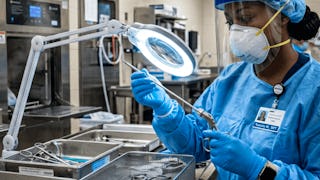
MedCerts
Skills you'll gain: Sterilization, Sterile Procedure, Equipment decontamination, Asepsis, Infection Control, Occupational Health, Hand Hygiene, Medical Equipment, Occupational Safety and Health Administration (OSHA), Personal protective equipment, Health And Safety Standards, Cleanliness, Bloodborne Pathogens, Record Keeping, Information Systems, Hazard Communication (HazCom)

What brings you to Coursera today?

Pearson
Skills you'll gain: Performance Measurement, Benchmarking, Performance Metric, Operational Excellence, Operations Management, Operational Performance Management, Project Controls, Internal Controls, Business Operations, Business Metrics, Operational Efficiency, Project Management, Performance Management, Project Performance, Operational Analysis, Project Implementation, Performance Analysis, Process Improvement, Performance Improvement, Process Design

University of Illinois Urbana-Champaign
Skills you'll gain: Operations Management, Supply Chain, Continuous Improvement Process, Operations, Process Improvement, Supply Chain Planning, Process Improvement and Optimization, Supply Chain Management, Continuous Quality Improvement (CQI), Process Analysis, Wholesaling, Quality Management, Lean Manufacturing, Statistical Process Controls, Process Capability, Statistical Analysis, Sustainable Business, Network Planning And Design, Process Control, Program Management

Skills you'll gain: Automation Engineering, Plant Operations and Management, Control Systems, Engineering, Scientific, and Technical Instruments, Engineering Drawings, Process Control, Electric Power Systems, Electrical Power, Communication Systems, General Networking, Network Protocols, Wireless Networks, System Monitoring, Mechanical Engineering, Equipment Design, Systems Of Measurement

L&T EduTech
Skills you'll gain: Accident Prevention

Arizona State University
Skills you'll gain: Statistical Process Controls, Process Control, Quality Assurance, Semiconductors, Process Validation, Production Process, Verification And Validation, Manufacturing Operations, Manufacturing Processes, Manufacturing and Production, Manufacturing Standards, Process Improvement, Process Analysis, Product Testing, Process Flow Diagrams, Electronics Engineering, Electronics, Reliability, Performance Testing

Skills you'll gain: Process Driven Development, Service Oriented Architecture, Business Process Automation, Problem Management, Process Modeling, Transaction Processing, Operational Databases, Debugging, Oracle Databases, Middleware, Enterprise Application Management, Software Engineering, System Configuration
L&T EduTech
Skills you'll gain: Oil and Gas, Petroleum Industry, Energy and Utilities, Process Engineering, Chemical Engineering, Production Process, Manufacturing and Production, Pump Stations, Safety Standards, Equipment Design, Thermal Management, Facility Repair And Maintenance
What brings you to Coursera today?
Best Process Control courses from L&T EduTech
Top-rated Process Control courses offered by L&T EduTech on Coursera.
- Instrumentation and Control Systems in Power PlantsL&T EduTechIntermediate1 - 4 WeeksL&T EduTech
- Industrial and Process Safety EngineeringL&T EduTechIntermediate1 - 3 MonthsL&T EduTech
- Natural Gas Production and ProcessingL&T EduTechBeginner1 - 4 WeeksL&T EduTech
Best Process Control courses for beginners
Top-rated beginner-friendly Process Control courses with no prerequisites.
- Six Sigma Tools for Improve and ControlKennesaw State UniversityBeginner1 - 3 MonthsNo prerequisites
- Sterile Processing BasicsMedCertsBeginner1 - 4 WeeksNo prerequisites
- Monitoring and ControllingPearsonBeginner1 - 4 WeeksNo prerequisites










