Systems Thinking Courses
Systems thinking courses can help you learn how to analyze complex systems, identify interdependencies, and develop holistic solutions. You can build skills in mapping system dynamics, recognizing feedback loops, and applying causal loop diagrams. Many courses introduce tools like system modeling software and simulation techniques, that support visualizing interactions and predicting outcomes in various contexts, such as environmental management, organizational development, and public policy.
Popular Systems Thinking Courses and Certifications

Coursera
Skills you'll gain: Systems Thinking, Creative Thinking, Innovation, Systems Analysis, Complex Problem Solving, Analysis, Business Systems Analysis, Strategic Thinking, Critical Thinking, Organizational Change, Decision Making, Collaboration

University of Colorado Boulder
Skills you'll gain: Systems Thinking, Stakeholder Management, Stakeholder Communications, Cross-Functional Collaboration, Planning, Project Planning, Strategic Leadership, Team Leadership, Strategic Thinking, Business Leadership, Team Building, Community Outreach, Business Systems, Community Development, Problem Solving, Project Management, Organizational Strategy, Relationship Building, Root Cause Analysis, Communication Strategies
Johns Hopkins University
Skills you'll gain: Systems Thinking, Health Systems, Health Policy, Public Health, Policy Analysis, Policy Development, Public Health and Disease Prevention, Simulations, Systems Analysis, Data Analysis Software

University of Michigan
Skills you'll gain: Generative AI, AI Workflows, Workflow Management, Information Architecture, Artificial Intelligence, Systems Thinking, Record Keeping, Strategic Thinking, Cost Benefit Analysis, Data Management

Arizona State University
Skills you'll gain: Data Storytelling, Influencing, Data Presentation, Strategic Thinking, Empathy, Visionary, Critical Thinking and Problem Solving, Strategic Decision-Making, Planning, Strategic Planning, Analytical Skills, Case Studies, Cognitive flexibility, Brainstorming, Leadership, Persuasive Communication, Creative Thinking, Data Analysis, Critical Thinking, Risk Management

What brings you to Coursera today?

University of Michigan
Skills you'll gain: Computational Thinking, Logical Reasoning, Critical Thinking, Data Analysis, Deductive Reasoning, Mathematical Modeling, Analytical Skills, Analysis, Experimentation, Mathematics and Mathematical Modeling, Critical Thinking and Problem Solving, Data Literacy, Systems Thinking, Statistical Methods, Simulations, Predictive Modeling, Programming Principles, Decision Making, Statistical Inference, Prompt Engineering

University of Virginia
Skills you'll gain: Brainstorming, Design Thinking, Innovation, Ideation, Stakeholder Analysis, Creative Thinking, User Research, Journey Mapping, Human Centered Design, Stakeholder Engagement, Design Research, Project Scoping, Planning, Persona Development, Design Strategies, Project Planning, Value Engineering, Product Development, Strategic Thinking, Creativity

Skills you'll gain: Software Architecture, Systems Development Life Cycle, Systems Architecture, Systems Thinking, Software Design Patterns, Stakeholder Communications, Business Analysis Tools, Systems Analysis, Data Flow Diagrams (DFDs), Stakeholder Management, Stakeholder Engagement, Data Architecture, Development Environment

Arizona State University
Skills you'll gain: Strategic Thinking, Visionary, Research, Influencing, Persuasive Communication, Strategic Decision-Making, Data Collection, Investigation, Proactivity, Negotiation, Complex Problem Solving, Communication Strategies, Creative Thinking, Experimentation, Scientific Methods, Decision Making, Recognizing Others, Contingency Planning, Active Listening, Cognitive flexibility

Pearson
Skills you'll gain: Economics, Production Process, Operational Efficiency, Economic Development, Resource Utilization, Business Economics, Capital Expenditure, Decision Making

University of Colorado Boulder
Skills you'll gain: Model Based Systems Engineering, Failure Analysis, Systems Engineering, Requirements Management, Scope Management, Design Reviews, Engineering Management, Change Control, Program Management, Engineering Change Order, Cost Management, Requirements Analysis, Contract Management, Root Cause Analysis, Test Engineering, Risk Mitigation, Systems Design, Systems Thinking, Organizational Leadership, Risk Management

University of Colorado System
Skills you'll gain: Systems Engineering, Verification And Validation, Team Management, Team Performance Management, Systems Architecture, Requirements Analysis, Requirements Elicitation, Scrum (Software Development), Systems Development Life Cycle, Teamwork, Systems Development, Configuration Management, Scaled Agile Framework, Team Building, Agile Methodology, Team Motivation, Organizational Leadership, Leadership Studies, Engineering Management, Leadership and Management
What brings you to Coursera today?
In summary, here are 10 of our most popular systems thinking courses
- Systems Thinking Basics: Coursera
- Developing a Systems Mindset: University of Colorado Boulder
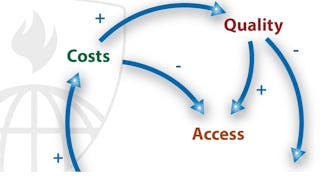
- Systems Thinking In Public Health: Johns Hopkins University
- Systems Thinking for AI & Automation: University of Michigan
- Professional Skills: Strategic Thinking: Arizona State University
- Critical Thinking and Decision Science: University of Michigan
- Design Thinking: University of Virginia
- Introduction to Systems Architecture : IBM
- Strategic Thinking for Everyone: Arizona State University
- The Economic Way of Thinking: Pearson










